

 Apple Podcasts
 Spotify
 Darren Appleton - Part 2 (Reinventing a Champion—From English 8-Ball to World 10-Ball Glory)

Key Takeaways
- Darren Appleton transitioned successfully from English 8-ball to global dominance in American pool by studying the timing, tempo, and cue delivery of snooker legends like Jimmy White and Ronnie O'Sullivan.
- The short-lived International Pool Tour (IPT) served as a critical stepping stone for Appleton, providing him with life-changing prize money and the financial confidence to switch disciplines permanently.
- Immersing himself in the intense, high-stakes money game culture of the Philippines allowed Appleton to master the tactical nuances, kicking, and percentage play required for American 9-ball and 10-ball.
- Learning from Filipino greats like Efren Reyes by playing lower-stakes matches helped Appleton understand the practical, tactical side of the game and accelerate his development on the larger table.
Darren Appleton’s rise was anything but gradual. In Part 2 of this Legends of the Cue interview, “Dynamite” recalls winning the first professional tournament he entered, developing one of pool’s most admired cue deliveries and making the career-defining decision to leave English 8-ball behind for American pool.
Appleton explains why his compact stroke, timing and cue-ball control were developed through observation rather than formal coaching. He remembers studying Jimmy White, Ronnie O’Sullivan, Steve Davis and Stephen Hendry, borrowing pieces from great cueists and shaping them into a style built for pressure. The discussion also turns to English stars Chris Melling and Karl Boyes and their early years together.
Darren traces his first exposure to American pool through televised women’s events, the Mosconi Cup and Matchroom’s World 9-Ball Championship. He recalls qualifying for the 2000 world championship, meeting Allison Fisher in Las Vegas and recognizing that the larger-table game offered both a technical challenge and a better financial future.
The road was difficult. Appleton discusses the International Pool Tour, the collapse of its promises and the reality of starting over in a discipline where kicking, jumping, breaking and percentage play demanded a complete education. His determination took him to the Philippines, where he immersed himself in the game, learned from elite players and discovered a pool culture that became a second home.
The gamble paid off spectacularly. In 2008, Darren Appleton became the inaugural WPA World 10-Ball Champion, earned a life-changing $100,000 prize and opened the floodgates to the World Pool Masters, the U.S. Open and the Mosconi Cup.
This is the story of reinvention, risk and a champion rebuilding himself from scratch. Appleton’s account shows how technical humility, total commitment and the willingness to enter unfamiliar territory can turn an established winner in one game into a global force in another.
Give Allison, Mark & Mike some feedback via Text.
Follow our show and/or leave a review/rating on:
Our website: https://www.legendsofthecue.com
Apple Podcasts: https://podcasts.apple.com/us/podcast/legends-of-the-cue/id1820520463
Spotify: https://open.spotify.com/show/4Za0IMh2SeNaWEGUHaVcy1
Music by Lyrium.
About
"Legends of the Cue" is a cue sports history podcast featuring interviews with Hall of Fame members, world champions, and influential figures from across the world of cue sports—including pocket billiards, snooker, and carom disciplines such as three-cushion billiards. We highlight the people, places, and moments that have shaped the game—celebrating iconic players, memorable events, historic venues, and the brands that helped define generations of play. With a focus on the positive spirit of the sport, our goal is to create a rich, engaging, and timeless archive of stories that fans can enjoy now and for years to come.
Co-hosted by WPA and BCA Hall of Fame member Allison Fisher and Mosconi Cup player and captain Mark Wilson, Legends of the Cue brings these stories to life—told in the voices of the game’s greatest figures.
Join Allison, Mark and Mike Gonzalez for “Legends of the Cu...
Frequently Asked Questions
Who is Darren Appleton?
Darren Appleton, nicknamed "Dynamite," is a champion cue sports player who transitioned from English 8-ball to become a dominant force in American pool, including winning the inaugural WPA World 10-Ball Championship.
What was the International Pool Tour (IPT)?
The International Pool Tour (IPT) was a professional pool circuit launched in 2006 that offered unprecedented prize money and top-tier venues, helping bridge the gap for many players transitioning into American pool.
Why did Darren Appleton move to the Philippines to practice?
Appleton moved to the Philippines for six months to immerse himself in their active money-game culture, where he played against elite players to sharpen his tactical skills, bankroll, and understanding of American pool.
Mike Gonzalez
So, what would you look at as your first big win as a professional?
Darren Appleton
Well, the very first tournament I entered, I won it. So I was I was quite lucky, really. The first national amateur championship, uh no, sorry, the first junior tournament I entered, I won it. And then I won the national amateur championship, the first attempt. The very first professional event I entered, I won it. So that was 1996. And then even when I come to American pool, it's a bit of a weird story, really. Like the first I was the first ever World 10-ball champion. So everything happened very quickly, you know what I mean? Like the first time I played in the World Masters, I won that. It's just everything, just I was lucky really that I I I took it like a duck to water, I guess. And I I don't think I've got that much ability. I I just saw all the hard work, really. So, but like Mark says, when I look back now, I think, oh, I actually had a good stroke. I I never looked at myself as having a good stroke, you know what I mean? Uh but then I see people like Mark and Jerry Bryceworth who use use me as their template a little bit, really, so that's like a nice thing to have in your cap. Uh but I always look at at great Qists like Ronnie O'Sullivan or Chris Mellon and uh all these guys, you know. I mean, I think they're the proper Qist, but but I I guess it's all about delivery, right, Mark? It's about how you deliver the Q and Allison's obviously got a beautiful Q action, but the timing and tempo was very important. I think I timed my timing and tempo was very good on the queue.
Allison Fisher
It's a great tactical player too, though, as well. You've got a really great mind for it, I think, too.
Darren Appleton
As regards the stroke, it was more like come natural, really. I never had a lesson. Probably regrettably when I look back now. I I think I I wish I did have some lessons, but I just watch and learn. I just watch and learn. Like so when I was younger, Jimmy White was my hero, really. And Jimmy always cued very low on the cue ball. So when I played English pool, I did the I I just copied Jimmy White. Because even though Jimmy probably didn't look like he's got the best, but when he was younger, I thought his cue action was amazing. The way he timed the ball, the way he went through the cue ball, it it was amazing. So I used to try and copy him a little bit. Uh so yeah, I just sort of copy and paste really. I used to do the same at darts, I I was a pretty good dart player. So back in the in the late 80s, 90s, you'd you'd have people like Eric Bristow, John Lowe, Jockie Wilson. So I used to copy their throw when I'm practicing. So I did the same with Paul, really. I sort of copied some players, like Snooker players, especially, like even Alison, because Alison sort of got the same stroke as uh Stephen Hendry back in the day, or Steve Davis. She always reminded me of Steve Davis and uh Stephen Hendry. So she had like the perfect stance, the perfect cue action, you know what I mean? So uh you're just trying to emulate all these little things and put it into your own stroke, really. Uh but the number one thing for me was all about timing and tempo. So when I watched Ronald Sullivan, his timing and tempo is is just incredible. The way he hits the ball, it's effortless, you know what I mean? Uh and it's so beautiful to watch. So so I I just copy and paste people, really. So I sort of like just steal just steal a little a little bit off everybody and then just work on my timing and my tempo. And I think once you get that down, then the cue action comes naturally, I think. Because end of the day, if you do the repetition then and put the work in, then then uh you're gonna get there eventually as long as you work hard enough. True.
Allison Fisher
But then you've got to say Earl Strickland who was just very natural, like Yeah, but Earl, Earl, he may be natural, but he still plays eight hours a day now. That's what I'm saying.
Darren Appleton
But he puts in a lot of work. Uh even Meeker, obviously, uh God God rest his soul, they play on on uh natural ability, you know what I mean? It's like very fiery, it's very fluid, very long and powerful, you know what I mean? Where yeah, I was I was never that style of player. Uh I'm Molak and Alex Pagalai and Dennis O'Colo sort of sort of style, you know what I mean? Yeah.
Mark Wilson
Uh Mark was how about uh your relationship with Carl Boys and Chris Melling? Didn't the three of you run around quite a bit in that era?
Darren Appleton
Yeah, I mean uh yeah, so obviously I knew Chris and Carl from Englishpool, especially Chris. Chris only lives about 20 miles from me. So when I was sort of 17, 18, just started driving, Chris will have been about 14. So I used to go and pick Chris up, take into county matches, which is like West Yorkshire against let's say Lancashire or something like that, or Manchester. So yeah, Chris's parents would give me money, uh pocket money for Chris, like to come to the tournaments. So yeah, it was like funny, really. And then uh he's still the same now as what he was then, and very cheeky, very confident, uh, very cocky, but not in a arrogant way. And yeah, it's just yeah, so uh Chris mainly. I mean we played in the same teams and everything. Uh so we we grew up together. Where Carl Boys is from Manchester, originally from actually he's originally from Bradford, but he moved to Manchester as a kid. Uh so yeah, Carl Boys, I got I got to know him more so let's say when I got to like 19, 20 years old. Well, probably a little bit later because Carl's a few years younger than me, so yeah. Uh probably early 20s when I got to know Carl when he first came on the scene. But Carl was never as good at English pool as than what he was at American pool. Uh he wasn't like one of the top, top, top players at English pool, like Chris and Mikkel and Gareth Potts, all those guys. Uh but obviously at American pool, he was a much better American pool player than he was English pool player. So interesting, really. But sometimes you're just you're just more suited to a certain game, and that was Carl Boys. But yeah, I mean obviously I've become really good friends with him. Because we all three of us played in the England team for English pool, also. So the England team, you'd have like seven or eight players, so you'd have like Garrett Potts, Mick Hill, Phil Harrison, Carl Morris, Keith Brewer, myself, Chris Mellon, and Carl Boys. I mean, that team on paper is absolutely sick. I mean, it was like at that time it was the dream team. You've got eight of the best ten players in the world all on the same team, so it was like a sick team, and uh so we don't so obviously we'd be playing every weekend somewhere at a tournament, so we we all become quite good friends, and then when I switched over to American pool, about a year or two later, Carl and Chris followed me basically. Uh so yeah, that we've been friends ever since.
Mike Gonzalez
Yeah. So take us through that transition then as you as you work your way through the English pool thing and then decide, okay, I want to I'm gonna try out this American pool thing. Did you get exposed to American pool a few years before you decided to sort of switch over and try your hand at it?
Darren Appleton
Yeah, it's quite funny, actually. I actually uh remember watching Allison on the ESPN because back in the old days that the ladies' tournaments would be on Sky Sports. Uh so the when they had the ladies, because the ladies' pool was bigger than men's pool, right? Back in the 90s.
Allison Fisher
Consistently on TV, yeah.
Darren Appleton
Mark, you don't seem too uh happy about that.
Mark Wilson
Well, you know, it was a funny thing. We shot ourselves in the foot, we alienated the women, and then we had terrible leadership that failed, and so ESPN ran us off, and then the women got all our hours. Which, as it turned out to be great. It was actually a great thing because they bring a softer image, much better, and kind of help the sport to progress here uh as far as changing people's attitudes.
Darren Appleton
So better looking as well.
Mark Wilson
Yes.
Darren Appleton
Yeah, I remember so I I watched it. It was on all the all the tournaments for the ESPN where Allison played and uh Julie Kelly and people like that, uh Kim Shaw. So it was like every month, really. So I I'd watched so I'd watch Allison. I knew Allison anyway from Snooker. So I remember playing uh playing doubles with Steve Davis and all that stuff. So that's that's when Snooker was massive in the UK back then. Because back in those days there was only like four channels. So Snooker was one of the main sports in the UK. Yeah. And obviously when colour television came along, Snooker was like this big boom, wasn't it? So it was there was never any amazing money in Snooker, but the players, I think Allison knows better than me, but I I would imagine the players made most of their money off the table doing exhibitions.
Allison Fisher
Yeah, I would say the the the earlier greats, you know, Alex, Jimmy, Dennis, yeah, Terry, they definitely made their money in exhibitions.
Darren Appleton
And what what about yourself? Like what did you do? Because obviously I would imagine there wasn't a lot of money in the Lakers game.
Allison Fisher
I did a lot of exhibitions. I did a if you nine nine games of snooker, and if you beat me, uh basically I charge £500 if I won, if they won, it was half the price. But I never lost. Because you know, nine games of snooker, it's gonna be hard to get all these club players beat me. So that's how I got paid, and it was actually quite good because I saw Mandy Fisher do that, you know, pay half if you if they lose. So that was a really good deal, I thought, and then just tournament play. So that was what I did.
Mike Gonzalez
Well and then and then she made she made big money going on things like swap shop and uh the Terry World. You didn't make big money on those.
Allison Fisher
Those were those were great media coverage, but I also got managed by Barry Hearn and did the Matrium League.
Darren Appleton
Yeah, I remember that.
Allison Fisher
I was doing the one game warm-up, so I'd travel around the country before the you know the pro players would come out, and then the following year he put me in as a player, so I got really good coverage, you know, and that's how I made sort of the bread and butter, really.
Darren Appleton
And Big Break is back now as well, you know.
Allison Fisher
I yeah, now tell me that is it on TV yet or not? They filmed it.
Darren Appleton
Paddy McGuinness and Stephen Hendry, but uh they haven't really they haven't showed the first one yet, but I'm looking forward to that. Uh I never used to care for that Paddy McGuinness, but he's his great.
Allison Fisher
Who is Paddy McGinnis? Who is he?
Darren Appleton
He's like a TV presenter, stroke comedian in the UK.
Allison Fisher
So he's like Jim Davidson was back in the old days.
Darren Appleton
And he's got like a northern accent, so it's so it is quite funny actually.
Allison Fisher
Uh so what about Hendry? How did he get that role? That's because he's like the Virgo now, is he, John Virgo?
Darren Appleton
Well, yeah, I guess so. I guess I think he's helped himself a lot with the uh q-tips, isn't it? Q Q-tips, yeah. Yeah, he's made himself probably more famous for the Q-tips and uh let's say the last ten years, because he hasn't played Snooker, has he? So uh so yeah, I guess he's he's got a bit of a personality, right? Actually, where when he was playing, he was a very dull. Who'd have thought of thought really Steve Davis as a character, you know what I mean?
Allison Fisher
Yeah, he's done very well. Done very, very well.
Darren Appleton
It's nice to see this, it's nice to see this different side of these players, you know what I mean? Where yeah, when I was growing up, you're thinking they were just boring, you know what I mean? Like you'd have people like Dennis Taylor, John Virgo, very good characters, but besides that, uh Alex Higgins are obviously, but besides that, there was all a little a little bit dull, really.
Allison Fisher
Well, Hendry was all about winning, winning, winning, so as was Davis. They were just off on their own, you know. Yeah, yeah, yeah. Amazing.
Mike Gonzalez
I see uh Henry as sort of like a Nick Faldo in terms of the focus during his playing career. Yeah, yeah.
Darren Appleton
Well, I when I look back at the 80s, I look at Nick Faldo, uh Eric Bristow, Steve Davis, they were like all three of them were just like winning machines, you know what I mean? Yeah, they were like the three biggest sports stars in the UK back in those days. Yeah. And uh like you had people like Sevi and all that's just amazing, wasn't it? But yeah, I mean, just ESPN really for the Sky Sports, watching Allison or and uh and then later Kelly. So and there was quite a few Brits, wasn't there? Kim Shaw was a good player, like you said, Julie Kelly came over, Kim Shaw.
Allison Fisher
Aaron Corps Karen Corps, of course, and then and then Kelly.
Darren Appleton
And then obviously back in those days, you'd have the Moscone Cup started where when Mark played.
Allison Fisher
Me, me and Mark.
Darren Appleton
I was in the first one with Mark. The Black Widow So yeah. It was funny. I watched every every I watched every Moscone Cup. So and then the World Nine Ball Championship started with Matroom, the Cardiff. Right. Cardiff, which was amazing. Mark Mark would have played in that. So I I actually qualified for the World Nine Ball Championships in 2000. I lost to the guy that got to the final, he lost to Efren in the was it Efren in the final? Oh yeah, so something like that. So I I did actually try my hand at American pool for the first time uh because of the world championships, and I qualified. It wasn't easy to qualify as well. It was like in Wales where you've got like all these these players who were not in the main tournament coming from Asia to try and qualify. It was very difficult to qualify. Yeah. So I managed to qualify somehow, got beat in the final 64, and I thought, oh, this is a nice game. Yeah. But but Mark, I'll know he played the tournament, it was an amazing tournament. It was in groups and it was in Cardiff, it was like a great setup live on Sky Sport. So that was my first taste of it, and then and then I went to Vegas. That's where I first ever made uh meet Alison in the elevator in at the Riviera.
Allison Fisher
The Riviera, the famous Riviera that's now imploded.
Darren Appleton
I just said hello and she said hello back. She says, Oh, you're from England? I goes, yeah. And that I wasn't confident. I just didn't have the the balls like to banter, no banter then. Yeah, I sort of dogged it a little bit. But I I I always had a soft spot for her because obviously I mean she's still good looking now, but but back, but back then she was the queen, you know what I mean? So thank you. So like me and Mick Hill was like me and McHill, I think it was me and McHill. Uh Chris Mellon was there as well. Andy Richardson. I don't know if you heard a guy called Andy Richardson. He was an American pool player. He actually played in the Moscow New York Cup one year. Did he? Yeah, I think the same year that Tommy Donald played and Lee Kendall. Uh so yeah, so we actually watched Alison play in that tournament uh at the Riviera, because we were in the amateur event, so it was like sort of sort of like just kids' pull, really. Uh, where Allison was in the uh the the like back then that was a big tournament, the BCA nine ball pens and night and BCA it was like a proper setup. And I I remember watching Buddy all play when he was still really good. Oh yeah. His cue ball was unbelievable. So me and Mick Hill were like we're like students of the game. Like Mick Hill's like probably the greatest English eight ball player. So we were like students of the of the game. So we and then we watch Alison play because then she was like the the player to beat, and just watching her cue action was amazing. So that was my first introduction to Alison, and then uh so yeah, then I got a bit of a taste for it then. Uh but I was still doing pretty I was doing really well at English pool, so it's it's hard to walk away from like your regular job, let's say, where you're making like 20, 30,000 a year, and there wasn't enough tournaments to to get that there wasn't enough tournaments out there to to make the switch. Uh but looking back, looking back, I I wish I would have made the switch earlier than what I did. Let's say so it was 2000. So I played a little bit here and there just for a bit of fun, American pool, but I kept watching the Moscone Cups. I thought I'd like playing that Moscone Cup. And especially because Europe was getting beat every year as well, so it made it even worse. So then 2006 came, and that was the introduction of the IPT. Yeah.
Allison Fisher
Right. Then a load of you came over, right?
Darren Appleton
Yeah, and what happened is that Facebook had just started about a year prior to that. Yeah. So so that's how I found out. I've I found out through AZ Billiards and Facebook that this international pool tour it was out there for people to to to to put their CV in there, like their credentials, is that what you call it over there?
Mark Wilson
Resume.
Darren Appleton
Resume. So I thought, oh, it's eight ball. American on American pool tables. I thought, oh, I I should apply for this, especially eight ball. And the prize money was crazy, you know what I mean? It was like big prize money. Uh so I'm thinking, oh, I'll I'll put my application in and just see what happens. And then about a month later, I got a reply saying that I've been accepted. There was only 200 players who got accepted. Obviously, all the greats were in there, and all the old BCA Hall of Famers come out of the woodwork, they all come out of retirement to play. So then I told Mick Hill, so McHill applied, he got in, one or two of us applied and got in. I think Chris Mellon. Uh, but the ones that didn't apply, because they didn't really believe it was going to happen, they ended up having to go to the qualifiers around the country in America to try and qualify. And it was very difficult to qualify. So people like Carl Boyce and Rob McKenna and Pat Olse, they were all trying to qualify for the IPT. Uh so yeah, I got accepted. 2006 came and uh I played the first tournament. It was unbelievable. I I finished seventh in the first tournament, uh, but I got $30,000 for finishing seventh. Oh wow. Yeah, wow, yeah. It was like winning the lottery. So I think the first one I think Torsten won the first one, right? He got three. Yes, he did. Well, actually, the first one was an invitation where there was only like 30 players. I think Alison, you would have played, right, Mark? Did you play? Probably. No, there was an invitation, one in Florida, where Mike Siegel got straight to the final without hitting a ball. So he was guaranteed $100,000 for just showing up for the final.
Allison Fisher
Well, you know what they did was they had the top, they had a top woman versus Siegel, right? Yeah, yeah, uh. It was supposed to be me. It was supposed to be me, and at the last minute, Siegel got frightened and ended up playing Lorry John, who was already retired at that point.
Darren Appleton
Yeah, I'm like.
Allison Fisher
So I it was supposed to be me, and it wasn't. She was said to be the top player at the time, and she wasn't even playing at the time. So she was guaranteed 75k. If she beat him, it was 150 and a spot as the king of the hill.
Darren Appleton
I remember it, it was like that would have been funny. It was an introduction to the to the IPT, and we was all there watching that match, and it was terrible. It was a terrible match. So yeah, you might have won that because I think Mike had retired at that time, right? He'd come out of great.
Allison Fisher
Ava Ava tells it, she he was watching me play at the BCA event and she said in and she said to tell that he was playing with his moustache, twirling his moustache, or worried about playing me. So he came off of there, talked to Kevin and said, I don't want to play her. And then that's then they picked Laurie John, you know. I don't know how, but anyway.
Darren Appleton
But the IPT was amazing because you all had to wear suits, like uh yeah, it was all dress up, yeah. It's all like dress suits, it was like proper. And all the food was organic food, so you'd have like a player's lounge, all the food was there for all the players, organic food only. This Kevin Trudeau, he was like very it was very on the natural health, health conscious. Uh and he gave like the best speeches you could ever listen to in your life. Like when you come out of the meetings after he'd done the speech, you like felt ten foot high, and you you you felt like a superstar, really. So yeah, we we couldn't wait for it to start. I did well in the first tournament, uh, and it was amazing like how they did it, it was in groups, like every round was in a group. So we you could actually lose like seven or eight matches in the old tournament and still win the tournament because every round was in groups, right? And the top three would qualify for the second round, and you were guaranteed prior, I think it was guaranteed like three or four thousand just for showing up. It was mental. Yeah, yeah. Uh so yeah, it was amazing. Then the second tournament was the World Open, which Ephraim won. It was like 500,000 to the winner.
Allison Fisher
He played Rodney, didn't he, in the final, I think.
Darren Appleton
Yeah, and I I finished 22nd. It was like it's one of those where you got place with where you finished in the group or something. So I finished 22nd in the second one and got $33,000. Loving it, aren't you? It's mental, you know what I mean? So but unfortunately, after that, I think this Stanley Ho was supposed to buy the tour, but it didn't happen. They they banned gambling in America. That's right. The online gambling. So Kevin Trudeau, he just he just it all went, it it just all went up in smoke. So it was like devastating, really. You s you sort of lived the dream for six months, and it it was a dream really. It's like the pinnacle for a pool player, and I don't think anything's got close to it since, regardless of the IPT. Mark, did you play on the IPT?
Mark Wilson
No.
Darren Appleton
Wow.
Mark Wilson
I was like uh I had to go through the qualifier process. You know, one time uh Kevin had a thing where all current Hall of Famers that show up and play get 30,000.
Allison Fisher
That's exactly what he did at that thing in Orlando. Amazing.
Mark Wilson
Yeah, it was amazing.
Allison Fisher
That's why they all came out 30 grand in their pocket.
Mark Wilson
Amazing. They're really happy for him too, because they deserve it. But some of them played really good still. Uh, what is it? Oh, yeah.
Darren Appleton
Ed Kelly played. Dallas West. Wow, Dallas West. But that Ed Kelly, he did really well in that invitational tournament. And I watched him, I thought, wow, this guy's amazing. He was like 70 years old. Seriously, he was sick. Uh so yeah, that that was really like Nick Varner. What a player. And then uh so yeah, it it folded, and I'm thinking, oh what what else? Sorry, can I swear? No problem. Yeah, I'm I'm thinking, what am I gonna do now? So uh it was like two options. I thought, do I go back to English pool or do I go into American pool full time and start playing nine ball and ten ball? And uh yeah, I thought I can't go back to English pool, there's no way.
Allison Fisher
So then I've got more opportunity.
Darren Appleton
So that was it. Uh the IPT, I've got the IPT to thank, I've got Kevin Trudeau to thank for my career, really. Even though a lot of people really dislike him and uh hate on him for what he did, because I think some players took a long time to get paid. But but for me, it was a a godsend for me. Uh we lived the dream and I thought, look, there's no way I can go back to English pool.
Mark Wilson
No matter what anyone ever says about Kevin Trudeau, despite the fact that some sides of him were scoundrel, he did more for pool than anyone else has. Yeah, I doubt. So that you can't take that.
Darren Appleton
I mean, look what we had there, it was unbelievable. We played at the Venetian, the Venetian, the the top of the room. Oh yeah, it was wonderful. And we were all staying, there was like five of us in the same hotel room, but this hotel room was massive. And then we went to the the hotel in uh Reno, which was amazing. Then we had the one in Florida, it was mental. But everything was just right, wasn't it? It was just perfect, and then unfortunately it just folded and so yeah, I thought there's no way I can go back to English pool. So then I I just started to learn how to play nine ball and ten ball properly.
Allison Fisher
So, how did you get to come over more regularly and stay here? How did that Yeah?
Darren Appleton
So I thought, right, so I was a bit naive at first. Like when I first started playing nine ball, I thought, well, it it's gonna be quite easy, really, to pocket the balls coming from English pool and a little bit of Not like Allison, but but Alison and I thought the same thing. Coming over to American pool, the pockets are massive, right? Mm-hmm. Especially back then. Yeah, but it was like four and a half inch pockets in in 2006, 7, 8, 9. They were like four and a half inches. So they were generous. So you're thinking, right, I can't really miss balls, but even though you can. But then I started playing people like Ralph Suke and uh Oliver Ortman, and you start playing these best players in Europe, and then you start playing your Johnny Archers and all these guys, and you think, oh, why am I not getting many chances at the table here? You know what I mean? You're thinking, like, I'm I'm not missing any balls, but I'm getting beat 9-3, 9-4. It doesn't make sense, right? So then you you quickly realise that the game's a lot more difficult than what you think. So then I thought, right, what am I going to do? Because I I'm not very patient. So I thought, right, let's go to the Philippines, because that's where all the best players were, especially I mean, they they are there now, but especially back then, it was unbelievable. So actually, I qualified for the 2006 World Championship, which was in the Philippines, the one what Ronnie Alcano won in which he beat Ralph Suke in the final, which again was a match room time. I did qualify for that, but I got knocked out by Buster Mante. Uh but it was a great experience. But then in the pool rooms over there, they they they just play for money all day and night. Like it's just non-stop action. Uh and you can play. Who knows about that, don't you, Mark?
Mark Wilson
Mm-hmm. Oh, yeah. I loved it over there.
Darren Appleton
You can play for $5,500, $200, $500, $1,000, $10,000, wherever.
Mark Wilson
Everybody beat me and followed me to the hotel.
Allison Fisher
So they were waiting for him, Darren, outside his hotel every day.
Darren Appleton
They do, don't they? They beat him to a pulp. Even the cleaners play good over there. Yeah. Like I said, like the cab drivers, but uh back then especially, it was uh pool was massive. And uh so yeah, I thought, well, let's go in the pool rooms, and I was playing $200 sets, $500 sets uh against really good players like uh people like uh Gomez and uh Corteza, all these guys, Jeff DeLuna. Uh so then what I did, I thought, right, when I went back to England, it was like 2000. So this around 2007 come because the world championships that year was like November. So in 2007, I packed my bags and I went to the Philippines for about six months, and I was playing money games virtually every day. And then I but I was clever because I went I went there with my with my stake or stroke manager at the time called Dave Wright. So we decided that we're gonna play him at eight ball first, because a lot of them didn't know who I was still, so I thought, well, if if I can build up like a bank role playing eight ball, so that's what I did. I I was playing a lot of them at eight ball, and I was beating them all at eight ball, uh Corteza, Gomez, Jeff DeLuna, uh Warren Kiamko. So I I so I I built up like a good bank roll, let's say ten fifteen thousand dollars, and then we decided to then start playing nine ball and ten ball. So I was playing with the house money, really. For the next three months I was playing with the house money against against against Cortesza, KMCO, uh Buster Mante, all these guys. And I was I I w I didn't go crazy and paying playing for 5,000, I was keeping it cheap, $500,000, $1,000, $500,000, $200. So when I played at Ephraim, I'd playing for $200, uh, but I told him, I said, look, if you beat me, I knew it was gonna beat me, but I said, if you if you beat me, just tell me what I was doing good and what I was doing bad. So after the game, he'd tell me what I was doing good, what I was doing bad, and sometimes he'd even stop me during the game playing $200 sets. He'd say, No, you should do this. I thought, really? But when he but uh but when he explained, like it was like a kick shot, for example, when he explained it, you think, oh, that's why it just makes sense the percentage side of the shot, right? So I just learnt off all those guys playing cheap, cheap money games, and then I play then I play guys at my level for more money. So then I was really, really, really in the battle then. But I just learned so much in those like it was like 12. I end I end up staying there for about 12 months. I learned so much over that 12 months, it was unbelievable. And and they all loved me, the Filipinos, because I I was like I was a bit fiery, obviously. I I got I got in a few scrapes with them as well, like the like the stakehorses, because they don't like losing. I mean I don't like losing, but these guys they will do anything to win, you know what I mean? So obviously I'd retaliate a little bit. So I I did actually get in a fight actually one time with with one of the stakehorses. Uh but but that's just the way it is over there, you know. I mean, but now that guy who I had a fight with, we're actually really good friends now. Uh so it's funny. Uh but that's the way it is in the Philippines. It's just they take whatever they can get. It's their living, they they live on the street, they live on the pool table, it's their life. So but even the cleaners play good. I mean, I was giving some of the cleaners like the seven, eight, nine playing ten ball, and they was beating me, and you're thinking, how how can he play pool? They're just unbelievable. So you learn very quickly that even the taxi driver, you know what I mean? That they all can play, it's unbelievable, and they're all so natural on the queue. Uh so that's how I learned the game. So then 2008 came. I thought, right, I need to start playing tournaments. So I went to America, uh, played a few games and a few money games in America, and then I started playing some tournaments, played the Derby City Classic, I won the straight pull there. My my first ever straight pull tournament at the Derby City Classic, I won it. I beat John Smith in the final. I always remember that. Yeah, and that's what we did. It's snowball from there. I I won a Euro Tour. I think it was my second Euro tour I'd ever played in. I won that. Uh back then, winning a Euro tour back then was like they're not easy to win. It was unbelievable. You you had all the best players in Europe there. So yeah, that that was amazing, and that qualified me for the world championships. And then I went to the back to the Philippines for the World 10 Ball Championship, and I won the first ever World Tem Ball Championship. What was that like? Well, that was unbelievable because I beat Wu Cha Ching in the final.
Allison Fisher
Wow.
Darren Appleton
And he had just won the nine ball and the eight ball at the age of 16 in 2006, so he was the man to beat, you know what I mean? And I went into that final with with with no fear, just really enjoyed it. I thought, well, I'm probably gonna lose it anyway, but I'm gonna enjoy it. And I played unbelievable. I I beat him 13-11, and it was $100,000 for the winner, so it was like it was like I mean, my previous best payday to that was like 10,000 or something.
Allison Fisher
Well, that must have felt like home turf too, because you've been in the Philippines for a year.
Darren Appleton
Yeah.
Allison Fisher
So I'm sure that the Filipino audience were behind you.
Darren Appleton
Yeah, I had a I had a lot of fans there, yeah. So it's meant meant to leave when I go back there now. I mean, I've got so many friends there, it's unbelievable. It does feel like my second third home. I think America's my second home, and then obviously the Philippines. But when I won it, it just opened the floodgates cost up to that point. I had no money really in 2008. But winning that $100,000, I mean, it was just I thought, right, there's no pressure now. Yeah. So then every everything snowballed from there, it just went mental. I got in the Moscone Cup, I won the World Masters, uh and just kept winning tournaments, and it just happened very quickly.
Mike Gonzalez
Yeah.
Darren Appleton
And then I won the US Open, and it's just everything happened very quickly. I'm thinking I'm like scratching my head a little bit, really.
Allison Fisher
Thank you for listening to another episode of Legends of the Cube. If you like what you hear, wherever you listen to your podcast, including Apple and Spotify, please follow, subscribe, and spread the word. Give our podcast a five-star rating and share your thoughts. Visit our website and support our four history projects. Until our next golden break with more Legends of the Cube. So long, everybody.
Pool Professional
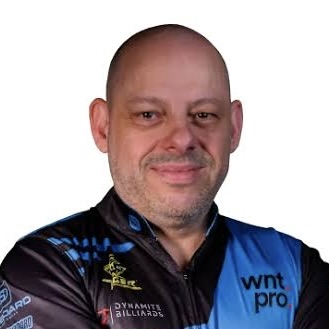
Darren “Dynamite” Appleton is one of the most accomplished and versatile competitors in modern cue sports. A four-time world champion, two-time U.S. Open 9-Ball champion, seven-time Mosconi Cup winner and 2017 inductee into the Billiard Congress of America Hall of Fame, the Englishman built his reputation by conquering games played on radically different tables and under dramatically different rules. His compact cue action, precise cue-ball control, tactical intelligence and fierce will to win made him a champion in 9-ball, 10-ball, straight pool and Chinese 8-ball—and one of the strongest all-around players of his generation.
Appleton was born on February 8, 1976, in Pontefract, West Yorkshire, and grew up as the youngest of three brothers in a rented council house. His father, Tony, worked with cars and as a handyman and also coached boxing; his mother, Susan, worked in a sewing-machine factory. Money was limited, but the household was rich in sport and competition. Darren played football as a goal-scoring striker and boxed as a lightweight, compiling a reported 12–4 amateur record with six knockouts. His first exposure to pool came when his older brother Shane received a six-foot table for Christmas, but football remained Darren’s first love for several years.
Pool took hold in earnest when Appleton was about 15. Inspired by exhibitions featuring his cousin Andy Appleton, one of England’s leading 8-ball players, Darren began practicing obsessively. He later recalled the guilt he felt whenever he missed a day. English pub pool offered an unforgettable … Read More