

 Apple Podcasts
 Spotify
 Jerry Briesath - Part 4 (The Teacher’s Legacy: How Jerry Briesath Changed the Way the World Learns Pool)


In the powerful final chapter of our four-part Legends of the Cue conversation with Jerry Briesath, we arrive at the heart of a life devoted not just to playing pool—but to teaching it, elevating it, and preserving its future.
Widely regarded as the most influential instructor in billiards history, Jerry reflects on how the modern game has evolved—from the decline of nine-foot tables and the rise of technology, to the dramatic sophistication of safety play and break mechanics at the professional level. With the clarity that has defined his teaching career, he explains why stroke mechanics—not aiming systems or English—remain the foundation of all great play, and why so many players are still taught the game backwards.
Jerry shares timeless teaching insights: the power of repetition, the importance of “shots you must make,” and why respecting so-called “easy shots” separates good players from great ones. These aren’t theories—they’re hard-earned lessons refined over six decades on the table, in poolrooms, academies, and classrooms around the world.
The episode also turns deeply personal. In a moving moment, Jerry answers the question of what he would do differently if he could start again—an honest reflection that reveals the man behind the mentor. He revisits a missed straight-pool shot against a reigning world champion that still lingers in memory, and he defines how he ultimately hopes to be remembered: as someone who loved teaching as much as his students loved learning.
Joined by Allison Fisher and longtime protégé Mark Wilson, this closing episode is both a masterclass and a farewell—an intimate portrait of a teacher whose influence will outlive generations of players. Jerry Briesath didn’t just teach pool. He taught people how to learn.
A fitting final word from one of the game’s true giants.
Give Allison, Mark & Mike some feedback via Text.
Follow our show and/or leave a review/rating on:
Our website: https://www.legendsofthecue.com
Apple Podcasts: https://podcasts.apple.com/us/podcast/legends-of-the-cue/id1820520463
Spotify: https://open.spotify.com/show/4Za0IMh2SeNaWEGUHaVcy1
Music by Lyrium.
About
"Legends of the Cue" is a cue sports history podcast featuring interviews with Hall of Fame members, world champions, and influential figures from across the world of cue sports—including pocket billiards, snooker, and carom disciplines such as three-cushion billiards. We highlight the people, places, and moments that have shaped the game—celebrating iconic players, memorable events, historic venues, and the brands that helped define generations of play. With a focus on the positive spirit of the sport, our goal is to create a rich, engaging, and timeless archive of stories that fans can enjoy now and for years to come.
Co-hosted by WPA and BCA Hall of Fame member Allison Fisher and Mosconi Cup player and captain Mark Wilson, Legends of the Cue brings these stories to life—told in the voices of the game’s greatest figures.
Join Allison, Mark and Mike Gonzalez for “Legends of the Cu...
The economics of the game have really changed from the time I was a kid, I know, uh, and uh, you know, you all lived it with pool halls having nine-footers, three-cushioned tables, snooker tables, and now I know where I live in South Carolina, I don't think there's a publicly available nine-foot table to shoot on within 50 miles of where I live.
Jerry BriesathAnd that is a total shame that we don't that that's happening to our sport. Let's hope it comes back. I don't have the answer, but I hope more nine foot tables come back. And I tell everyone that has a choice one statement the more you play in a nine-foot table, the better you will play on every table. That's true. Period. Even if you it's when you go from a little table to a big table in one day, you're gonna have trouble. You go from a big table to a little table, you'll never have trouble.
Mike GonzalezYeah. I feel like you use about half your game on a bar box compared to going from a nine-footer down.
Jerry BriesathI don't know if that's the correct answer. Everything is closer, everything is easier. Okay, and people say, well, the balls are congested, but pros will run out of rack and nine ball ten times more on a little table they will on a big table. They're easier. Even though the congestion is there, pros are finding their way around. But look at how they run off those racks of eight ball. A ladies' tournament that you played in in Wisconsin.
Mike GonzalezNo. One in one in Wisconsin, the Jasmine won. She won that eight bowl.
Allison FisherOh, I didn't play the eight ball. World eight ball, no. The world eight ball, two things.
Jerry BriesathThe world eight ball tournament was the best play by women I ever saw in my life. They all played 800 plus, the four finalists. Unbelievable. Yeah. I was so amazed and relieved to see that kind of play. Unbelievable.
Allison FisherThey're getting better and better. There's more information out there, and everyone's getting better and better now.
Jerry BriesathYeah, boy, I hope I hope they do that again. And they did a great job. A first annual selling as a first annual go off real good. They did a lot of work. Peach Hour and Oldhausen did a great job there.
Allison FisherYeah.
Mike GonzalezYeah. Jerry, some of your work in the past has involved uh writing instructional columns. For a while, you were writing uh some instructional columns for AZ Billiards, I believe.
Jerry BriesathThat was a long time ago, Coach's Corner, I think they called that. But I I do articles every few months for VNEA, and I got a about two inches thick in my drawer here of those articles. They're fun to do, and sometimes I worry about what I think I've said everything. You know, how do you keep saying things? But so far I don't have to start over completely, but it's not a lot of things. There's a little repetition.
Mike GonzalezAnd you've established your Jerry Bryseth uh pool schools. You uh probably spend the summertime doing those in Wisconsin and then the winter out in the Arizona area.
Jerry BriesathThat's correct, yes. I'm not as busy as I used to be, but that's okay with me. And I love to do one with Mark every year. That's that's the highlight of my I love to do those.
Mike GonzalezAnd where do you guys do that, Mark?
Mark WilsonWell, the last one was in Kansas City in July, and then it's just at random. When Jerry's available, I try to secure him just because you know he's he still I still learn from him when I teach, you know, and he's he's the leader of the the whole thing. I organize it. We work together, we work together quite nicely, kind of like you and I, Alex. Yeah, yeah. And so if you're a stroke mechanics person, I think really one of the biggest things that was said here today is that uh the emphasis needs to be the opposite of what most people think. Um I was guilty too. I thought it was about aiming, English, and bankrupt. If I could just learn those three things. Well, actually it's stroke mechanics and it's an ongoing thing the rest of your pool life. You're always working on that stroke. And after all these years, after 51 years of being around Jerry, I now got that through my head pretty clearly. It's got about to be about that stroke.
Mike GonzalezWell, Jerry, you've been the recipient of some wonderful recognition over the years. I'll go back with our listeners to 1997 when you received the BCA's President's Award for your efforts in furthering pool instruction. You've already mentioned your induction into the BCA Hall of Fame in the Meritorious Service category. That was in 2022. Prior to that, however, they inducted you into the inaugural class of the Wisconsin Billiards Hall of Fame. That was in 2018.
Jerry BriesathWell, that was great. I mean, it's in your hometown that that means so means a lot. And Mark, you're in that too, aren't you?
Mark WilsonYeah, a couple of years after you.
Jerry BriesathYeah.
Mark WilsonYeah.
Jerry BriesathBut great, very great. There's a guy that runs that, John Kramer, just does a fantastic job of setting it up and getting the recipients in all lined up. And he's he's got a kind of a one-man show. He's got some help, don't get me wrong, but to to start that like he did. Uh other states have tried to copy what John did to set that up. So great, great job there.
Mark WilsonYeah, first class endeavor by John. I was very, very impressed.
Mike GonzalezWell, you can you can tell us and our listeners how this next recognition rates among these others, but I thought it was pretty cool that the BACA now has an award that they give every year. It's for the P PBIA Instructor of the Year Award. It's called the Jerry Bryceith Award. Now, that's pretty special.
Jerry BriesathThat is, it is. It is. I enjoy it, and I enjoy congratulating whoever gets it. That's that's most of the fun.
Mike GonzalezNow, how many of those have been students of yours over these past several years?
Jerry BriesathProbably not very many of the of the because at the last guy in in in New York, I guess great instructor, but they're from all over, so I I don't think there's many. But we just hope that or I hope that people get more into the mechanics before they start teaching English and the other stuff. English is a necessary evil, and everybody teaches English different. I've been experimenting with it for sixty some years, and I've got it down now of teaching English to somebody that's not good with English or just learning it's the fastest way I ever. So I got a system now that'll in ten minutes they're allowing for English without even knowing it. And that's wonderful to advance to get better at that. So I did get better at that in the last ten years.
Mike GonzalezI think I know the answer to this question, but if you were to give advice to a new pool instructor, what would you tell them?
Jerry BriesathStart with the cue ball on the spot. First thing you do is to make sure you they understand that they don't control the balls. As whoever controls a stick, the best wins. And put the cue ball on the spot, shoot shots, and teach the student to use the spot. When you're not around, the the best, second best teaching aid in the world is that spot. First is you. The second best is that spot. Shoot some draw shots, follow shots. See if that stick goes perfectly straight, see if it goes three inches when you shoot soft, six inches when you shoot hard, or seven, but in that ballpark. You don't want to follow through a foot. Some of those coaches still teach a few overseas, big long foot and a half follow-through. That's unnecessary to me. No follow through. It's okay, but it's unnecessary.
Mike GonzalezWell, something I did as a result of uh learning from these two at the pool school. I took a piece of uh of felt, leftover felt from my table. It's about three feet long. I've got a big black line running down the middle of it. I line it up toward a far corner pocket. I've got a I've got a line where my bridge goes, I've got a line where the ball goes, I've got two tabs, one where the ball goes and one where that stick needs to end up. And I'll just hit 50 shots, just ball into the pocket and just watch that Q-tip. I guess that's what you're telling us.
Allison FisherYeah, that's the way to do it.
Jerry BriesathThere's one more thing that that helps. Anywhere from a 700 player down to a 300 player. Uh when you talk about use the terms easy shot, people come back at you and say there is no easy shot. Well, let's change it to shots you must make. Okay. And that was tough for me for a long time. A guy came up to me in Vegas and put a cue ball a foot from the rail, an eight ball halfway down the table, and said, Jerry, throws his arms up. I missed that shot straight in. How the hell can I do that? And I said, Well, there's a lot of distance between the cue ball and the object ball, a lot of distance between the object ball and the pocket. Those are the close, those are the toughest shots. He said, Oh, wait a minute, I know exactly where to aim on a straight in shot. How can you say that? On an angle shot, I don't I it's not that easy. What's an easy shot? He had me. That was a brilliant comeback. And I said, So I had to think about something. So here's what I came up with, and l everybody I teach now gets this. This is new. Last I don't know, five years or so. When a when both balls, the cue ball and the object ball, are on the same end of the table, and it's 50 degrees or less, you gotta make them all. If you miss that shot, you just put it back, stop everything you're doing, put it back, and shoot till you make four in a row. If in a little better players, if you make that shot and don't get the proper shape, that you should put that ball think and get move the cue ball four times in a row on that piece of plate. You gotta piece of plate. That's your goal. Doing things four times in a row impresses the brain that starts remembering. Three out of five don't work, eight out of ten don't work, it needs him ten in a row, certain things. But but repeating a shot four times in a row, if they're both on the same end of the table, and it's 45 degrees or 50 degrees or less, you you repeat that shot four in a row, your accuracy will just go up every week. It never fails.
Mike GonzalezThat's Allie. That sounds a lot easier than potting those long blues.
Allison FisherWell, I I knew that growing up, Steve Davis used to say you never miss never miss an easy ball. If you never miss an easy ball, then your success rate's gonna go way up. So it's the same thing as as Jerry's saying. I like the way he puts it.
Mike GonzalezYeah, never miss an easy one. As you described it, Jerry, the the the easy ones, as you said, less than 50 degree cut, same end of the table. You should never miss them.
Jerry BriesathThat's right. If you miss it, repeat till you make four. You'll just see your accuracy. Brain remembers. That's why what you call seeing the shot. After a few weeks, you start seeing all those shots, and you never miss them. And when pros are really good players, say, geez, I'm just missing easy shots once in a while. And I use this term. I said, the trouble with an easy shot is you have to respect every shot. You can't just you when you don't you can't disrespect any easy shot. Any easy shot can be easily missed. So just show respect for it and you'll never miss them. Or you'll miss them less than the next guy or girl.
Mark WilsonWhen you go to modern day tournaments these days, Acustad events, you will see Jerry Bryce that's often sitting in the front row, and he's not just there socially, he's there observing the pros, and he's always interested in the stroke mechanics. And just talk about your fascination with modern pro players, Jerry.
Jerry BriesathWell, it's it's it's amazing how they're coming out of the woodwork, world-class players. It's amazing, isn't it? The last 20 years. They just come. Here's a guy from a little country you never heard of, and he's right up in there. How do they do that? And a lot of a lot of that is government-funded operations, which we don't have, but we're America. And but those guys that's Chinese and that were the government sponsors, boy, they're turning out players like crazy. They have academies and stuff. Wow. Mm-hmm.
Allison FisherWell, I think in a lot of these countries the sport is very respected. You know, in some countries it's that mispent youth, but in a lot of these countries that give government funding, it's a very respected sport. And so that's why you're seeing a lot of young players picking up a queue and playing.
Jerry BriesathYeah. Yeah, I agree 100%.
Allison FisherWell, the other thing is there's a lot of information through technology now. So a young player can just at the end of the phone or a computer, they can access all the knowledge now very easily.
Jerry BriesathA lot of information out there on uh YouTube. Some of it's not so good. And I tell I tell all the the up and comers that I teach. I say people are like when Tyler grew up and and started playing very well. I said, Tyler, everybody's gonna give you suggestions, everybody's gonna talk to you and tell you what to do. I said, You always smile and thank them and throw out the bullshit.
Allison FisherWell just say fantastic in your words.
Jerry BriesathFantastic. But that's what I tell them. People are gonna give you advice, listen, smile, and if it's if you don't agree with it, throw it away.
Mike GonzalezYeah. So the nine ball you observe, for example, at the Derby when you still go to the derby, is it a different nine ball game than what you would have been watching 30, 40 years ago when that became the prevalent game in the States?
Jerry BriesathTotally different. Safeties have the most changed thing in the last 30 years. Safeties. When way a long time ago, you never heard of a safety. You just blasted trying to hit the ball. Hope something went in. There were no safeties kind of in nine ball way back. You just tried to hit it. And now the safety play is so spectacular how they can. You might have three balls on the table and you might not see your ball. You might have the cue ball and two balls on the table, and the guy will hit them just right, and you you can't see your ball. That's how good they are.
Mike GonzalezAnd why's that become more important? Is it strategic or pockets are smaller and they're forced to play a little bit more conservatively? Why do you think that is?
Jerry BriesathWell, that's just because the game has evolved with the which with the knowledge of safety just evolved. People get better and better at it. Once they became aware of how important it is, it just became more important all the time. So they have to learn it. If you don't play good safeties, you can't win it at the pro level at all. I mean really good safeties, and there are some good systems out there for two rail kicks, three rail kicks, and there's not enough of those good ones on on YouTube, I don't think. Because some of those pros just hit the ball every time. So you know they have a system. Let's find out what they are.
Mike GonzalezYeah, fair enough. Any other changes to nine ball that you've observed uh from years back? The break.
Jerry BriesathThe cut break and and knowing fixing the rack. They can fix the rack so good in nine ball. So good. You might make the nine, five in a row. That's how good they can fix the rack. You might make the the nine ball one out of four, one out of five.
Mike GonzalezIf you're racking your own.
Jerry BriesathJust by separating a couple balls. You can make the wing balls seventeen in a row by leaving a space between a couple balls. And that's why you have to use that rack that freezes all the balls. And I've seen I've seen that just recently. How people fix racks. I just threw it out before it's cheating to me, so I just didn't think about it. But I saw it last week, matter of fact, is where I really learned about it. I had a I had a master instructor from Europe here from Savania or so I forgot. He's a master instructor. Mietzia is his name. And a good guy and very gif very learned at at pro uh medicine, at pro muscle memory, and pro very knowledgeable. Great guy. I spent four days with him and in Prescott. And I learned a lot from him, and he learned some mechanics from me. So great trade-off. We took him to the to the Grand Canyon. I took him to Sedona, so he had a good time here.
Mike GonzalezI think I saw your picture on Facebook with him from the Grand, it looked like the Grand Canyon in the background. Yeah.
Jerry BriesathWe got out of the car, okay, and we were 100 feet from the grand from the ledge. And I said, Close your eyes. I took him by the arm and I walked him out right to the edge. Oh. And when he opened, I said, open your eyes. And he just almost cried. Wow. Yeah.
Allison FisherWell, sure. I trust you with that.
Jerry BriesathYeah.
Allison FisherAnd then it goes pictures, I said, I'll take five steps back.
Jerry BriesathYeah. That's great.
Mark WilsonThat's great. Jerry, when I was in Cunnique, I remember LJ and Gina playing in there.
Jerry BriesathWell, you know, Gina has just been a super, super person. And just to show you where her heart's at, she last year or the year before donated a kidney to whoever needed it. Yeah. Wow. Could you do that? I don't think I could do that. But she's just a giving person, and LJ's a retired police officer. And he still plays a lot of pool. And so he's doing good. He started a spray business, pressure spraying, washing houses and stuff. Makes more than when he was a cop. Having fun at it. Yeah.
Mike GonzalezSo just so our listeners know, then LJ, LJ is your son. And Gina is your daughter.
Jerry BriesathOkay. And I go, I try to go to I'm going to the International Nine Ball Open next month. And that's always fun to go to. I'd like to go again to the to the Derby? Philadelphia. Philadelphia. That's a good one. I want to go to that one too if I can swing it. So they're fun to go to, see old friends and talk smart.
Mike GonzalezWell, I will spend some time, as Mark knows, down in St. Augustine for the International Open. So I hope to meet you in person. So you'll be making some new friends as well as seeing old friends. As we wrap up here, Jerry, uh, you may not know this, but we've gotten accustomed to asking three final questions. All right. So I'm going to give the honor of the first question to the Duchess of Doom. Allison?
Allison FisherOkay, Jerry. How are you doing? If you knew when you were 20 what you know now, what would you have done differently?
Jerry BriesathIf I knew now, I would have tried to been a better father.
Mike GonzalezNext question. That's a good one. The good answer. So I get the second question, Jerry, and it's it's a simple one. And as a golfer, you'd appreciate this. I'm going to give you one mulligan, one shot to do over. Might be a pool shot, might be a life shot. Where would it be?
Jerry BriesathOh boy.
Mike GonzalezSorry. Can you think of a shot in competition that maybe you missed that uh would have made a difference in one of your events?
Jerry BriesathWell, yeah, I'll never forget the shot I missed playing Joel Balsus when he was world champion. We had I had him at Action Billiards, and it was when he was work current world champion. And we played when I picked him up at the airport, he said, Who am I going to play this time? I says, Me. He's okay, then we play up to 200 points instead of 150. Yeah, because I played him in the US Open and he beat me. And and so we got there and the the afternoon game, I ran 134 on him and beat him 200. hundred to sixteen in four innings and at night we played uh he I he beat me two hundred to one seventy five in four innings. Well it was two good straight pool matches and I missed a ten ball I missed a ten ball there that I still remember.
Mike GonzalezThat much that long ago huh?
Allison FisherYeah long time ago.
Mike GonzalezWell we'll go to Mark Wilson for the appropriately final question.
Mark WilsonHow would Jerry Bryseth like to be remembered?
Jerry BriesathJust as somebody that enjoyed teaching as much as people enjoyed learning. People say well I had a guy yesterday who took lessons from lots of people yesterday spent four hours mechanics he says I never expected anything like this because he's been taking a lot of lessons in null mechanics and he just went from a 450 to a five fifty in one day.
Mike GonzalezThat's the best part isn't it seeing that yeah yeah he was so happy he called me last night just beautiful picked it up well that's great that's that's the fun part as you both know well listen uh Allie and I sure have appreciated you coming on to tell your story on legends of the queue we'll give Mark the last words but I know Allie and I wanted to both express our appreciation for you coming on and sharing your life story.
Allison FisherAllie it's been a joy Jerry thank you so much for being with us people will treasure hearing your story and I can't wait for them to get it out there and so they can listen to it. It's always lovely seeing you.
Jerry BriesathAnd thank you so much both of you and Alison I hope to see you because you've got a place to stay thank you very much.
Mark WilsonI'll let you know when I come out there okay yep thank you and I could never repay you Jerry as my mentor and still an inspiration to me all these years I remember you know we've been 51 years together so thank you very much.
Jerry BriesathThank you Mark it's uh goes both ways. I love you like a father.
Allison FisherLove you too bye bye thank you for listening to another episode of Legends of the Q. If you like what you hear wherever you listen to your podcast including Apple and Spotify please follow subscribe and spread the word give our podcast a five star rating and share your thoughts. Visit our website and support our pool history project until our next golden break with more Legends of the queue salon everybody
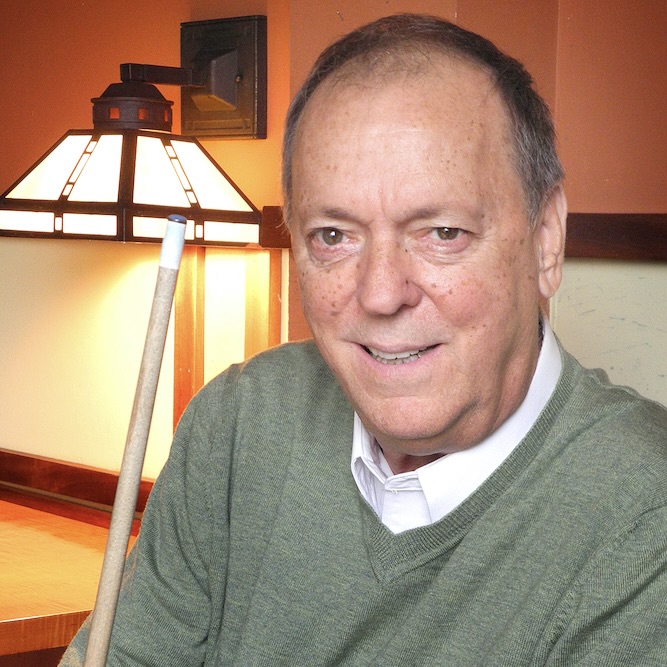
Pool Professional and Instructor
Jerry Briesath is widely regarded as one of the most influential instructors in the history of pocket billiards, often described as the “father of modern pool instruction.” Born in March 1937 in Winona, Minnesota, Jerry’s journey to becoming the game’s definitive teacher didn’t begin under bright tournament lights or inside a training academy. It began with work, hard, everyday, small-town work, at his father’s one-man gas station, where discipline and service weren’t motivational slogans, they were simply the price of admission to life. Jerry has recalled pumping gas for 23 cents a gallon, checking oil by hand, and learning early that consistency and pride in the basics are what separate “good enough” from exceptional.
Before pool ever took hold, Jerry was an athlete. His first love was golf, and he was good enough to play high-school varsity as the number one player—an important detail because so much of Jerry’s later teaching would be built around athletic movement, rhythm, and repeatable mechanics rather than guesswork or superstition. That athletic foundation, paired with a curious mind, made him a natural problem-solver when he eventually found his way to a cue and a set of balls.
Jerry’s introduction to pool came during his time in Milwaukee, where, in an era with little formal instruction available, he learned the old-fashioned way: watching strong players, asking questions, experimenting, and running balls late into the night. In our four-part conversation, Jerry describes the poolroom not just as a place to play, but as a living classroom, one … Read More