

 Apple Podcasts

 Spotify
Michaela Tabb - Part 3 (Making History at the Crucible)
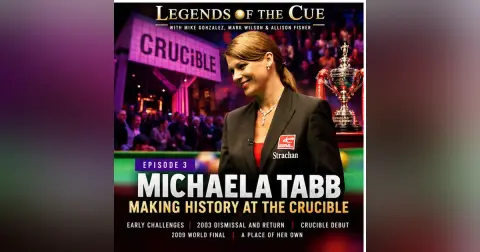
Getting into professional snooker was one thing. Proving she belonged there was another. In Part 3 of our Legends of the Cue conversation, Michaela Tabb reveals how difficult her early years on the professional snooker tour really were. Hired without the traditional referee apprenticeship, she learned almost everything on the job while navigating resentment from some established officials and the pressure of being the only woman in the room. Michaela remembers the referees who supported her, ...
Key Takeaways
- Michaela Tabb was headhunted directly into professional snooker without going through a formal refereeing school, learning the intricacies of the rules almost entirely on the job.
- After facing a devastating and abrupt release in 2003 due to cost-cutting measures, public outcry and pressure from broadcasters like the BBC and Sky led to her reinstatement just months later.
- Stepping through the famous pink curtains for her Crucible debut in 2003 presented an entirely unique level of pressure, marked by nearly a thousand spectators and immense media scrutiny as the sport's first female referee at the venue.
- In 2009, Michaela made history by refereeing the World Snooker Championship final between John Higgins and Shaun Murphy, becoming the first woman to officiate snooker's ultimate match.
- Maintaining intense mental concentration, pacing, and proper positioning on the table for hours are critical skills that separate elite snooker referees from amateur counterparts.
Getting into professional snooker was one thing. Proving she belonged there was another.
In Part 3 of our Legends of the Cue conversation, Michaela Tabb reveals how difficult her early years on the professional snooker tour really were. Hired without the traditional referee apprenticeship, she learned almost everything on the job while navigating resentment from some established officials and the pressure of being the only woman in the room.
Michaela remembers the referees who supported her, the extraordinary concentration required to officiate professional snooker, and even why she initially avoided wearing perfume because she didn’t want players to feel their familiar competitive environment had changed.
Then came 2003.
After working tirelessly to establish herself, Michaela was unexpectedly released during cost-cutting measures. She describes the anger and devastation of losing the role—and why being invited back months later ultimately meant even more than being hired in the first place.
From there, her career accelerated.
Michaela recounts walking through the famous Crucible Theatre curtains for the first time, the overwhelming atmosphere inside snooker’s most iconic venue and the constant feeling that, as the only female referee, every mistake would receive additional scrutiny.
Finally, she takes us inside the defining assignment of her career: the 2009 World Snooker Championship final between John Higgins and Shaun Murphy.
After spending an entire season worried that one mistake might cost her the assignment, Michaela became the first woman ever to referee a World Championship final—and walked away on “Cloud Nine.”
Give Allison, Mark & Mike some feedback via Text.
Follow our show and/or leave a review/rating on:
Our website: https://www.legendsofthecue.com
YouTube: www.youtube.com/@LegendsoftheCue-MLG
Apple Podcasts: https://podcasts.apple.com/us/podcast/legends-of-the-cue/id1820520463
Spotify: https://open.spotify.com/show/4Za0IMh2SeNaWEGUHaVcy1
Music by Lyrium.
About
"Legends of the Cue" is a cue sports history podcast featuring interviews with influential figures from across the world of cue sports—including pocket billiards, snooker, and carom disciplines such as three-cushion billiards. We highlight the people, places, and moments that have shaped the game—celebrating iconic players, memorable events, historic venues, and the brands that helped define generations of play. With a focus on the positive spirit of the sport, our goal is to create a rich, engaging, and timeless archive of stories that fans can enjoy now and for years to come.
Co-hosted by WPA and BCA Hall of Fame member Allison Fisher and Mosconi Cup player and captain Mark Wilson, Legends of the Cue brings these stories to life—told in the voices of the game’s greatest figures.
Join A...
Frequently Asked Questions
When did Michaela Tabb make her Crucible debut?
Michaela Tabb made her historic Crucible debut at the World Snooker Championship in 2003 during a match between Mark King and Drew Henry.
Who was the first woman to referee a World Snooker Championship final?
Michaela Tabb became the first woman in history to referee a World Snooker Championship final in 2009, overseeing the match between John Higgins and Shaun Murphy.
Why was Michaela Tabb temporarily let go by World Snooker in 2003?
World Snooker brought in an outside company to implement cost-cutting measures and reduce the number of contracted referees using a points-based system that penalized newer officials, resulting in Michaela and another referee being temporarily let go.
What do you The thing is they didn't have a referee in school. I mean nowadays I'm sure people are trained properly. But back then you didn't have any school, did you? Schooling to do this job.
Michaela TabbNo, that well that because I was basically headhunted, I never went through any like school of refing or and they do all that now. They have they have world classes where you go through the rules, you're taught the rules, and then you go into a classroom scenario and they set situations up. I never had any of that. I I learned everything on the job. Yeah.
Mike GonzalezYou know, there is video available of uh Michaela refereeing that first match against the case.
Allison FisherMust go and watch it after this.
Mike GonzalezNo, the one with with Ken and James. Yeah. I I I've seen it. There's a there's a uh little video, it might be a home video, and and she's kind of in the booth and she's going, now uh James, hold on, James. Was it was it was that a pink or a blue that you just popped up? Let me catch up. Let me catch up here.
Allison FisherProbably mum and dad posted that because they were proud of our first match.
Michaela TabbOh it was it was so bad. It really was so bad. But it did you know I I I've always thought, and I mean you we're gonna touch on obviously the rest of my career, but there's there's been some highs and there's been some terrible, terrible lows. But I I d I am a strong believer that uh things are meant to happen for a reason. So it was all to uh you know to help strengthen me and um and and to learn, you know, who knew that that's what you did to judge a free ball? I knew after that, because they showed me, but I didn't know before.
Mike GonzalezLet me ask you a question, just uh two two slants to this. One is how long did it take where you finally felt accepted in this role? And uh looking at it a different way, how long was it before you felt I belong in this role?
Michaela TabbBoth actually came at the same time. So so I started and I got my contract in uh 2001, and um and I I was doing well. I had had my head down for two years. I had worked really, really hard. Um, and I felt as if I was accepted by by the players. Still, you know, there was obviously still um some referees who weren't so keen on me, but you know, hey-ho, could get over it. It's at that point I felt as if I was there. Um and it wasn't quite the the two-year period um because I didn't have two years of service. And um in 2000, early 2003, World Snooker brought a company in um to help cost cut and to re-evaluate the their uh their not so much their accounting, but to just sort of go through their their books and and help them, help them save money. Um one of the things they decided to do was reduce the number of uh referees who had a contract. Because when I started, there was 16 of us that was given contracts, and they came up with this scoring system that was then gonna determine who the referees that weren't gonna uh stake. They were basically gonna let go. Um, and as soon as it came out, I I said straight away, well, there's there's no way I'm gonna pass this. There's no way I've I'm gonna have a an um I'm gonna get through this. And they were like, Oh yes, yes. I went, well, it's not. You're you've allocated points based on experience, points based on length of service, points based on um if you if you've done like finals or or things like that. I couldn't win on that type of um point score because I I was new and I was inexperienced. So of course everything, every point was going to come low, and lo and behold, they um at this point they had 10 left. I think we'd lost six at the end of the first year, and they were taking ten to eight. And myself and Johan from um Holland were the two newest, and we were the two that basically they let go. Um, and this happened at the end of the 2003 year snooker year, which is like the May uh kind of year, uh April, May. Um, and I then was quite quickly gone to the World Um Nine Bowl Championships in Cardiff. And I so I was actually at that event when I heard, um, and I I told them I was in the like the staff room when Steve Davis was there, uh Sharon Tutley, the uh the events coordinator was there. And I said, Oh, I've I've just had the phone call and I've just been told I'm being let go. Um, and Steve Davis actually said uh he said that'll not stick. And I kind of looked at him, he went, There's no way the broadcasters will allow that. There's no way. Um, and I I have never felt so frustrated in my life and and hurt and um betrayed. I'd I'd I'd worked so so so hard, really, really hard. Um and I I I was losing I was losing the role through no fault of my own. Um and it it it was a frustration because there was nothing I could do um to change it. So the summer went on, and unbeknownst to me, um both the director of uh the BBC or it was um IMG were the the media company that broadcast on behalf of um them at that time and Sky had been in touch with the world snooker to say, What the hell are you doing? Um you know, the bet this is the best thing you ever did for the game, um, etc. So uh so yeah, it um he and I was like, oh my goodness, what's going on? And so my my boss had basically called me to say this and said they they want you back. Um this was the September 2003, and I was like, Oh my goodness, but we've I've already missed so much of the season, I've got so many days that I won't be able to uh cram into a year because I'd miss so many events. And he went, if I'm being honest, Michaela, I think if you say what you want, you you'll get it. Um so we renegotiated my contract, it was pro rata, and I said quite importantly, I want it to be two years continuous service. I want my service to be from when you let me go, uh, because obviously from employment rights in the UK, two years uh counts for like statutory sick pay, though those kind of things. Um and they did, and I started again, and that was the point that I suddenly realized I had acceptance and that I was where I needed to be.
Mike GonzalezYeah, so you you go from this high, which we're gonna come back to, which was your crucible debut, then you get let go, then you get called back. Let me ask you this about getting called back. Was that a bigger deal for you than getting hired in the first place?
Michaela TabbOh, massive. Absolutely massive, much, much of a difference. I I felt justified. I I felt it vindicated in in what I'd had to go through. It it just it felt right because I was a good referee, and there were older people there who were who still had contracts. Uh, and I'm not I'm not saying because I I was younger or you know, some people would say better looking or or whatever as a female compared to some of the older gentlemen. I I don't mean that, but I'd I'd worked so hard and I was doing such a good job. It just it felt all wrong that I'd been let go. You you don't, that's not the way the work environment should be. Um so yeah, that that that was massive, massively more important to me than getting the job in the in the first place. Um just you know, it was proof that I deserved to be there and I'd been doing the right thing.
Mike GonzalezYeah, yeah. Well, let's go back to that high moment that preceded uh this uh this momentary lapse of judgment on their part. Uh you make your crucible debut, and it was a match with Mark King against Drew Henry in 2003. Uh, you gotta take us through that experience and and let us know. Did that Moscone Cup experience to help prepare for the pressure of the crucible?
Michaela TabbUm I no, I I don't think it did. I think the all the pool and the Muscone experience kind of from the hooker face, you know. That's not what you feel inside, but that's what you project outside. That that's kind of a key thing, I suppose. Uh I I would say the the Muscone experience probably prepared me for everything except the crucible. The crucible is a place like no other. Um other level. There will never be anywhere like it. It the atmosphere, it's uh it's making the hair stand up in the back of my neck, thinking about it, is is incredible. It is absolutely incredible. And so for my first match, um we had an MC at the time called Alan Hughes, and he'd go out onto the floor and introduce the referees before the players. And in those days, and there will be some footage somewhere, I'm sure, they they had a pink curtain. So how this was ever acceptable, I've got no idea. But they had a pink curtain that there's a walkway down into the crucible and uh before you get to the steps, and then walk down into the playing area. Um, and this pink curtain uh drew together, and the string was on one side, and someone had to stand and pull the string to open the curtains to let you go through. So we're standing, but myself and the the other referee, because it was two tables, we're standing behind the pink curtain waiting to be introduced. And Alan Hughes has said, we're gonna make history today. Um, she um and it it the buzz that went around, it was just incredible. Um, and all I could think two things was don't wet yourself, you know, in that that moment of nervous energy, and don't trip down the stairs.
Allison FisherYeah.
Michaela TabbSo um I successfully managed to navigate both of those things. Um, but it I was in bits, in absolute bits, but it was still one of the most incredible memories I I will ever have. That and my first vinyl, the those two very, very similar experiences in the Crucible were uh were incredible.
Allison FisherAs soon as the curtains opened and you stepped into the crucible arena, what struck you? The the people, the noise.
Michaela TabbYeah. Um because when when you're walking out into it, you've got nearly a thousand people, but both tables are open. They've not got the divider down at this point. So you're walking out to this applause by like nearly a thousand people. It it was like oh like, oh my god, I'm I'm Michaela Tab and I'm I'm actually walking out to referee in the crucible. It's oh it it's it an experience, it's incredible. You you must have felt that when did it feel like that to play in it?
Allison FisherI never played in it. I I'd left the tour by then, but I'd only I'd been there to watch, so I know what the crucible is like, but I'd never played in it. But I imagine how your parents felt because you there you were as a little kid watching it on TV, and now you are refereeing in the Crucible Theatre. Were your parents there at the time you first stepped out, or were they just watching it on TV? Um they were watching on TV.
Michaela TabbMy mum, my dad came to his first event, his his first snooker event that I refereed when I did my first world final. He never came to one before that. I don't I don't know why, um, or whether he was waiting for um for that moment. I'm I'm not sure. Mum came a few times with my my children, my husband came, but my dad never did until that first final. But I was on my own um in that first I wasn't, I had a friend, my good friend Jill stayed with me. So she stayed overnight. I can't remember if she came to the the uh the actual arena. I can't remember uh whether she was there that day or not, but I know she was there one of the or for a couple of nights staying with me. Uh but yeah, just incredible, absolutely incredible. But so you know what it felt like to be a spectator. It feels like you're in your living room, doesn't it?
Allison FisherIt's so it's amazing. Yeah. It's amazing.
Michaela TabbYeah, and that's it that's what's like tenfold. You're it's so such a small arena. When they bring the um the barrier down, so you separate stable one and two, you can't get to where you need to be as a referee. So I'd spent, you know, all these years learning where to stand effectively, yeah, to then go into the crucible theatre and you can't get there because it's it's so small, yeah. And so it's so alien because your memory, muscle memory means you want to be there, but you can't get there, so you're there and and it it's all you're you're on edge. You're on edge constantly while it's two tables till it goes down to one table. Right. Even now, if I went back to do that now, it would still be the same because you're not in the place you know you need to be.
Allison FisherYeah.
Mike GonzalezYeah.
Allison FisherDo you make any mistakes in that first match that you remember that maybe people didn't see or not in the first match, but I've definitely done a few since. Who doesn't make mistakes?
Michaela TabbYeah, exactly. It it you know, it develops us. Right.
Allison FisherNow is it high when you're walking out, then you've just come off, is it an adrenaline rush, you've finished that match. Is it hard to sort of come down off of it?
Michaela TabbOh, it very, very much so. You know, that first one was was massive because uh there'd been a lot of media attention, there'd been a lot of attention that they they had their first female professional ref at the Crucible World Championships. Yeah. Um and you absolutely I don't know, I'm not sure how long it went on for because I don't think it was that long, and I had to go back out and and do another match because you don't get long between them. But yeah, I so so proud of myself. Uh and obviously everybody was, or everybody told me they were around me, you know, as they do. Um it it was just it was amazing. It was what I wanted it to be, which was not error-filled, obviously. Um, because you just don't want to be remembered all look. Thing is, right, as a only female, everybody knew that female was called Michaela, or they knew who she was. If a male makes mistakes, there's so many of them that it's not as easy to identify who it was. So you sort of see it. I almost felt as if I was under the microscope a little bit, you know? Yeah.
Mark WilsonWhen you watch snooker matches, do you watch the referee and then see what you think if they're doing it right or not as good?
Michaela TabbOr can't help myself.
Mark WilsonYeah.
Michaela TabbI can't help myself. Like, what was he doing over there? Why is he over there? That's not the right place to be, or yeah, yeah, that was a good call he made, or she made, or whatever. You can't help because it's in your natural, or it's it's what I've taught what myself to do. So yeah, you do end up watching what they're doing.
Mark WilsonHow about when you watch how crude American referees are?
Michaela TabbAh, American referees are they're the worst. Because I can I say I've just I've just alienated a whole race of my. You just did. Yeah. I did, I know, but I can't help it because historically American referees are lazy. Whereas I've been taught from a snooker background, which is the more professional environment. Um so we stand behind the player, we move about behind the player, we try not to be seen unless we need to be. Um it's a whole different ballgame for American referees. They quite often stand in one place or stand right in front of the shot. I mean sometimes they're sitting on a seat.
Allison FisherNo. Oh, yeah, that happens too.
Mark WilsonIt it's the crudest thing you've ever seen. It's an embarrassment, but there's no school, and then they just go out there self-assured and try to pretend that they know what they're doing, and it's uh um really speaks to the state of the sport.
Michaela TabbI've I've done a number of events um over in America, and I've I've kind of tried um to help teach a more professional view of how the the referees should react. And and to to be fair, some of them understand it. Um I haven't seen it lately or recently, so I wouldn't know whether any of that has been adapted or whether it's just gone by the wayside seeing I've I've not been over for a while. I don't know. But I wouldn't change the way I do it. Um if I'm not behind the player, then to me, I'm not in the right place to see the shot properly, and I don't want to miss a foul because I'm not standing in the right place. So I'm not gonna change my way of doing things. They they can do what they like. I'm I wouldn't change my way. It's too important. You it's like I said before, you know, you're um you the referee's always expected to do the right call. Well, how can you do that if you're not standing in the right place?
Allison FisherSo, how does it feel on your feet? Attention span, some matches go very long, don't they, in Snooker? So, how's the attention span, you know, how does that feel? You must get tired.
Michaela TabbYeah, twofold there as well. I always, always have worn a heel. Um, I'm a woman um and I'm proud of that, and I can't go out with a flat shoe. That's just me. But having said that, it would be a cushioned boot, or it would be something that would be a comfortable boot. There's no point in going out for any length of time in anything that is not comfortable is far too long, and you've got to be too fast sometimes, especially if you've got like Sarani on the table. You you can't afford to have anything uncomfortable while you're dashing around the table after him. Um, so that's kind of important. The the mental tiredness, oh my goodness, because that is the biggest thing as a referee. Yeah, the concentration you require throughout the whole match. And when I started, they didn't have these replay um machines so much like they do now. Yeah. So I was taught Colin Brind, uh former referee who was also um wonderful and was very good to me, I have to say. Taught me if you find you're losing concentration, he would say, start marking the coloured balls that are not on the spots. He says, pull yourself back to basics, right? Look at your bulk climb. You're green, your brown, your yellow. Where's the green? Is it on the spot? Yes. Where's the brown? Is it off the spot? Off the spot. Where is it? Plot it. Get a guy, get got start to get a mark. It's like um, I don't know, halfway between what the brown spot is and where the yellow is. I I can't get the depth from the back, but he would he taught me to to pull yourself back and start refocusing and plot. Because if you had a foul and a miss and you needed to put the balls back, you needed to know where they were. So he was really, really good in helping to try and teach my brain how to how to do that, which which is a skill, because it's it's hard, it's a lot.
Allison FisherWell, that's a question I wanted to ask is about the miss rule. Because in the beginning, when you were starting refereeing, was that there then or not? I I'm not sure when that came in. That's such a tough rule, isn't it? Foul in a miss and you get to replace the cue ball back where it was, to remember that and to replace any other balls that might have been disturbed is so difficult, I think, when you've been standing there a long time trying to keep attention. How did you deal with things like that?
Michaela TabbWell, that was kind of going back to what sort of Colin suggested that if you've been able to pre-plot, especially the the colours, then something could happen and they could be moved, but you've got you've already got it, and especially the ones that are on the spots. The ones that are on the spots are the easy ones, it's the ones that weren't on the spots. Um the rule of thumb is that you utilize the two players because they have two different angles from their two seats, and as quickly as you can, you come to an agreed solution. Um the easy one is when the when the the players snicker because you know that you may have to replace the cue ball. Um, and then you so you can you get a look and you get a look at the angle. So that's the easy one. The hard one is when they're just trying to do a thin snick off the pack and they could see it fully and they miss. Right. Because if you're not concentrating, that's the one that'll get you.
Mike GonzalezYeah.
Michaela TabbAnd I just learned very quickly, if I don't know where it is, don't try and bluff it.
Allison FisherIt just say, I've got no idea where this ball was.
Michaela TabbThat's exactly what I say. Yeah. Um I would pre-I would go first and go, I'm really sorry, but I got no idea. Yeah.
Mike GonzalezYeah. So Michaela, you progressed through from those events of uh 2003 with the the high of the crucible, the low of the release, the the high of getting accepted again as a referee and getting re signed. Uh had a chance to uh referee a lot of significant finals, but uh it was in 2009 you made some more history because that. Was your debut at uh at uh refereeing a final in a world championship? So I gotta ask you this. Two years prior, you're in hospital with little baby Preston, watching the world championship on television. Could you ever in your wildest dreams imagine that in two years you'd be back in the crucible doing the world championship?
Michaela TabbI I had never planned to stop refereeing, but obviously that came down to my husband being able to look after our young child, which allowed me to continue it. Um but I I did because that's what I'd been working towards. Um and I I knew that as long as I kept going and and kept working, that was the the ultimate um result was gonna be I was gonna get um a world championships. If anything, it felt like it was a long time coming, but that wasn't a bad thing because it meant nobody could say I was being pushed because I'd been refing at this stage for eight years. Snooker for eight years before I got the world final. I got my first final in 2007, I got masters final 2008, and then I progressed to the world final in 2009. So no, I'd I'd I didn't um I wasn't surprised. I have to say though, I'm glad that I didn't have the final in 2006, because that was a really long, heavy going one.
Mike GonzalezThat went on.
Michaela TabbI had to, it was on record, it took me about three days to watch it. It was um it went on to about Abaz one in the morning or something.
Allison FisherThat that was like wasn't the Ebden one, was it? Who was it? Yeah, it was Ebden, Peter Ebden, yeah.
Mark WilsonYeah, yeah. So what was going through your mind right before the players uh entered the arena in that final?
Michaela TabbIn the I tell you, um what was going through my mind was thank God we're actually here. Um in that particular year, and I don't know why, but they told me at the beginning of the season that I had the final. Um, and I felt like I'd spent a whole season panicking about making a mistake in case they took it away from me. So to finally get there, it was like, oh thank God. Right. Right. Every match, every event before that was like, oh my god, oh my god, I can't make a mistake, I've got to do a good job. It was like I still felt as if I was having to prove myself because they told me so far in advance they don't do that anymore. I don't think you even know necessarily more than a couple months in advance now. I knew at the beginning of that season. So it was it was almost like a relief that was finally here. Um, and I had I had two great players in the I tell you that's the other thing. Yeah so back. Still great players. Yeah, I had I had um John Higgins and Sean Murphy. Oh wow the relief when Ronnie got knocked out of the event that year is like thank god, thank God.
Allison FisherI don't not many people would say that. Just a referee, possibly, right?
Michaela TabbYeah, yeah, exactly. Probably only the referees. Right. Yeah, so absolutely. That that was the first thing. Yes, I don't have to worry about him. Um I got him in my second world final, but that was okay, it didn't matter by then. Um yeah, it was literally the relief of eventually we have got here. Now we can we can go out and uh and enjoy it. So yeah.
Mike GonzalezYeah, and and to think 17 years later in this last world uh championship in May, these two players did quite well, and I can't imagine anybody playing better and losing than than Sean Murphy did in May.
Allison FisherIt was a fantastic match, wasn't it? Did you watch it this this last one?
Michaela TabbYes, I did. Snickers actually in such a good place just now. They're they're really um some amazing talent, as there always would be, but still it just some of the you know, some of the older ta even you know, Ronnie Mark Williams. I know where's he come from? Incredible. Yeah, still able to play at the the top of his game, and then we've got all the young Chinese players coming through. It's it's a really, really exciting uh sport.
Mike GonzalezYeah, yeah. So back to that uh that first world final, uh Murphy and and Higgins. How long did it take you to kind of get settled in that first frame or so, huh?
Michaela TabbYou're you're a frame to frame and a half, I would say. The the first frame, you're trying to remember what one and seven adds up to if I'm being on it. I could imagine that.
Mike GonzalezDid you have the clicker again?
Allison FisherDouble checking, treble checking, you know.
Michaela TabbYeah, you do you do. I mean, we've got a scoreboard in the arena, but you you don't obviously tend to look at it every shot. But you the the stress, the internal stress and anxiety makes natural things not so natural. And you you do, you you sort of second guess until you get into the the the sort of flow, um, and and then it becomes another match, which it did. Uh and I I had four amazing sessions, but yeah, that very first frame is nerve city, really, really was uneventful or pretty uh smooth sailing throughout the from what I remember, smooth sailing. Um uh I think it was. There was a few things in the match, a few little things that was good, good to have, good to happen. Showed I knew what I was doing, sort of. Um, but that I think the first frame was was good. All you want, do you know what all you want in the first frame and a final frame? If you have a decider, you just want somebody to do a big break. Under break. Yeah, yeah. Start and finish it in one visit, please. Then I don't have to worry about anything. That's all you want. You don't want foul and misses, you don't want any of those controversial free balls or yeah, uh any of those situations. Yeah, but I can't even remember it. I've got it on an old tape here, a DVD. I've got it on a DVD somewhere. I've never watched it actually. Yeah. Really? You should do.
Mike GonzalezYeah.
Allison FisherGet some popcorn out, teaching out, and have a little watch and say, is that really me out there?
Michaela TabbI'd need to dust the DVD player off. I don't even know where that is.
Mike GonzalezDid you have family there with you for that one?
Michaela TabbI did. I had my my husband, um, my eldest son was in the arena. My sorry, my my mum and dad, my eldest son. Um, my younger son was in the hotel with my uh mother-in-law, because Preston was only three at that point. So she looked after him while we went to work. Were you calm the morning of did you feel calm? No, no, I just no. There was nothing calm until I got out into the arena. I just felt as if it was just like, could we just get there already? I think that's the best way, isn't it? It was bad, it was bad. Once it got started and once the nerves had sort of passed, then I I was I was doing my job. And there's you don't feel it doesn't feel like I bet you're just you're doing your job then. It just feels normal then. But the the building up and the weight and then the getting to that point, that's the that that's the tough part.
Mark WilsonMichaela, have you ever refereed a maximum 147?
Michaela TabbI have. I never did one at the Crucible though. That's one of the things it would have been lovely to have had in my career. Um my first one was actually Ding Jum Wei in the Masters. Yeah. Um and it was his first as well, which was quite nice. Yeah. Um so I've I've reffed some I've reffed some very good ones, and I'm not gonna say bad ones, I don't mean there's there's never a bad one four seven. Um what I mean by that is I one of my one four sevens, um one of the ones I will remember, but for all the wrong reasons. I'm in China and I've got um Neil Robertson, and we're on table three. Now, table three in China means that one round the back that had two people spectating. No. And we had a one-four-seven in a what was a little booth at the back of Beyond with nobody. That's crazy, isn't it? Just crazy, crazy, you know.
Mike GonzalezYeah, yeah. What a shame they missed it. Yeah.
Michaela TabbThey actually had they had a guy filming it, but I don't know if he got it all, or whether the camera sort of the f sort of moving camera walked into place up on the balcony when they realized it was a 147 on. I'm not, I can't really remember, but yeah, just there was like two spectators and then eventually this cameraman and me and whoever he was playing, and that was it.
Allison FisherSo back to that that crucible moment, what was your clearest memory after the final ball was potted?
Michaela TabbI'd I think just the pure elation that it was over, and it was quite a quick one. It was something like oh, I don't I think you might need to tell me what a score it was, to be honest. But it was in terms of what it could have been, it was quite a quick one. It was just like I've done it, I've finished it, I've got out whole, unscathed. Um and I I was on cloud nine, and I have to say that cloud nine stayed with me for about three days. It was like I couldn't wipe the smile off my face. I just felt amazing. It it just it was incredible. I felt wonderful. Um, and if you you know, if you could bottle that up, you could sell it, you make a fortune, that was absolute pure joy, absolute joy.
Allison FisherAnd you're surrounded by your family, which was lovely. Yeah, yeah. Thank you for listening to another episode of Legends of the Cube. If you like what you hear, wherever you listen to your podcast, including Apple and Spotify, please follow, subscribe, and spread the word. Give our podcast a five-star rating and share your thoughts. Visit our website and support our poor history project. Until our next golden break with more Legends of the Cube. So long, everybody.