

 Apple Podcasts
 Spotify
 Mike Panozzo - Part 1 (From Chicago Sports Pages to Billiards Digest)
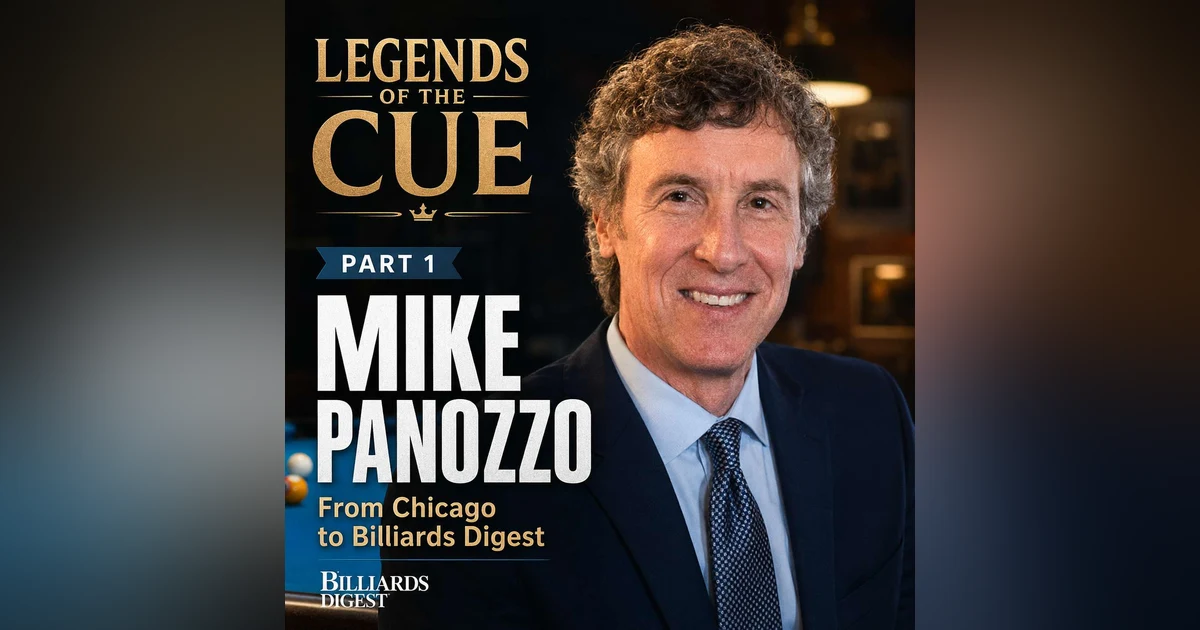

In Part 1 of our conversation with Mike Panozzo, longtime Owner and Publisher of Billiards Digest Magazine, Legends of the Cue goes back to the beginning of one of cue sports’ most important storytellers.
Mike grew up on the South Side of Chicago in a close-knit Italian-American family, surrounded by relatives, neighborhood traditions, Catholic school discipline and the unmistakable rhythm of Chicago sports culture. Long before he became one of pool’s most trusted voices, Mike was a kid racing his brothers to the morning sports page, reading every word of Sports Illustrated, and dreaming of becoming a sportswriter.
In this episode, Mike reflects on his early love of writing, the fifth-grade teacher who encouraged him, his boarding school years in Wisconsin, and his path to Marquette University’s journalism program. He shares how his father’s work ethic, his family’s values and his own curiosity about people shaped the journalist he would become.
The story then turns toward the unexpected opportunity that changed his life: a job interview with Mort Luby Jr. at Luby Publishing, home of Bowlers Journal and the young billiards publication that would become Mike’s professional home for more than four decades — Billiards Digest.
Listeners will hear how Mike entered the pool world without being a player, how he learned the billiard industry from the inside out, and how Mort Luby became a mentor not through lectures, but through example. This opening chapter sets the stage for a larger story about pool, journalism, magazines, players, promoters, and the evolution of cue sports in America.
Give Allison, Mark & Mike some feedback via Text.
Follow our show and/or leave a review/rating on:
Our website: https://www.legendsofthecue.com
Apple Podcasts: https://podcasts.apple.com/us/podcast/legends-of-the-cue/id1820520463
Spotify: https://open.spotify.com/show/4Za0IMh2SeNaWEGUHaVcy1
Music by Lyrium.
About
"Legends of the Cue" is a cue sports history podcast featuring interviews with Hall of Fame members, world champions, and influential figures from across the world of cue sports—including pocket billiards, snooker, and carom disciplines such as three-cushion billiards. We highlight the people, places, and moments that have shaped the game—celebrating iconic players, memorable events, historic venues, and the brands that helped define generations of play. With a focus on the positive spirit of the sport, our goal is to create a rich, engaging, and timeless archive of stories that fans can enjoy now and for years to come.
Co-hosted by WPA and BCA Hall of Fame member Allison Fisher and Mosconi Cup player and captain Mark Wilson, Legends of the Cue brings these stories to life—told in the voices of the game’s greatest figures.
Join Allison, Mark and Mike Gonzalez for “Legends of the Cu...
Mike Gonzalez
Welcome to another edition of Legends of the Q and Allison Fisher. We have a journalist today, so I think the level of scrutiny of our program here is going to be elevated a bit, don't you think?
Allison Fisher
I do. I've known our guest since 1992, and initially I was very wary of him because he's the paparazzi. Over time we've become friends, though. He's fair-minded, loves the sport, and has witnessed the legends, the newbies, and all the changes in our wonderful sport over the decades. I call him Flash, but that's another story. That's a story we'll have to talk about.
Mark Wilson
Today's guest has been involved with Pool throughout my entire career and is one of the few that knows the modern history and politics of Pool throughout the last 40 years. Mike is never short on opinions and insights from both the player perspective and the industry. Welcome aboard, Mike Bonozo.
Mike Panozzo
It's great to be here. Thanks so much for having me. It's going to be interesting to be on the other side of the interview.
Mike Gonzalez
Well, Mike, thanks so much for joining us. We've all looked forward to this a lot. And of course, for me personally, it's a pleasure to talk to somebody that grew up on the south side of Chicago. So as you probably know, that's what we like to do is go right back to the very beginning and learn a little bit about your upbringing. So tell our listeners about what life was like growing up, I guess probably you would say late 50s and the 60s, and uh in the Roseland uh community of uh Southside Chicago.
Mike Panozzo
Yeah, it's far south side of Chicago. I grew up in a uh largely Italian neighborhood. And, you know, it was a great, it was a great place and a great atmosphere to grow up in because I was surrounded by family. You know, in a city like Chicago, they say, where's Little Italy in Chicago? Where there's a dozen of them, because every part of the city had a different pocket of Italian neighborhoods where the Italians from that neighborhood all came from the same spot in Italy. So when Italians from my mother's, my father's town came, they all came to the same neighborhood in Chicago. And so it was all relatives and close friends. And uh it was, I never realized how unique and how how fun and how lucky I was with that until I went away to high school and started meeting non-Italians and they would I just assumed everybody was Italian when I was growing up. So it just uh it was a it was a great place to grow up. I had three brothers and two sisters. So we were, you know, in and in our neighborhood, we were about normal size family. Yeah. Wow. And uh, you know, went to a Catholic school and you know, went to my grandmother's house every Sunday for lunch after church and that whole bit. It was a it was a pretty typical old ethnic, you know, youth period back in if you were in the 50s and sixties, right? Yeah, yeah. That was very common in a big city in an ethnic neighborhood to grow up that way. And so I was just really fortunate to do that. And then I went, uh, you know, our neighborhood started to change and we didn't know we were gonna move. And I have no idea why, but I talked my parents into letting me go away to high school. So I went to a boarding school in southwestern Wisconsin, and that was that was kind of a life-changing thing for me because I was, you know, I never had to go more than three blocks away from my house, and everybody I knew was a relative or cousin or whatever. And uh suddenly I was living in a dorm with people from all over the country who I didn't know, and I could make any kind of decisions I wanted to make. I could hang around with the wrong people if I wanted to. So it was, it was I grew up in a in a real hurry. It was probably the best, best thing that ever happened to me.
Mike Gonzalez
Yeah, I suppose if you'd stayed home, you probably would have gone to Lane Tech or Whitney uh Young or you know, one of the high schools in that area.
Mike Panozzo
Mendel High School was the uh Mendel High School was the Catholic high school on the south side where my brothers went. Yeah. And um where all my buddies from from grade school ended up going going. And yeah, it was it was a very good school, too.
Mike Gonzalez
Yeah. I mean, and you didn't have to go very far to find pockets of other ethnicities, so you could have gone due west and been the the Irish neighborhood of Beverly or a little north to get to Mayor Daly's old dumping ground just south of Kamisky Park.
Mike Panozzo
Yeah, there's a you know, there's a lot of great neighborhoods in Chicago. There were a lot of them. Were you a Sox guy? Always. Well, you know, i it was both when I was growing up. When I was a kid, because the Cubs were on WGN. And so we'd come home from school and you could watch and it was all day games, so you could watch the game every day when you came home from school, and that's what turned so many people into Cubs fans, you know, so many kids. And so yeah, we did that a lot. We did a lot.
Mike Gonzalez
But I was uh I was a diehard Southsider, so you would have watched Jack Brookhouse on WGN, I suppose. Yes, listen to him, Jack Brickhouse, Pat Hughes, you know, and then eventually Harry Carey, but uh Harry was on the South Side first, wasn't he?
Mike Panozzo
He was. He was. Those were those were the glory years for me as a youth growing up and going to the ballpark when Harry Carey used to announce from the center field bleachers, and we would all sit out in the center field bleachers where he was announcing, and we'd all drink beer, and we'd all send beers down to him while he was announcing, and we'd send little notes down to him that he would say things on the air, like Mike and Ken and Tony are here, and whatever. It was just it was a lot of fun. Those were those were great, those were great days. That's uh yeah. Getting kind of back there in the in the age category there, but but those were fun times. I I was very fortunate where I grew up and the family in which I grew up and the friends with which I grew up. Yeah, I I couldn't have been luckier.
Mike Gonzalez
Yeah. So did you just play play other sports as a as a kid? I know you weren't a pool player growing up, so No, I wasn't a pool player growing up.
Mike Panozzo
I was uh, you know, I played all the uh baseball, I played a lot. In the winter, we played hockey a lot. Uh, and then I I became I I really took on a love for tennis uh when I was uh getting uh through grade school and into high school and played tennis all through high school. Straight A student? God, are you kidding? I was this will come as a complete shock to Allison and Mark, but I spent a lot of time in the principal's office when I was in in grade school. The nuns, there was a there was a hallway going to the principal's office that I think that they renamed the Mike Pinozo threwway. I was I was there a lot. I was a problem child. Not a like a roughhouse, you know, doing really bad things. Just just class clowny, you know, never taking things seriously, whatever. You know, I was I was a problem.
Mark Wilson
That doesn't sit well with nuns either.
Mike Panozzo
No, nuns, nuns don't don't take to that well. So I I got my knuckles smacked a few times with rulers.
Mark Wilson
I'm a Catholic boy too, so I can definitely understand. Yeah.
Allison Fisher
As am I. Did you get your knuckles smacked too? Mark. I don't believe Mark did.
Mark Wilson
Oh, yeah. Well, uh usually wasn't my fault, but nevertheless, I was blamed.
Mike Panozzo
Never is.
Mike Gonzalez
Right. I I too was a problem child. And I think finally, uh back to the uh the principal we had, Sister Eloja, it was this uh eight, eight grades, you know, one through eight. We had 70 kids in the whole school, and my graduating class was five boys, the basketball team, and two girls. And it almost she made me feel like it was her life mission to make sure I turned out okay. Was that was that your experience?
Mike Panozzo
Um, yeah, I had a whole team of people who were trying to work as hard as they could to make sure I turned out okay. Uh but yeah, you know, like like all of us, we probably all had our favorite teacher, the teacher that actually impacted us the most, whether they knew it or not, something they said, the way they treated you, the jobs they let you do, the person they let you be a little bit more than the other people did. And I had that, I had that in grade school too. I had a teacher who had a huge impact on me in terms of what direction I decided to follow from grade school in.
Mike Gonzalez
Yeah.
Mike Panozzo
So was that your influence toward journalism or it actually it actually was. Yeah. This was in fifth grade. I was a fifth grader and I loved writing. I just wrote everything I wrote was just way too long. But that was but I loved writing. And, you know, a lot of the when I said that's what I wanted to do, a lot of teachers and would kind of like roll their eyes at her, scoff at it, or say, you know, that's that's you know, you're not you'll never make a living doing that, whatever. But she was very encouraging to me and thought that I was a decent writer. And whether she really thought that or not didn't matter. She believed in me and wanted me to follow that. And so really, I can honestly say from from fifth grade on, writing is what I told myself I was going to do, which was really fortunate because even in fifth grade, I knew that anything that involved math or science was not going to lead to a very good future for Mike Bonoso. So at least it was something that I felt comfortable with. And uh and so that's what that's from that point on, that's all I ever wanted to do. Yeah.
Mike Gonzalez
I think Pat Fleming was doing statistics at that age. He probably was. He probably was. He was counting things and tracking things. So you were writing. We're going to come back to that theme, but tell us a little bit about your folks.
Mike Panozzo
Uh my folk, my mother, um, they both came from small towns in northern Italy, um, very close in the same kind of community of villages. And my father was a funeral director. Uh, it was he was a second generation, his father and his father's brother started a funeral home on the south side of Chicago. And my father uh w went to Notre Dame and then came back and uh went to work at the funeral home with my grandfather, as did his brother, my dad's brother. And so that was our family business, was the funeral business. And my mother was a stay-at-home mom. She didn't even have a driver's license until, geez, I was probably 13, 14 years old by that time. And so that, you know, we just had a very traditional 50s, 60s family. Mother at home, you know, doing your laundry four times a day and cooking all the meals, and dad, you know, working his butt off all the time. And uh yeah, my father was a huge influence on us just by his worth work ethic. Nobody worked harder than my father. Nobody was more devoted to his job than my father. No one was more devoted to the community than my father. Um, and it just rubs off on you. He didn't, he never had to tell us anything. You just you just feel it and you realize it, and you realize later that you're living it because you watched him do this his whole life. Um and uh he was, you know, uh not surprisingly one of the most respected people in our community and know, you know, South Side was very well known and very well loved. Uh so yeah, again, just super fortunate. You don't get to choose your parents, but I I lucked out there. Yeah. And where did you fall in the pecking order with the six kids? I was number four. I was number four. I have two older brothers and an older sister, and then a younger brother and a younger sister. And um, yeah, it just you know, I don't remember people always talk about their older brothers beating them up when they were kids and doing nasty things. I don't remember any of that. You know, we just all it was just chaos in our house all the time. Everybody was just running around doing what what they did. You know, you found your things to do. You were you took off first thing in the morning during the summer and you didn't come home until dinner time, and you caught up with your friends and you found things to do, playing baseball, riding your bikes, doing whatever it was. So it was, you know, pretty normal childhood from that standpoint.
Mike Gonzalez
Yeah, I would think too, by by the time your folks got to number four, it kind of takes the edge off a little bit. Maybe you had it a little easier than the trailblazers that came before.
Mike Panozzo
Well, you know, they most families who have multiple kids, you know, the oldest one is the straightest one, and the the one who was the best student and followed all the rules. And then the next one, my second oldest brother, was completely off the rails and still is. And then my older sister was, you know, a valedictorian straight A student type of thing. And and then there was me. And yeah, that's that's when yeah, the wheels went off the track there, too. Yeah.
Mike Gonzalez
So you mentioned the early influence with with uh a direction toward writing as as early as fifth grade. What sort of writing were you enjoyed doing? Was it sports related or just all kinds of different writing?
Mike Panozzo
No, when I was in grade school, I just wrote whatever, you know, I liked making up stories. I would just create these fictional stories and they would be slightly based on real life, but I would embellish and and just grow the story out. I liked doing that. I liked more of that essay type writing when I was in in grade school. Once I got to be 12, 13, 14 years old, then I started moving into, I was a huge sports fan. And so I started moving into, you know, this is what I want to be as a sports writer. You know, we we raced downstairs to the breakfast table in the morning to see who could get to the newspaper first with my older brothers. And because someone was going to grab that sports page, and then you had to wait. If you were a kid in the 60s, you know, we didn't have TV in the lit, in the you had to eat in the kitchen and there was no TV there. So you just had to sit there and eat and wait until it was time to go catch the bus to go to school or whatever the case was. And so my older brother would always be the first one down there, and he would grab the sports page, and he would take forever reading this damn sports page. He read every word because that's what you did to keep yourself busy. And while he was reading the newspaper, I don't know if you you did this in your youth, but kids in the 60s remember this. The rest of them would sit there and read the serial box. We would read every word that was on the serial box because that was all that was in front of us. And so um, and so we did that. And so, yeah, we we fought for the sports page, and I loved reading the columnists. I loved reading the way people wrote about sports. Yeah. And and I knew that my future as an athlete wasn't going to get me into the paper. So my ability to write was going to be my ticket to get into the sports pages.
Mike Gonzalez
Yeah. Let me read off some names. Maybe they sound familiar to you from your youth. Dave Condon, Irv Kopsen, Jerome Holtzman, Bill Jouss, and Bill Gleason.
Mike Panozzo
That's, you know, they they that was the nucleus of what was the original sports writers. Radio show. They had a radio show called The Sports Writers, and that preceded anything that ESPN ever did or anything like that. And they had a great show once a week, but they were also terrific writers. Jerome Holtzman was one of the great baseball writers of all time. His book, he had his book uh uh No Cheering in the Press Box. He was he was a phenomenal writer. Gleason Jouss, all those guys were great writers. Chicago had uh, you know, not surprisingly, had terrific writers in those days, great sports writers, and and good columnists, Mike Roiko, people like that. So, yeah, these were names that I was very familiar with. And as like a lot of kids in my youth, if you liked sports, you were a sports illustrated subscriber. And so we got Sports Illustrated at the house every week. And that's that was the first time that I remember reading things and thinking, man, these guys really know how to tell a story. They really, you know, it was pretty amazing stuff back in those, the in the glory years of sports illustrated. And that had a that had a huge impact on me as well. I am 68 years old, okay? I went to my mother's house for Mother's Day, and she told me to go down to the basement that there was a chest down there, and she said, sooner or later you got to do something with this chest. I opened up the chest. It was hundreds of sports illustrated from the 1970s.
Allison Fisher
Wow.
Mike Panozzo
From the late 60s and early 70s. Uh and I, because I would get those issues, and I never threw them out. Clearly, I never threw them out.
Allison Fisher
That's cool.
Mike Gonzalez
Yeah. So did any of those people I named or others that you remember uh become sort of influencers, either either subconsciously or consciously, to your writing and your writing style?
Mike Panozzo
Not really my writing style. I just, you know, I think they I think subconsciously they helped me understand how to form stories, how to develop a lead, especially in reporting. Because I thought that my writing was was all going to be, I was gonna work for a daily newspaper and do sports reporting. So this would be daily overnight deadlines, and you had to know how to, you know, put those stories together in short order. And I found that interesting. When I went away to high school, I went and and and became a little bit of a writer for the local newspaper, just to cover basketball games, high school football games, and and kind of learned that craft. And I would just read everybody's, I would read the papers all the time and just kind of try to, you know, let it sink into your head how stories get formed and the proper way to, again, report on an event. So yeah.
Mike Gonzalez
The boarding school experience in Wisconsin, was that instrumental in sort of then leading you to consider Marquette as a choice for college?
Mike Panozzo
Uh yeah, it was because it was a Jesuit high school and Marquette is a Jesuit uh university. My whole family, my dad, his brother, my two older brothers, my older sister, most of my best friends in grade school, all went to Notre Dame. And I assumed I was going to Notre Dame. And Notre Dame said, you're not quite the student that we're looking for, Mike. So the reality set in really fast that I was not going to be a Notre Dame student. And and Marquette was had a national class journalism school. And Notre Dame really didn't, but I just wanted to go to Notre Dame because that's what my whole family did. And so I went to Marquette, and that was another one of those great breaks that I got, was that Notre Dame said no, and Marquette said yes. That turned out to be another one of those, just, you know, everything just happened, things just fall into place pretty well for me.
Mike Gonzalez
Yeah. So how did your skills develop then writing and otherwise and communications at Marquette over those four years?
Mike Panozzo
Uh, just through the classes that I took. I didn't write for the paper there. I was 20 years old. I mean, I wanted to go out and party. I was I wanted to go out with my friends. I didn't want to be covering events, I didn't want to have deadlines. You know, the classwork was enough for me. And so I just tried to learn through the classwork. And then I just I just always figured that once I got out of college and I got thrown into the pit, you know, you were gonna learn how to you were either gonna swim or sink. And I was never a really uh self-confident person. I had a lot of insecurities, but for some reason I thought, you know, just give me an opportunity and I'll I think I can do this.
Mark Wilson
What southwest Wisconsin community was that school?
Mike Panozzo
It was a little town called Prairie de Chain, which is right on the Mississippi River, uh right in the southwest corner of the state. And it was a it was a small private school. Dorms was on about a hundred-acre campus right along the river, and only had about 300 or so students, and mostly from Chicago, Milwaukee, and then others, Iowa, Ohio, you know, a lot of places, mostly places in the Midwest. And um, yeah, it was a it was a great it was a it was a great experience.
Mike Gonzalez
Allison, you raised your hand.
Allison Fisher
Well, I did, and then I took it down. But I was just gonna ask you about brothers and sisters. Have any of them went into writing? Did any of them lead you along that way or no?
Mike Panozzo
It's interesting, not not at all. My my my older brother, Dennis, was a huge sports fan, and he liked, you know, he didn't really write much, but he liked reading the papers and he liked sports writers and and um he probably, you know, was the closest to come to that. But yeah, we we had a really disparate group of brothers and sisters in terms of the directions they went. I had a couple, my oldest brother ended up being, you know, and having an accounting degree, and my second oldest brother had an engineering degree, and my sister had an engineering degree, and so yeah, we were all over the board, but I was the only one that was more of the um uh LibArt type of Yeah, yeah.
Mike Gonzalez
What's the biggest takeaway you took uh away from Marquette?
Mike Panozzo
Boy, I you know, college to me was more about obviously the the educational part was was great, but Marquette was was a pretty good wasn't the biggest, it wasn't an overly large university, but big enough. But it was it was about community and it was about friendships. I mean, that's again, I I always just figured, you know, once I get out into working world, everybody always told me you learn more in your first month on on a job than you did in four years of college. And partial it's partially it's because in four years of college you really didn't do a lot other than to whatever you the the least amount you needed to do to get through classwork. Um and so I was kind of in that boat. Uh but I still have uh fond memories of that school in terms of the friendships. uh that I developed and the way the school led me and stuck with me, you know, when I would be going sideways in one way or another. And so yeah, it was a very supportive university and a very good community. And my friendships had a lot to do, you know, they they have more impact on how you act as a person and and your growth as a person and and the direction you go and your commitments and things like that than you than you realize at the time. You just think you're all living in a dorm together or living in an apartment together or partying together or whatever. And it's all kind of incidental. But it does have huge impact on on who you are going forward. And Marquette certainly had an impact on me.
Mike Gonzalez
So when you you finished up there, it was still clear in your mind what you wanted to do for a living.
Mike Panozzo
Yes, it was. And and I had teachers in high school, you know, when I told them this was what I wanted to do in college who said, you know, that's a really dumb idea. I still don't know why. They just always thought journalism was like you know real real college educated people don't do that. But at Marquette, because their journalism program was was so developed and so nationally known, they were very serious about helping you learn to become whatever kind of journalist you wanted to be, whether it was print or whether it was you know television or radio broadcast, things like that. So yeah, it was a it was a terrific university from that standpoint. Yeah.
Mike Gonzalez
So you graduate, do you take some time off? Do you travel or do you just jump right into something?
Mike Panozzo
No, my father had no interest in time off was not something we ever experienced as kids. No one was going to say I'm going to go to Europe for a year and find myself because my dad would find you real fast and he would he would change that direction real fast. So yeah it was it was you know come home get a job as fast as you can. Well you know journalism was not the easiest field to get a job in I sent out tons of resumes and I would get all the the job clippings from the university and and you know sent them to small newspapers in Virginia and where all over the country I was I was ready to go anywhere and start at any level. And it was not it was not as easy as you know I didn't think it was going to be easy but it was it was it was not very easy. And then out of the clear blue uh my aunt had sent me she was a teacher and she had gotten some placement job placement things from a university she worked with and one of them was for this small magazine publisher in downtown Chicago and it was called National Bowler's journal. And my father knew of it right away because he was like every father in the 50s and 60s he was a bowler. He bowled every Thursday night and so he knew this magazine and so and knew the family that owned it and so I went interviewed for this job and it was a magazine that company that a small uh magazine owned by a man named Mort Luby who had a bowling magazine that was established by his grandfather in 1913 and is still in operation today and is the oldest monthly sports magazine in America. And he also had a billiard magazine because during during the 40s 50s 60s the bowling magazine always devoted a half dozen or so pages to billiards because the industries were so linked together in terms of the distribution network and in terms of the manufacturing even and so he always devoted some pages to billiards. And then in 1978 he decided to spin this off and create a a separate billiard magazine called Billiards Digest and that was in uh September of 1978. So in uh by August of 1980 he had already been through three editors and was looking for another editor. And so I went into an interview with him and I just thought it was really going to be about you know some clerk type of job or writing a stringer almost just help in the office. And all of a sudden he handed me this I sat down in his office and he handed me this list of responsibilities of the editor. And I thought well and this was one of those moments where it was like okay just this is what you knew was this was coming you got to fake your way through this just get me in the door and I'll make it work. I'll find out whether I can do this. And so that's what I did. He asked me about photography. I said you can't get a camera out of my hand and the truth is and my the truth is at Marquette I had a half a semester of photography. And you know he he asked me all these other questions and I just told him I lay out and design sure we did that and I mispronounced Willie Hoppe's name trying to name drop. And so he decided to give me a shot and said well we'll give you a little test run. There's a woman bowler in the Chicago area that we want to do a story on we want you to go interview her and then turn a story in and I'll I'll pay you either way whether we use it or not and that'll give me some ideas your writing skills. And so I went to interview this woman bowler and the editor at the time stopped me on the way out the door and said you know this woman goes by the name Patty Ann. Nobody knows what her last name is she just goes by Patty Ann. And he brought me in and decided to hire me and give me a shot and uh that was 46 years ago.
Mike Gonzalez
Yeah. Now we're talking about uh Mort Luby Jr.
Mike Panozzo
a fellow that became very very important to you uh as a mentor in your life and someone who's recently passed so uh these uh these reflections are going to be quite real for you yeah Mort was um he was uh an icon in the bowling business and at that time in the billiard business everyone knew Mort he was very well respected um he was a um he put the whole magazine together he was kind of a Hefner type I mean he he did the layout and design like Hefner used to and he wrote all the stories and he um you know and he was a terrific writer but uh what he taught me was about knowing about the entire industry you have to get out there you have to talk to the players you have to talk to the room owners you have to talk to the retail store owners you have to talk to the manufacturers and you have to figure out learn about how all of this fits together and how all of this works how this industry operates um where the money comes from where it goes you know who faces different problems than somebody else and you know he was so inquisitive and so interested in people's stories about and he loved talking to everybody from every part of the bowling business independent and I literally used to follow him around at functions trade shows events whatever and I just watched him I just watched him because he could work a crowd and it wasn't you know it wasn't small talk. He would sit with people whether it was a pinboy from a bowling center or the CEO of Brunswick it was the same thing with him. He wanted to learn about what they did and what's important to them and what are they what's what's going on in the business now and how are things impacting different parts of the business and and then he loved talking to the players because they were the stories that he wrote the profiles about. And so I just watched him do all this and I learned so much from he wasn't a instructor type of mentor he wasn't a this is how you do this mentor. He was a just watch what he does and and try to do it yourself. I mean you know the most you ever got out of him was I would turn in a story and and put it on his desk for him to read it through and he would just write the words try again on it and hand it back to me. And that was that was as much as you were going to get out of him. Thanks for the well that's but they they had to go figure out what was wrong, what was missing, what needs to be and and I loved that about him because I was never I never needed pats on the back I I was always more uncomfortable with that than anything else. I just like you know figure my way through and know myself that I'm getting better at it. He had a huge impact on me. He was one who convinced me to stick with billiards far longer than I ever thought I was going to.
Mike Gonzalez
Yeah.
Mike Panozzo
Were you naturally curious or is that something you kind of picked up from him you know I don't know I I I think I I think I've always been curious. I've always you know uh my friendships with people I always liked hearing about them more than I liked you know talking about myself which might kind of surprise given how much I've dominated this conversation today but uh but you know I I I always enjoyed learning about people um and the part about learning more about how these people fit together in a business was something that I learned from him and that was very instrumental and instructive.
Mike Gonzalez
So why don't you describe for our listeners what Billiards Digest looked like back in 1980.
Mike Panozzo
1980 Billiards Digest was bi-monthly so it only came out six times a year it was probably about 48 pages uh 36 to 48 pages somewhere in that range mostly black and white just you know a couple of pages of color what I learned for Morton was how to efficiently and economically put a magazine together when it came because color back then was very expensive to to use and things like that. So I learned all about that for you know from him as well. But yeah it was a very small magazine uh we covered tournaments we did profiles on players similar you know in that respect to how it is now it's never really changed much in terms of who it serves and how it serves them. We probably used to write a lot more about the industry back then when we do than we do now uh but there's a number of reasons for that but um yeah it's it was it was a very small uh modest little magazine and and you know very tight budget so so when I went out I had to take the photos I had to interview all the people if I went on a trip someplace for a tournament I was obligated to go around that town and find a local pool room and talk to the owner and do a story on that and then go to the local retail store and find the owner and do a story on that and then do a story on the tournament. And that was great practice as well in learning about the industry and the different people in it and and what's important to them and how it all fits together.
Allison Fisher
You want to jump in with anything I mean did you immediately love the industry the pool industry?
Mike Panozzo
You know what I I really did. I didn't know you know a one ball from a grapefruit but I um I loved the players I loved the people um you know they were very welcoming to me I think you know they didn't treat me I they knew I wasn't a player um and they knew they weren't you know they weren't being nice to me because you know I was a writer for Sports Illustrated. I was just you know a writer for a small industry magazine and and but they were um it's a very you know you know this Allison you know how welcoming the the billiard industry is the the people in it the players in it the industry people in it it was in our day when we started you Mark and myself it was very family run the businesses as well you know so the between the businesses and the players it was a very easy industry to get hooked into because you wanted to see you loved seeing these people you loved talking to them and you wanted to do it more often Michael uh do you uh when you were at Marquette did you have any exposure to State Street in Madison and and maybe some of the pool industry up there Viking Q or Te Week no? Yeah no I can't say that I really knew anything about pool in those in my college years other than you know a couple of the bars had a bar table and we would play occasionally that was the extent of it.
Allison Fisher
Well the serious partying took place in Madison just so you know I guarantee that yeah yeah I guarantee that we didn't do too bad in Milwaukee but thank you for listening to another episode of Legends of the Cube if you like what you hear wherever you listen to your podcast including Apple and Spotify please follow subscribe and spread the word give our podcast a five star rating. Until our next golden break with more Legends of the Cube along everybody.

Journalist
Mike Panozzo has spent more than four decades doing something few people in cue sports have ever done: he has watched the game from nearly every angle — journalist, editor, publisher, historian, advocate, industry insider and, ultimately, Hall of Famer.
Best known as the longtime Owner, Publisher and Editor of Billiards Digest, Panozzo has been one of the most important chroniclers of modern pool history. Since joining the magazine in 1980, fresh out of Marquette University with a journalism degree, he has documented the players, promoters, room owners, manufacturers, tours, controversies, characters and turning points that shaped the sport from the post-"Hustler" era through "The Color of Money" boom, the rise of the women’s professional game, the internationalization of pool and today’s streaming-driven global landscape.
Panozzo’s story begins far from the tournament arena. He grew up on the far South Side of Chicago in a close-knit Italian-American neighborhood where, as he recalls, “Little Italy” was not one place but many. Surrounded by family, Catholic school, Sunday meals at his grandmother’s house and the rhythms of Chicago sports, he developed an early fascination with writing and storytelling. He was not, by his own admission, a straight-A altar-boy type. He joked in the interview that the hallway to the principal’s office might as well have been named the “Mike Panozzo Thruway.” But even as a fifth-grader, he knew he loved to write. A teacher’s encouragement helped him believe that writing might become not merely an interes… Read More