

 Apple Podcasts

 Spotify
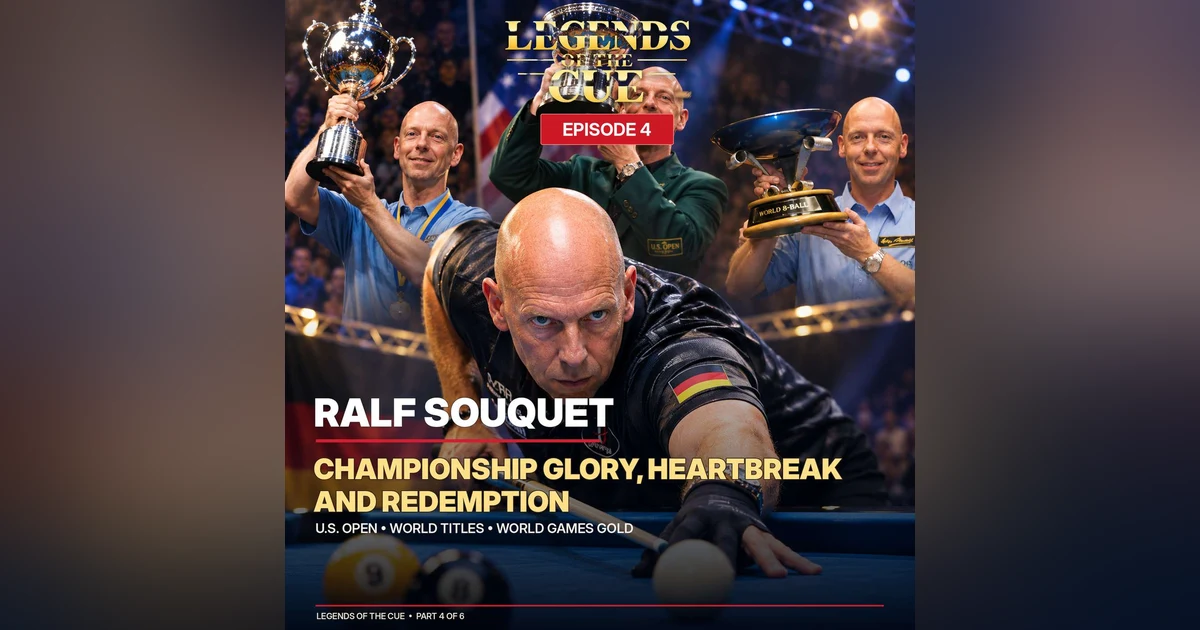
Ralf Souquet - Part 4 (U.S. Open Glory, World Titles and World Games Gold)

Key Takeaways
- Ralf Souquet emphasizes that straight pool (14.1 continuous) remains the absolute best practice game for developing precise position play, fine touch, and advanced cue ball control for other cue sports.
- Winning the 2002 U.S. Open 9-Ball Championship stands out as one of Ralf's most cherished titles, particularly due to the intense pressure of a drastically shortened shot clock during its first-ever pay-per-view stream.
- Reflecting on his career, Ralf considers winning the gold medal at the 2009 World Games in Taiwan—defeating Yang Ching-shun on his home turf—to be his greatest career achievement, even surpassing his world titles.
- Ralf notes that while losing high-stakes world championship finals to Mika Immonen in 2001 and Ronnie Alcano in 2006 took time to digest, those experiences ultimately fueled his determination to claim victory in other disciplines.
- Capturing the 2008 World 8-Ball Championship provided immense personal validation for Ralf, as 8-ball is his favorite discipline and winning titles in it came with far fewer opportunities.
World championships are won in moments, but legendary careers are forged through decades of triumph, disappointment, resilience, and determination.
In Part 4 of our Legends of the Cue interview, two-time world pool champion Ralf "The Kaiser" Souquet revisits some of the most emotional and unforgettable moments of his extraordinary career.
Ralf reflects on becoming World 9-Ball Champion in 1996 and what the victory meant to his family. He explains why straight pool, or 14.1 continuous, remains an essential foundation for developing great players, and recalls winning the 2000 U.S. Open Straight Pool Championship.
Then comes his remarkable 2002 U.S. Open 9-Ball Championship victory over Alex Pagulayan—a dramatic final featuring an increasingly frantic shot clock as television coverage threatened to run out of time!
Ralf candidly discusses the heartbreak of losing World 9-Ball Championship finals to Mika Immonen in 2001 and Ronnie Alcano in 2006, and the satisfaction of defeating Alcano to capture the 2008 World 8-Ball Championship in his favorite discipline.
Perhaps most revealing is his account of the 2009 World Games in Taiwan, where he defeated Yang Ching-shun, the same opponent who had denied him gold eight years earlier. Ralf explains why that victory remains his greatest career achievement, even surpassing his world titles.
Join Mike Gonzalez, Mark Wilson, and Allison Fisher for championship stories, colorful behind-the-scenes memories, and a compelling look at what separates great players from enduring legends.
Give Allison, Mark & Mike some feedback via Text.
Follow our show and/or leave a review/rating on:
Our website: https://www.legendsofthecue.com
YouTube: www.youtube.com/@LegendsoftheCue-MLG
Apple Podcasts: https://podcasts.apple.com/us/podcast/legends-of-the-cue/id1820520463
Spotify: https://open.spotify.com/show/4Za0IMh2SeNaWEGUHaVcy1
Music by Lyrium.
About
"Legends of the Cue" is a cue sports history podcast featuring interviews with influential figures from across the world of cue sports—including pocket billiards, snooker, and carom disciplines such as three-cushion billiards. We highlight the people, places, and moments that have shaped the game—celebrating iconic players, memorable events, historic venues, and the brands that helped define generations of play. With a focus on the positive spirit of the sport, our goal is to create a rich, engaging, and timeless archive of stories that fans can enjoy now and for years to come.
Co-hosted by WPA and BCA Hall of Fame member Allison Fisher and Mosconi Cup player and captain Mark Wilson, Legends of the Cue brings these stories to life—told in the voices of the game’s greatest figures.
Join A...
Frequently Asked Questions
Why does Ralf Souquet consider straight pool an essential practice game?
Ralf believes straight pool teaches players precise position play, small-table management, and a deep understanding of how the cue ball and object balls react, which benefits performance in almost all other cue sports.
What made the 2002 U.S. Open 9-Ball Championship final so dramatic?
The final against Alex Pagulayan featured a rapidly shrinking shot clock—whittled down to a frantic 20 to 25 seconds—because television and pay-per-view coverage was on the verge of running out of time.
Why is the 2009 World Games gold medal Ralf Souquet's favorite career achievement?
Ralf views the World Games as the Olympics of non-Olympic sports. Winning gold against Yang Ching-shun in front of a massive crowd in Taiwan after losing to him eight years prior made the victory deeply fulfilling.
How did winning the 2008 World 8-Ball Championship impact Ralf Souquet?
Since 8-ball is Ralf's favorite discipline and opportunities to win a world 8-ball title were rare, capturing the championship provided immense personal satisfaction and validation as a strategic player.
So this first uh World Nine Ball title, first world championship, must have been, at least to date, your greatest win. Who did you most want to share the moment with?
Ralf SouquetWell, uh of course, my my parents, and uh because at this time I was not married, so I otherwise I would have said my wife, but uh that was a time where I was actually single. No, was I or no, actually, no, no. I I I was married at the time. Sorry, yeah. So yeah. Uh no, so I I I was married at the time. Uh so yeah, it it went to my back then second wife and and uh obviously friends in my in my uh in my home pool club and of course my my my family, uh my my dad and my my mom, yeah. Because they they made it also possible for me that I could you know uh choose this uh route in life. I mean they easily could have said, well no, you you know stick to your job. I mean I I did do an internship in uh uh to be a salesman for car parts. So I actually did finish a an internship, and and so I I could go back eventually and and sell cars or s or car parts, even though I I wouldn't like that part any any longer or anymore.
Allison FisherBut uh that would be a plan B. No, that's plan I don't know. Yeah, we don't want that one, yeah. But what changed when you returned home as world champion?
Ralf SouquetFor me personally, not much. You know, I it was it was just a nice title to have, obviously. That's everyone, if you are a competitive player, you you want to win the the biggest title that is uh possible or available, and at the time it was the uh world title, and uh so I was only the second German, but also I believe only second European title holder on the man's or in the man's division after Oliver Ortmann who won it the year before me in '95. So that alone was you know a a great achievement, but it didn't change me as a person or the way how I saw the game or my career. You know, the rest just stayed the same. It was another title, as I said, you know, great to have, and that I could very be proud of, still I'm proud of. And it's a title that you that you're never gonna lose, you know. Once a world champion, always a world champion.
Mike GonzalezYou know, it's well you mentioned uh you mentioned your first world title we talked about in 1996. Let's let's move into the early 2000s now, where uh you sort of changed disciplines. You'd you'd mentioned the loss to Mika in the in the world final in 2001, but she had a couple of other important titles early in the new century, Mark.
Mark WilsonUh you came to America and won the 2000 U.S. Open Straight Pool Championship. Um what does Straight Pool um bring to your rotation game?
Ralf SouquetWell, I I still say it up to date that Straight Pool is probably the best game to practice in order to be good and at most other pool games available. I'm not necessarily talking about bang pool because you know that's a game that has only been known more or less in the in the US. I do like it, but I don't get to play it as often, maybe once a year at the Derby, and that's about it. But that's a game that I really like. But uh in straight pool you have to come with the long shots at times, but you know, you have to have a great position game in a in a very you know small field of the table, which is also then helpful if you're a one-pocket player. So you you get a fine touch, but you know, you you get to know how the balls react, not only the cue ball, but also when the cue ball hits the stack and and the other balls, like ball three, so to speak. And yeah, it's it's just a great practice game, it's just not such a good game on a competition level because it's a little bit too boring to watch as a non-pool player. Obviously, as an insider, yeah, it's it's a great game to watch and to play. But also here you have the fact that you know if you run 150 balls and out, you know, the opponent you have to sit down and there's not much you can do about it. So that's that's something that I kind of started disliking over the years, you know. But in general, I I like to practice the game still because it it also keeps you focused for a longer period of time, because if you want to run 100 balls or 200, you gotta stay focused for an hour, hour and a half, two hours, depending on how fast you you play. And uh and I really have to admire guys like Jason Shaw or John Schmidt when they try to do these high runs with six, seven, eight hundred balls. I mean, I could never do such a high run. I've been asked several times to give it a try, and I said, I'm too old for that sh, you know, I'm I'm gonna die at the table, you know. It's just not happening. And it's also because I'm I'm not such a fast player. You need to be a really, really fast paced player to you know to do that, because with my playing style, I would lose so much energy that I would I mean I probably could do three, maybe four hundred, even though I've never ran three hundred in my life, but that's because those high run attempts were done on like five-inch pockets. And I and I haven't played on a five-inch pockets table in my whole life, I have to say, even in the in the very first beginning, the pockets were a little tighter. So I've never tried it. Maybe I will give it a try at some point, but I would bet actually money on it, even though I'm I never do any bets, that I would probably not even reach 500 because of the way I play, you know, of my playing style. Because on the other hand, with big pockets, it also means there's a big pocket for the cue ball. So it's a lot easier to scratch too, you know. But players like Joshua, I could I could see him running a thousand because he is such a fast player, and and so it'd be good to see him try, actually, wouldn't it? Yeah, if he would give it a try, I don't know. Torsten is also quite a fast player when it when he is in his rhythm, especially playing straight ball. But I don't know if if he's gonna give it a try or not. But but you have to be a fast-paced player in order to have a chance at all to run that many balls.
Allison FisherYeah. How so let's go back a little bit. How did you recover from the disappointment of the 2001 World Nine Ball Championship final against Mika? That was a tough one.
Ralf SouquetWell, it was it it took a few weeks, you know. It I really had to let it sit. But on the other hand, you know, the fans in Manila they were so great and they were so cheerful. And um, yeah, I mean, they actually made it easy for me to you know get over the loss a lot quicker because they really cheered me on and they they still love me to death over there. And I I can tell, even if I go there nowadays and not being so successful in the last, let's say, 10 years, maybe, they still admire me, they they still recognize me. And uh yeah, it's it's it's just great to go back to the Philippines because it's such a pool crazy country, and uh I would actually love to see more events being played there. Because there's so much potential in the world. Yeah, not only fans, also players. I would probably say 200-250 players that nobody knows yet that could easily win any big event.
Allison FisherYeah.
Mike GonzalezYeah, it's great. So you win the the the 2002 US Open nine ball title. I know on the golf side, an American-born golfer winning their national championship, the US Open in golf, is a big deal. But even as a German-born player, this had to be a big deal.
Ralf SouquetIt was a big deal, yeah. Big time, because the US Open in in pool or in nine ball, as it now it's called the US Open Championship Pool, I believe, Metroom, you know, they they got rid of the nine ball part, even though everything is played nine ball. But officially it's called the US Open Nine Ball Championship, and uh yeah, it is, or it was the biggest and hardest, or one of the hardest events to win in the circuit for several reasons. You know, first of all, uh in the first I don't know, 35 years or so, it was a true double elimination format, meaning that if you had lost early on, you had to win 13-14 matches on the loser side coming back to to win in the finals. And so by the end of the tournament, you were dead. You were either in dead stroke or you were just dead, you had no more energy, no more power to survive, you know. So winning this event meant yeah, I mean, it meant the world to me. It was probably even a better feeling than uh winning the the world 9 ball title in '96, believe it or not. Um, and of course, you know, US Open all the great players, you know, they most of them they won a US Open title, but a lot of them did not win it. And it's it's been a dream and a goal of the majority of players, you know, to win a US Open title, and to win it and get that green jacket is just it's just a great achievement. And in particular, in the year when I won it in 2002, it was the very first time when there was pay-per-view to stream the finals. I think there was a time slot of three hours. It might have been four hours, I'm not 100% sure about that anymore. But knowing Barry Berman, who back then was still running it, and you know, he always had someone singing the national anthem and this and that, and he had a pipe core playing just before the the final match started, so he had all that recorded already, so that time already was um no longer there for the match. It was a race to 13, if I'm not mistaken, I believe it was, yeah. So I it was me and Alex Pegeline in the finals. Um, yeah, before they did some interviews, so they had some other players interviewed before what they think who's gonna win, and so on, so on. They recorded that, so that was all part of the show. So at the end, maybe there was like two and a half hours left for the actual playing. So we started just normal without a shot clock, and at some point, I don't know exactly what the score was, let's say maybe 7-5, whatever. They realized we might be running out of time here. So they started putting us on a clock. And I think the shot clock started with let's say 45 seconds. A few games later, still was you know going back and forth, and so was nobody really running away. Uh they shortened it to like 35. At the end, there were like, I believe, three minutes left on the clock before the stream would have gone dark and nobody would have seen who actually wins it. We had a 20-second or 25-second short clock. I mean the shortest short clock that ever has been used, and that was on in the very first time when they streamed it or you know had a pay-per-view. And luckily, I somehow ran out, and even though I played a bad position and I, you know, got over the finish line with 13-11, and I was absolutely dead, and I I sunk on my knees, actually hurt my knees by the celebration, but it was the greatest feeling on earth. Yeah.
Mike GonzalezOh, that's great. That's great. Well, you know, sandwiched between these two victories, the the 14-1 in 2000, the nine ball in 2002, you were able to represent Germany in the world game finals. Now, this outcome wasn't what you were looking for, but sweet revenge did come some eight years later.
Ralf SouquetLater, yeah, exactly. In 2001, besides losing the final against Mika in the World Championships, I also made it to the finals of the World Games in Akita, Japan, where I played uh Yang Chinshun, one of the big Taiwanese stars. Unfortunately, he passed away also like a few years back at a very young age. Um I think he was, I don't know, maybe 46 by the time he passed away. But he was one of the biggest talents coming out of Taiwan back in the days. The first one was Fong uh Fong Pan Chao, yeah, who became the world champion already in '93, where I lost against him in the semi-finals. That was in uh Koenigswinter, also in Germany. That's also another story. So I have to I have to go back to '93 first. So here I was already in the semifinals in my home country, Germany, Königswinter, playing Feng Pang Chao in the finals, uh, in the semifinals. Um back then we were playing sets. Um not sure. I think we were playing two out of three sets, race to six or race to seven. Not sure anymore. Anyways, I won the first set, was on the hill in the second set, so basically had a good chance to make it to the finals. That would have been against another fellow German player, where I probably was the super high favorite. To make a long story short, I did not win the second set, and then the tournament director who was also, I don't even know if he was the tournament director, but he he was somehow in charge, let's put it that way. He came up with the idea to put us on a shot clock. Shock shot clock, sorry. Um it was kind of late. I mean it was like maybe 11:30 at night, but it was not like we uh they had to wait for the table or anything, because on the very next day only the finals were scheduled, and that was the last match of the day. Because the two semifinals were played at the same time on two different tables. So obviously, nobody asked me or nobody you know said something. They just said, yeah, well, the match is kind of going slow, blah, blah, blah. So we we put them on a shot clock for the for the last set. Yeah, that put me completely off my form, so I ended up losing the last set like 6-1 or so or 7-1. So I didn't really get a good chance anymore, and that you know, yeah, that put me into third position in the world championships already back in '93. That was before I won my world title three years later. Feng Pang Chao ended up winning it. So now we're going back to the to the world games, you know, Feng Pang Chao being the first big player coming out of Taiwan. So Yang Chinchun was definitely the second one that they came out, along with many, many grades thereafter. I mean, now there's a list of probably 25 players that you can name. So playing Yan Chinchung there was I had it. I played a good tournament because you know it was a great year. I made it to the finals of the World Championship, also to the World Games. But there I had basically again no chance because roles were just not on my side. Um he played good. I played also not bad, but you know, just not good enough, and I didn't have uh the roles after the break that you need, you know, to have maybe easier layouts on the break. So, anyways, I I lost. So eight years later, in 2009, in the world games in Kaoshung, again, alongside Allison, we both won the gold medal there. Um, obviously, she in the women's division, I in the in the men's division, and my uh final opponent again was Yang Jinchun, the same opponent that I had in 2001. And now it was on his home turf in Kaoh Shung because that's where he was born and raised. So again, I I faced a big arena. So I don't know if Ellie remembers, but I thought it was like 2,000 to 2,500 people in the arena because I'm not sure if the woman's final was at the same time or if it was at a different time. You may know or not, or you may remember.
Allison FisherI remember the I remember the arena. I remember how big it was, and we were we were all playing at the same time, and we I think did Darum win uh no, he won another time, didn't he? No, he won it four years later. Yeah, there was a snooker players, and then there was a three cushion players.
Ralf SouquetYeah, snooker, three cushion, woman's pool, and man's pool. Yeah. But I'm but I'm not sure if it all happened at the same time. It might have been, but yeah. But it was like the last discipline of the world games to begin with. Everything else was finished, so that was the last day of the whole, you know, games, of the whole world games. And of course, I don't know how many other Taiwanese uh athletes were successful in the world games there. I would say maybe not so many because Pool was one of the very few sports there where Taiwan was, I'm not saying a heavy favorite, but where they had a great chance to win a medal. So the whole uh delegation of Taiwan was there. So was the German delegation of the whole World Games because all the other sports and disciplines were already finished, so it was like a huge crowd there. And there I again I played one of my best matches in my whole career. I can't remember the final score, but I won by a pretty big margin there as well. So I got my revenge in the finals against him, and also got finally the World Games gold medal, which still, in my opinion, is the biggest achievement of my career. Because I always said the World Games is like the Olympics of the non-Olympic sports, and it only happens every four years, even though there is no prize money and no other thing. But you know, to be at the same venue sometimes or the same stadium with so many other great sports, and you have an opening ceremony with 30,000 people in the stadium and also the closing ceremony.
Allison FisherYeah, it's amazing.
Ralf SouquetI actually was supposed to be the German guy that carries the flag in to the closing ceremony, but I had to give so many interviews after the finals, I had to do the doping tests, then I had to drive from the uh actual venue that was a little outside to this first back to our hotel, then to the stadium where the closing ceremony is, where that I actually was late for like five to ten minutes. So they had to find another athlete from Germany to carry the flag in. I didn't mind, but you know, that would have been like the the icing on the cake, you know, because it was promised to me after I sank uh the the final nine balls. So that was yeah, that would have been like a really, really great feeling, but yeah, that didn't happen, but but still it was great, you know, because once I got to the stadium, you know, uh people like said you have to hurry up. So I had still the gold medal on my neck, so I kind of ran into the stadium, but they were still like um underneath the stadium, so that they did they were not uh they didn't walk or they hadn't walked out yet. They were still like uh underneath you know where the spectators are sitting. But on the way there, you know, there were so many fans from Taiwan that congratulated me because They saw it all on television because that was the main sport for them. I mean, it was yeah, just an unbelievable feeling.
Mike GonzalezYeah, that's great. And you must have passed the doping test.
Ralf SouquetYeah, of course I believe so. Otherwise, you know, we won't be here.
Allison FisherUm I I think I remember, um if my memory serves me correctly, it was very important for you to win gold. Because wasn't there funding for the German association?
Ralf SouquetFor the German uh Federation, that's the only well, up to then it might have changed nowadays, but back then that was the only event where um the funding from the German government could be basically achieved by winning a medal. Winning gold, I believe back then the number was like 300,000 for four years, so that it meant like 75,000 per year from the government for the billiard federation. Yeah, silver medal probably would have been 200,000 and bronze 100,000. I don't know the exact numbers, but I I've been told afterwards that it was probably like uh 300,000 for the over four years. Yeah.
Allison FisherAnd you got nothing.
Ralf SouquetUh I got a tiny little bit. Before the games, they they asked asked me or they they told me if some of the players would win a gold medal, because it also counted for the Snooker and the and the Caram players. So they said as whoever wins the gold medal gets a certain amount, but it was a very, very tiny, small percentage. So it wasn't like a big thing. But it it was at least something yeah.
Allison FisherLet me tell you what I got, nothing.
Ralf SouquetAnd paid my own way.
Allison FisherPaid my own way, and also I think I got a spot last minute because somebody pulled out.
Ralf SouquetSo that was that was the case with me uh when we had the World Games 2005 in Duisburg, Germany. I remember that one, yeah. And I was being uh obviously I was not the defending champion, but I won the silver medal in Akita 2001. But that obviously did not qualify you automatically for the next World Games. Even back then, being a champion, like I was in 09, yeah, did not qualify me for the 2013 World Games, which I then didn't play because the year when it mattered to qualify, I had not my best season. And that's why you know I could not play, I believe it was in Colombia, was Bogoda, not Bogoda, but yeah, but somewhere in Colombia.
Allison FisherI never got a spot in a keto, I was number one in the world and never got a spot in a keto just because of the not playing in the European championships because I was already in America. Yeah, all that stuff.
Mike GonzalezMark, amongst the four of us, we've won a total together of two gold medals. Yeah, that's right.
Allison FisherHaven't we done well? What a team!
Mike GonzalezYep. Team in the silver. All right, we'll go to uh 2006-2008 sort of time frame then, Ralph. Uh uh, you are the world nine-ball runner-up in 2006, uh, but then went on to win a world eight ball championship in 2008. Allie, you want to talk about the 2006 one first?
Allison FisherYeah, what stayed with you after losing that 2006 world final to Ronnie Alcano?
Ralf SouquetYeah, it was not a not a nice situation because I played one of the best tournaments there. I had a a great semifinal that's uh against uh Taiwanese player, uh Fuji Wei, that went uh completely crazy with you know many safeties and kick shots and and eventually I came with a great shot and I I actually made it to the finals probably as a not saying a heavy favorite, but as a favorite, even though I played the hometown boy, Ronnie Alcano, in Manila in the finals. But the way he had performed so far and just barely made it to the to the actual to the semifinals, or actually barely made it out of the group to begin with, in the in the early stages. Um yeah, saw me as um the the favorite in the finals, but again in the finals I I couldn't get going. You know, I had either I didn't make a ball on the break or I had funny layouts, and uh Ronnie Alcano started a weird break already in the semi-finals, and I'm not sure if it was against Wu Chal Qing or who he played in the semis, where he started drawing the cue ball back on the break like really weird, like you know, breaking from the side, drawing it back basically to the same rail where he was breaking from, so hitting the long rail, short rail, and then back to the middle of the table. And you know, he was so successful with it and always had like a roadmap afterwards, like super easy outs. And yeah, again, I lost by a big margin like 1710 or 1711, similar to the loss 2001 against Mika. And uh yeah, even though I had played one of the best tournaments in my whole career overall, the finals just didn't go my way, you know. Um so I I rather just you know play so-and-so now and and make it to the finals and then pull out the best performance in the finals, you know, like I did in Sweden when I won it in '96, you know. So it always it it also took quite a long time to digest and really let it sink because you know, when you are in the finals of a of a big championship, then you want to win it. Of course, uh 126 other players, they probably would have liked to be in that position that I was in, but yeah, you know, finishing second is also still the first loser, you know, kind of.
Allison FisherYeah, nobody remembers second, do they? That's the other thing.
Ralf SouquetExcept you lose like Jimmy White six times in the world championships. Then they'll remember you. Yeah.
Allison FisherA proficient loser, a proficient runner-up.
Mark WilsonYeah, for what Jimmy did though, you you had to beat everybody that's won it before, and then you just get to the final, and then oftentimes they put a superhuman match on you, then you get stuck saddled with the second place runner-up, but you're amazing to ever get six runner-ups in the world championship, too.
Ralf SouquetThat is that is true, yeah.
Mark WilsonWhen you played uh Ronnie again in 2008 in the eight ball championship, uh what was different that time?
Ralf SouquetWell, um first of all, I thought that I was by far the better eight ball player, you know, when it comes to strategic, strategic or just you know, going or seeing the wreck and and trying to run out. You know, I I thought I had the better game on my side, which you know doesn't really matter a lot, but when it comes to critical situations, then it's on in the long run, it will matter. And uh therefore, yeah, there is never a guarantee that you're gonna win a match, no matter how big of a favor you are or how big of an underdog you are. But uh I I had a pretty good feeling, and and of course I was not I had in my mind that I you know lost against him a couple of years before in Nine Ball on his his home soil, and even though that was in Fujara, which is uh one of the Emirates in the uh Middle East, but um yeah, I mean that was eight ball was always my strongest game, I thought, and I I still believe, or I it's still my most favorite game of all, but the rules have changed over the years so that it it became more of a shooter's game like nine ball is or or ten ball, that's you know the advantage of the strategy got taken away more and more. But back to at that point, I I felt like I'm I'm the better eight ball player, and I I really you know wanted to win that title because that was a title that was always on my list, besides the fact that you know you don't really get many opportunities throughout the year to win an eight ball title because you know you have the maybe the German championships, which I hadn't played in over 20 years. Then you have the European Championships that happens once a year where you can win the title, and then the the World APOL championships once a year as well. So we talk in three events, and maybe if you're still playing in the league in Germany, you can play it like seven weekends a year in in the league, but that's about it, you know.
Mark WilsonI think one and uh one of the one of the biggest things is that for a straight pool player playing eight ball, that lends itself to that. Ronnie probably grew up playing rotation games, so you're gonna be more well-versed in the rotation games. Your next shot's numbered for you. In eight ball, you're gonna have to think up what you want to do and when you want to do it, and then execute. And it's the two different mindsets.
Ralf SouquetI mean, it's yeah, it's it's a it's a f first of all, I mean, I started playing eight ball, like probably most of the pool players did. It wasn't straight ball, it was it's always been eight ball, at least in Germany, and then straight pool came along, and then nine ball, and then ten ball. So that that's the order. So when I started playing in 74, it was purely eight ball. Of course, different rules. I mean, the rules have changed, I don't know, 45 times since then. You know, always you know a little twist here, a little twist there, but the majority of the game stayed the same. And so um, yeah, it was and it's it's different thinking, as you said. You know, it's basically backwards thinking. Um, so you you you have to know which ball you're gonna shoot last before the eight, and then go from this ball back to the first ball where you start. As in all the other games, you start with the with the one ball, like in nine ball, and then you know, uh think your way through to the nine ball. So it's actually it's actually opposite uh or reverse uh order of thinking. Yeah, that's why the game is uh different to begin with. Besides that, you know you may have I don't know, ten different opportunities to run out in eight port table. Not always, sometimes you only have one or two, or maybe not even one, so you have to play a safety. But if the table is wide open, then a lot of opportunities can also make your minds strange where you don't even see the the easiest path anymore, so you make it self you make it hard on yourself, and this is basically the trick to try to find the easiest way for yourself to run out.
Mike GonzalezYeah. So when when you won that uh eight ball title in 2008, did it feel a bit like validation on what you had done uh twelve years before with winning your first world title?
Ralf SouquetUm of course, again, you know, it's always great to to win a world title. Um It was on my on my lists, it was definitely one of my major goals. And actually, I wanted to win the world 8-bowl title more than winning a world 9 bowl title because you know I also knew there's there's less opportunities to to win the 8-ball title because it doesn't happen every year, or it didn't happen back then every year. You know, there were some years where it just was no championship. Nine bowl, you know, I figured, yeah, there's always be a next year. So yeah, and being an 8-bowl player or considering myself an 8-ball player, I really wanted this title pretty bad. And uh even when or when the IPT was around, that was you know a few years before that, um that was played in April, so I figured I might have a pretty good chance of winning some good cash there, which I did partially, but not really as much as I was hoping for with the numbers they were offering. And I I was on the final table with Thorsen when when he scored the big 350,000. Uh and I was actually the only one beating him on in that final round because two players from Germany, so we had to play first round, so I beat him, but then he won all the rest, and I lost all the rest of my matches. So he ended up winning, and I finished fifth. So uh it was still a pretty okay payday, but could have been a much better one, yeah. Yeah, especially in my in my favorite game now.
Allison FisherThank you for listening to another episode of Legends of the Cue. If you like what you hear, wherever you listen to your podcast, including Apple and Spotify, please follow, subscribe, and spread the word. Give our podcast a five-star rating and share your thoughts. Visit our website and support our Paul History project. Until our next golden break with more Legends of the Cue, so long, everybody.