

 Apple Podcasts

 Spotify
Ralf Souquet - Part 5 (BCA Hall of Fame, Six Masters Titles and Life Beyond Pool)
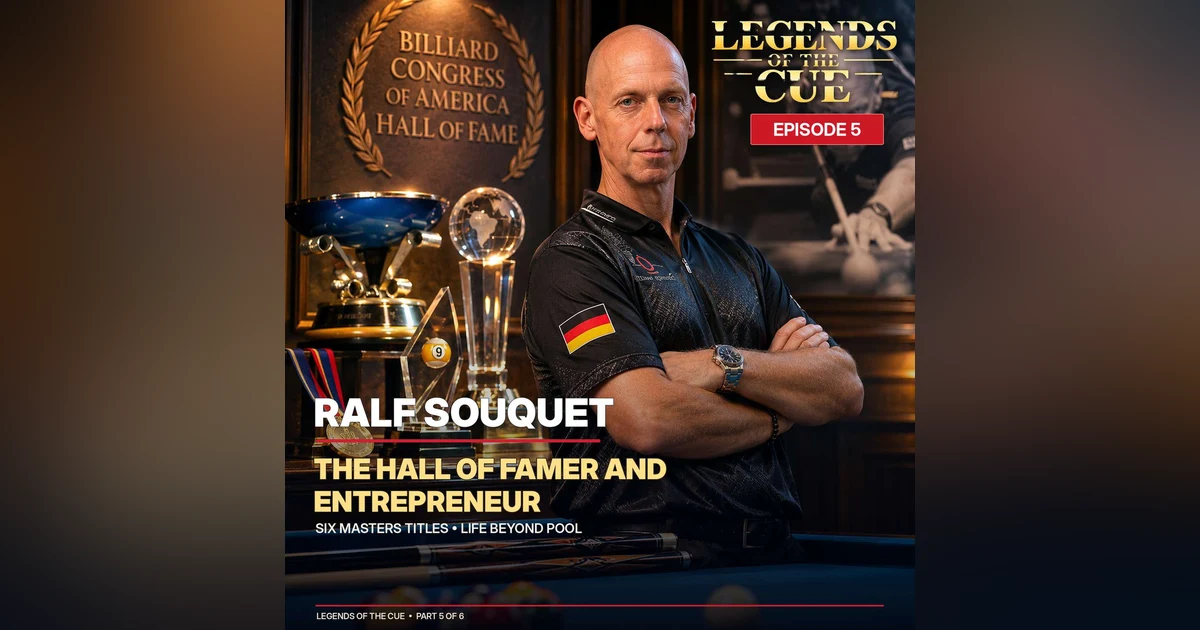

After decades of competing against the world's greatest pool players, what drives a champion to keep improving—and how does he prepare for life beyond the tournament arena? In Part 5 of our Legends of the Cue interview, Ralf "The Kaiser" Souquet reflects on his induction into the Billiard Congress of America Hall of Fame in 2011 and the remarkable achievements that cemented his place among professional pool's all-time greats. Ralf shares memories of entering the Hall of Fame alongside the col...
Key Takeaways
- In Part 5 of Legends of the Cue, Ralf 'The Kaiser' Souquet reflects on his 2011 induction into the Billiard Congress of America Hall of Fame alongside Danny DiLiberto.
- Souquet discusses the secrets behind winning his record sixth World Pool Masters title and partnering with Thorsten Hohmann to capture the World Cup of Pool.
- The conversation highlights the evolution of pool equipment, including Souquet's transition to low-deflection shafts and the development of his own Kaiser cue tips and carbon-fiber shafts.
- Souquet shares insights on the demanding training standards of younger generations and why proper fundamentals are essential for long-term success in professional cue sports.
- Looking toward the future, Souquet discusses his experience captaining Team Rest of the World in the 2026 Reyes Cup and managing a roster of international rivals.
After decades of competing against the world's greatest pool players, what drives a champion to keep improving—and how does he prepare for life beyond the tournament arena?
In Part 5 of our Legends of the Cue interview, Ralf "The Kaiser" Souquet reflects on his induction into the Billiard Congress of America Hall of Fame in 2011 and the remarkable achievements that cemented his place among professional pool's all-time greats.
Ralf shares memories of entering the Hall of Fame alongside the colorful Danny DiLiberto, winning his record sixth World Pool Masters title, and partnering with fellow German champion Thorsten Hohmann to capture the 2011 World Cup of Pool. He also remembers heartbreaking defeats against Filipino legends Efren Reyes and Francisco Bustamante before passionate Manila audiences.
The conversation explores the challenges of competitive longevity, including his 17th Mosconi Cup appearance in 2017, changes in pool equipment, modern coaching techniques, and the extraordinary training standards of today's younger players.
Ralf also opens up about business investments that didn't work, the development of his own Kaiser cue tips, and his experiments with carbon-fiber shafts and new playing equipment.
Finally, we discover how Matchroom approached him about captaining Team Rest of the World in the 2026 Reyes Cup—and the difficult decisions involved in selecting a team of international superstars.
Join Mike Gonzalez, Mark Wilson, and Allison Fisher for a revealing look at reinvention, competitive excellence, and the next chapter in a legendary billiards career.
Give Allison, Mark & Mike some feedback via Text.
Follow our show and/or leave a review/rating on:
Our website: https://www.legendsofthecue.com
YouTube: www.youtube.com/@LegendsoftheCue-MLG
Apple Podcasts: https://podcasts.apple.com/us/podcast/legends-of-the-cue/id1820520463
Spotify: https://open.spotify.com/show/4Za0IMh2SeNaWEGUHaVcy1
Music by Lyrium.
About
"Legends of the Cue" is a cue sports history podcast featuring interviews with influential figures from across the world of cue sports—including pocket billiards, snooker, and carom disciplines such as three-cushion billiards. We highlight the people, places, and moments that have shaped the game—celebrating iconic players, memorable events, historic venues, and the brands that helped define generations of play. With a focus on the positive spirit of the sport, our goal is to create a rich, engaging, and timeless archive of stories that fans can enjoy now and for years to come.
Co-hosted by WPA and BCA Hall of Fame member Allison Fisher and Mosconi Cup player and captain Mark Wilson, Legends of the Cue brings these stories to life—told in the voices of the game’s greatest figures.
Join A...
Frequently Asked Questions
When was Ralf Souquet inducted into the BCA Hall of Fame?
Ralf Souquet was inducted into the Billiard Congress of America Hall of Fame in 2011, entering alongside fellow cue sports legend Danny DiLiberto.
How many World Pool Masters titles has Ralf Souquet won?
Ralf Souquet has won a record six World Pool Masters titles throughout his illustrious professional pool career.
What are Kaiser cue tips?
Kaiser cue tips are a specialized line of eight-layer pigskin billiard tips developed and tested by Ralf Souquet to offer players high consistency and performance.
What role did Ralf Souquet take on for the Reyes Cup?
Ralf Souquet served as the non-playing captain for Team Rest of the World in the Reyes Cup, bringing together top international players to compete.
Well, we talked about what came the following year after that 2008 World Eight Ball Championship. That of course playing for Germany in the World Games and you bringing home the gold. But it wasn't too long thereafter that uh several other good things happened in your career. Let's take you back to 2011. You got the call to the hall, the BCA Hall of Fame. Where were you when you heard about that, got that news for the first time?
Ralf SouquetIt's a very good question. I don't even remember. I I do remember that there were talks of uh getting inducted the year before already. Um but then like last second, uh Francisco Bustamante, he won the World Nine Ball Championships in Doha. And with this title that he did not or yeah, had hadn't achieved by then, that put him just slightly in in front of me. So instead of being inducted in 010 already, it happened in uh a year later, which was okay, but uh but I don't really remember where I got the news, if I was in the States somewhere or back home, that I don't recall, to be honest. Yeah. Because it was also a a year that was uh pretty busy and successful, yeah. Because in in that year I also won my last uh World Pool Masters title, which was in Manila in the Philippines, which also was my very first title that I won in the Philippines. That that took me quite a few years to be successful there. I I was in some finals before, yeah, and it was the sixth master's title against Dennis Ocolo again on his home soil, and uh and yeah, five years after losing to Alcano in Manila, and in between I had a few other opportunities where I fell short like a little bit, and uh and finally I won the master's title there against Ocolo, and then a few days later in the same arena, uh we won uh with the doubles with Torsten Home in the World Cup of Pool there, where we lost in the finals like in 2009 against uh Bustamante and Reyes as well, leading 9-5, going to 11 in the finals, and already looking as I mean, already having at least one hand on the trophy and uh that was still one of the greatest moments of my career, even though we lost in the finals. But playing against Boosty and Efren in the finals and with an absolutely amazing, crazy crowd in a shopping mall in in Manila with yeah, again, 2,000 people completely going nuts there. Yeah, but it it's a memory that will yeah, will always be there, even though we lost.
Allison FisherYeah, yeah, that's wonderful. So, what made you and Thorsten such an effective doubles team in the World Cup of Poor when you finally did get over that one?
Ralf SouquetI don't know exactly. I mean, we have I would say similar playing styles and also thoughts, how we play the game. Thorsten himself is a good eight-ball player, you know, and uh I don't think it has anything to do with that I was his hero when he was young, even though he he mentions it all the time. But uh yeah, it's just we we gel pretty good when we we play in doubles because you know we have just uh uh very uh similar approaches seeing the table and and going to the table, and that makes it a lot easier than if you have completely opposite styles trying to partner up.
Allison FisherYeah, that's a great partnership. Two chimps.
Mark WilsonSix masters titles span different stages of your career, what kept working for you?
Ralf SouquetI don't really I don't really know. I mean, especially the format. I think every single time when I or when I won the event, it was a different format. It was a different race. Uh we played longer sets, shorter sets, two out of three sets, race to four. I mean, it was everything. So it was never actually the same format throughout all these years. So I don't even know what the what the secret is. I just, you know, liked this event for whatever reason. But the the funny part is whenever I had won it, the following year the defending champion opens up the the next event. So you play on a brand new cloth that has not broken in, where the referee has not wrecked uh the wreck once before. I lost, I believe, every single time coming in as the defending champion afterwards. So I I don't only have good memories about it, and I don't really know why it it worked out my way, but uh yeah, for some reason I seem to like the format. Yeah. Yeah. But I don't know the secrets, you know. It's just yeah.
Mike GonzalezSo going back to your uh the induction ceremony for the BC Hall of Fame in 2011. Who else was able to be there to share that moment with you?
Ralf SouquetUm well Denny DiLoberdo got inducted. Uh I think it was just him and me. Am I missing one?
Mike GonzalezI would have loved to have heard that speech.
Ralf SouquetNo, I think it was only Denny, Denny, and and myself. Yeah, only the two of us who got inducted. And um yeah, I mean it was, you know, Denny. I I really loved him. I mean, I've never really seen him in his prime as a player. I've seen him playing, but he was uh no longer in his prime. But he was one of the greatest characters in the game, and definitely one of the also best commentators in the game, too, because he was so knowledgeable and and had so many inside info about players and and so many stories to tell over all those years. And uh Yeah, and and funny, uh, or you know, just recently when we played a WNT event in Arizona in in Phoenix, I uh got to meet his daughter. And and we had a pretty nice chat, you know, in in that tournament for quite a long time. So I got to meet her and uh and she told some some stories about him and and how Danny talked about me, and and so yeah, it was was just great, you know. It was was great to to be inducted alongside him. Yeah. In in Chesapeake, I believe it was, yeah.
Mike GonzalezWell, Mark, jumping ahead to 2017, Ralph returned to the Mosconi Cup team for his 17th appearance.
Mark WilsonWhat did you change to keep competing against younger generations?
Ralf SouquetWell, obviously I I didn't change anything, but uh I try to go with the flow. I mean, you know, through all the time, you know, if you have the pockets were changed and you have new equipment getting along. I mean, I I started playing kind of late with the predator equipment back in 2007. So I have to go back a little bit. Uh and it took me yeah, quite I don't know, four, five, six months to get used to the low deflection shafts, even though my excuse me, my my back then uh Joss shafts were kind of on the lower deflection side because they were trimmed down from an original 13 millimeters to like 11.78, whatever it was, and with a a thinner diameter, you know, the the deflection also was a bit lower. So it wasn't like completely new to me when I started playing with the predator shafts, but it was still different because all of a sudden the outside English shuts or the running English huts, they were different than before, so now I had to aim fuller. And on the inside English, I could basically aim just where I wanted to hit it as if I was aiming without English. And that was something that took me a few months to get used to, but you know, uh but overall it it was a little better than the more deflection uh yeah standard shafts, so to speak. So that's I I I I basically fell into that as well, so I always tried to adopt somehow and and go along with the flow or with the new things that uh you know get into the market. Um yeah, I've I've never really had a coach that that I worked with, aside from Horus Fondenov and Jimmy Rampey for little periods. And that actually started a bit later in my career, and I would say like two, three years ago, when I actually started with a with the former German coach, Andreas Huber, working a bit because I I realized that I developed a few bad habits over the years, and I wanted to get rid of them again, which I still haven't achieved completely yet, and so I'm still working on that. But up to that point I've never really worked with a coach properly. We did have some coaches when I was still in the German national squad, but it was not really like working on technique or anything, it was more like you know getting prepared for the next event or you know, just doing some exercises. But I wanted to work on my technique again, which I know is not like I don't have the the hundred percent fundamentals like some of the new generation players nowadays, because they've been brought up from the very first minute like this. So they are almost like robots when you see the new generation playing, you you hardly see any any freestyle like a Bustamante or Keith McCready or Alan Hopkins and and all those guys, or Oliver Orman sideways, and Norbert Lange back in the days, also a great German player that died way too young, also with the sidearm. So those players you don't see anymore. They're no longer existing, you know. Yeah. At least not in in Germany or Europe. They might be still existing in the States somewhere because you know there is there's a less, I'm not saying there's less cons uh the the whole um the whole federation setup is is different there. You do have leaks, but on an amateur side and you only play on bar tables. Yeah. I I don't think that there are any leaks existing playing on a on a big table with you know proper teams where professionals actually also join the teams. And that's something that is in in my opinion missing.
Mike GonzalezYeah, definitely. Well, you know, as you bring that up, uh, why don't you just opine a bit on the state of European professional pool, how it's evolved from the days of Allison Fisher and Eva Mataya and Kieran Kor and Gerda and players like that to today's crop of young players and how they stack up now against the rest of the world?
Ralf SouquetI mean, it's it's not getting easier for them because especially the the Asian players are so super strong, no matter if they're from China or from Taiwan. And there were there were times when Allison was dominating, when Karen Corr was dominating, when uh Eva, when she first came over from Sweden to the States, when when they were dominating, or some of the other American women. But at some points, you know, the the Asian players, they they started their program. They had coaches that drilled their players for like 10-12 hours every day, and they set up the same shots, I heard a thousand times, and then not they don't leave the pool room or wherever they practice at until the uh potting percentage is, I don't know, let's say 90%, you know. But that's in their mentality. I don't think you could do that, not even to a European player, but we do have coaches that work with younger women or younger male students, and those players are brought up properly, you know. They they get the technique practice right out of the gate, so their fundamentals are 110%, I would say, and to build up on that is much easier than when you are a wild stroker that you know that that might look fancier or you get maybe get a little more power out of certain shots, but in the long run you are also you also have the danger of making a mistake or not hitting the cue ball where you actually want to hit it. With good mechanics or with good fundamentals, it's a lot easier to to build up on. And that's that's the big difference from of course again, you know, Allison and all the other snooker players that uh you know came along and started playing pool, their fundamentals were already great because in snooker you have to have great fundamentals, otherwise you're useless. You're not gonna make it far. So that was a a huge advantage for them. And that's something that the pool playing society had to learn, you know. Yeah. And that's what I I never I mean, I I'm a I'm a a street player, so to speak, you know.
Allison FisherI Well, it's interesting that you're saying you're starting you know getting lessons now from Andreas. And with that, how often would you see him and what sort of things does he work on with you? I'm just curious because it you know to do this at your age is quite admirable.
Ralf SouquetNot not often enough, obviously, because I I travel so much and then he's also busy with other stuff. So there were times in the last couple of years where I was there like three, four times a week for a couple of hours or so.
Allison FisherYeah. Yeah, that's great. Do you still want to work on it? You know, do you have to really to compete?
Ralf SouquetAnd but but but the thing is he he doesn't have the time to let's say travel with me, and it's also obviously you can't see you in person. Yeah, it's also a financial thing because when you're playing in an event, it would be much better to have someone there. And and he was actually there as the German coach when I won the the World Games Gold Medal 2009. So we had worked together back then a little bit. So and and that's helped a lot too, you know. Yeah.
Mike GonzalezRalph, at some point you began uh the transition from just playing pool to getting into some business ventures as well. Tell us a little bit about some of the things that uh you have been or are into.
Ralf SouquetWell, I mean, I've I've tried several things over the years. Um, obviously knowing that when you get older, you know, the the chances of winning events uh are getting you know smaller and smaller. On top of that, uh sponsors, you know, usually are signing the hot players that are up and coming. So it's also more difficult to pick up uh a sponsor after losing you know one of the or or two of the bigger ones that I had over many, many years. That includes Simenus. Um so uh yeah, so I I had some ideas. I invested into a pool hall once that didn't do too good, so I I lost some money there. I went to the stock market that didn't do much good either. So uh so I've I've actually burned some money already along the way. We all have um so at some point I said, yeah, um, you know, it's it's really really difficult to find a good tip or a very consistent good tip. And I had the opportunity because I I found someone that's uh you know helped me financially a little bit and invested uh into my projects. So I you know started my own Kaiser tips. They are on the market two years already, but again, um I haven't done much uh advertising with it because I was still you know working on the actual products. I was I wasn't happy right out of the gate, so it took a while, so it takes a lot of time testing and this and that, and then you have to ask other players too, or other people try it out, and but at some point, you know, it's I I need to put in or invest some money into the marketing because that's that's the only thing where you can get your product known. So uh, and that's basically the the fact that I'm missing. But the product itself, I love it. I'm I'm super happy with it, and I haven't heard I would say out of a hundred feedbacks, I might have gotten one just so-and-so feedback. That was not like I mean he wasn't unhappy, but he wasn't 100% happy because he thought that the chalk didn't hold on to the surface quite good. I said, well, you know, um, as normally you need to scuff up your tip a little bit in order for the chalk to hold, because if you make a hundred shots and do draw shots, power shots follow through, and if you never scuff up your your tip, eventually you're gonna miskey, or the chalk is just has a hard time sticking to the to the tip, especially when the balls might be waxed or having some other polisher on it, because that polish from the ball will get to the surface of the tip, you know, and before you know it, you have like a ice tip where nothing holds to, you know.
Mike GonzalezYeah. So I've I've got a but yeah. I've gotta ask you this. Am I able to purchase a 50 millimeter Kaiser tip?
Ralf Souquet15 or 15? But no, you cannot.
Allison FisherYeah, well, how do you even come to the piece of red chalk?
Ralf SouquetNo, yeah, yeah. Uh red chalk is probably available. Uh no, actually, Tom doesn't have a red chalk, but they have a pink chalk, you know.
Allison FisherYeah, pink. You can have pink, which is yeah. But no. The chalk's probably about the size of the tip, though. That's the problem.
Ralf SouquetThe chalk is actually bigger. No, the the the tip was 15 millimeter, not 50. 15.
Mike GonzalezOh, gotcha, okay. I misunderstood much literally.
Ralf SouquetYeah, yeah. No, and and my tips uh are actually um there were supposed to be 13 and a half, but they turn out to be like third. I mean, there are officially 13 and a quarter. Because I I also wanted to have a different size. I didn't want to have a 14 or 13 millimeter because nowadays most diameters are below 13 to begin with. So I figured, you know, with uh 13 and a quarter or maybe 13 and a half, you know, you don't have to cut off as much. And uh it was a little trickier for the factory to, you know, because they had to make that tool, especially for me, in order to be able to make those tips. But yeah, yeah, it was doable and they did it. And uh yeah, the the the big difference, or I think it's the big difference from my tips to most other tips on the market is that I have two different colors. So I have uh a total of eight layers in the majority of my tips. So we have two, yeah, I call them brown beige bright layers on the bottom and six black layers on the top. But all the eight layers are actually out of pigskin. So you you could play all the way through if you wanted to, but my recommendation is that you change the tip as soon as you don't see any more black on the sides of the tip. So this is my my changing indicator.
Mike GonzalezYeah, yeah, and your differentiator from competition, I guess.
Ralf SouquetYeah, yeah, that too, yeah.
Mike GonzalezInteresting. Any other ventures that you found yourself into?
Ralf SouquetUm, I'm also you know working on a on a brake queue or a break jump queue. That is I'm I'm using it for over a year now, but the final product is not finished yet. And I'm also working on on an own carbon fiber shaft.
Mike GonzalezGotcha. Gotcha.
Ralf SouquetThat's I'm I actually started playing with in the Doha tournament a few weeks ago. I figured, you know, things are not going my way anyway, so why not just start playing with it here, you know?
Mike GonzalezYeah.
Ralf SouquetAnd uh because at some point you you need to start playing with it under pressure. I've I mean I I've been practicing with it for like three, four months, but not only. I'm always going back and forth between my wooden shaft, which is also a low deflection shaft by Arthur Qs, one of or the Cue sponsor that's that I have. But uh yeah, I I figured when I when I look at the the majority of the top pros playing, they're all playing with carbon fiber. Most of the shafts I don't like because they are way too noisy, way too pingy. That was something that always turned me down. That's why I never really found a shaft that I liked. Then there was one shaft that Howe produced that I kind of liked. It was more silent but I didn't like the taper because it was more of a caron taper. It became too fat too quick so it was not a pro taper. I liked the way it played and it felt and it sounded but you know that with playing with a closed bridge didn't do the job properly. So I was searching around and and then also Arthur started making their own uh carbon fiber shafts but not as or not to a point where I said I I liked them and then I had an o opportunity at a at a different place and now it's yeah a tiny little shoe maker a custom maker that is uh yeah he made a couple of shafts for me that I'm trying out and maybe we yeah maybe they they come on the market soon with a very very tiny small uh number of pieces per year.
Allison FisherWhat do you think about carbon versus wood? Because you've always played with wood, haven't you most of your career.
Ralf SouquetI mean the the advantage is you don't get any nicks in it. You don't have to deal with problems with uh high humidity when you travel the world because wood still is a living material. It still you know changes. Sometimes when you are let's say in Florida or somewhere in Asia I feel like the the shaft becomes thicker it like you know blows up and then when you get back home or go to Vegas where it's super dry then it shrinks again. And and those are things that obviously are not ideal but it's just the way it is and we we didn't know any better but with the carbon fiber it's just gonna stay the same all the time. It's not gonna get any nicks. The only problem is you cannot change the taper. With a wooden shaft you can always experiment when you say okay it starts at 12.5 you trim it down a bit gets 12.3 whatever and that's the the downside of it you know it's it's very hard to find the perfect taper with the perfect diameter that actually suits my game the best and you cannot have 12 different types of shafts on the market to please each and everyone. How about the way they hit well the one I have right now is super quiet is very silent. I mean if you would close your eyes and you play with a glove that is big enough you probably wouldn't know it that it is a carbon fiber shaft and that is something that I'm looking forward to. Not many companies were able to produce such a shaft. Now I've found one but you know we are in the final stages I'm I'm not 100% happy yet because I'm still missing a few shots too too many certain shots but it is much easier to uh I mean there's so much more power in it so you you just need way less effort to bring the cue ball around the table than with the with the wooden shafts you know and in some positions where I really have to work crazy hard to get around the table see the other guys just shooting easily and they get around and easy peasy you know and just and then I just don't want to have that disadvantage anymore.
Mike GonzalezThe power the power game so we'll keep our eyes open then for the Kaiser carbon when it comes to market. So we talked about at the top very briefly your opportunity most recently to captain as non-playing captain the rest of the world in the Reyes Cup with an opportunity to turn rivals into teammates.
Mark WilsonMark how did the Reyes Cup captaincy come about and uh what did you establish before the team arrived um well I had obviously a lot of headaches.
Ralf SouquetI mean I Emily from Metroom uh she had asked me after the Legends event which took place in January in Manila and yeah when you know the event was over we we sat back in the office and you know finished the financial part of the event and uh she basically said Earl was there and I was there. Earl obviously won the legends event so uh he said well I have two opportunities for you guys and first she she asked Earl she said Earl how would you like to play in the Premier League pool which happened I think like a couple of months later like in March in Orlando Florida and he wasn't really super happy when he heard the news but he said yeah let me think about it but I think eventually he turned it down because I don't think he he played it and uh Emily offered me uh to captain team rest of the world and I said right away yes why not you know and obviously back then already I started thinking hmm what what have I done here you know but obviously knowing or not knowing who's gonna make the team because you know it was just the beginning of the season and uh so you you don't really know what's what's coming and who's gonna qualify. The only thing I kind of knew was that it'd probably be at least two Americans if not three depending on the world rankings obviously you know because team rest of the world if there would have been let's say three Americans in the top five or so in the WT rankings then I assume Emily would have said at some point yeah you gotta choose three Americans and only two non-Americans. I'm not saying two Europeans it could have been some other players from South America or from Australia you know whoever is in in the rankings high enough so at at some point I don't know exactly when the first cut date was uh I think it was after the US Open I think after the US Open the first uh couple of players were basically qualified for the Rayers Cup which was the highest ranked American which was Shane because he had a very successful stretch in uh the three or four uh US events where he won the one in uh not the one in Phoenix the one before that the Arizona Open which was actually not even played in Arizona but it was called the Arizona Open so he won that event and he finished high in the in the other ones and uh also in the US Open he yeah he finished high so so he was the highest ranked American player and qualified and FSR obviously qualified winning the US Open you know so that put him on number one. So that's basically the first time when I started thinking a little bit more again because before that I didn't even know who could be on my team or who would be on my team. And even Metro never told me yeah it's got to be three Europeans and two Americans or whatever. So they they left it really open until the very last second and uh so I I didn't really know how to prepare. The only thing I knew was that I had to most likely get a team together that are normally rivals or will be rivals like five or six weeks later again when they face each other in the Mosconi Cup. So that was the the main task the fact that Federer was high in the rankings to being let's say a former European I mean he to me he is still a European even though he plays under the American flag and him knowing also from my home local team in Germany because he played one season in my team in Germany as well and knowing him also from Mosconi Cups even though I never played with him on the Mosconi Cup as a player because I think my my last was 2017 and his first Mosconi must have been 18 or 19 so it was past my Mosconi Cup time. But I knew him obviously before also because of Johan Roysink working with him as a junior player already because he you know they've they've been working for many many years in the past so it was his I would say main coach when he started to become a good player and so I yeah I've you know I've I've seen him and played him very very often also on in European championships and and events so I I knew it was not so difficult to get uh feder on my side even though he is now playing for the US side but knowing his background and knowing that he has worked with Joan for quite a while that made it a little easier um on the other side you know my my other wild card was uh Joshua which in my opinion was a no-brainer because to me he is the best player in the world for several years already because he's the most talented player on the planet he is one of the hardest workers on top of it which makes him so successful. I mean there are so many talents that I've seen over all those years but they were all lazy and not willing to put in the work. And then on the other hand you have the hard workers that don't have a lot of talent so they also are only good up to a certain point. But then you have a player like Josh who is yeah just yeah outstanding and an absolute individual that is hard to compare. It's like a Michael Jordan of basketball or maybe a Tiger Woods in golf and and I don't know you know some other uh sports people from from other sports but but he's just like a yeah Ronnie O'Sullivan and Snooker very good example too when we talk about Cue Sports or uh Raymond Coleman's in in three cushion yeah it's just something different that that separates him from from all the other players you know he's I don't know what it is but he's certainly different. You know he's great talent uh big hunger and actually yeah loves to work and and and loves to get better every day and and every minute you know and and that's what it takes to become a a great champion. And obviously it it helps a lot if you are a big talent on top of that and if you have that combination that's hard to beat.
Allison FisherVery dangerous thank you for listening to another episode of Legends of the Cue. If you like what you hear wherever you listen to your podcast including Apple and Spotify please follow subscribe and spread the word give our podcast a five star rating and share your thoughts visit our website and support our Paul History project. Until our next golden break with more Legends of the queue so long everybody