

 Apple Podcasts
 Spotify
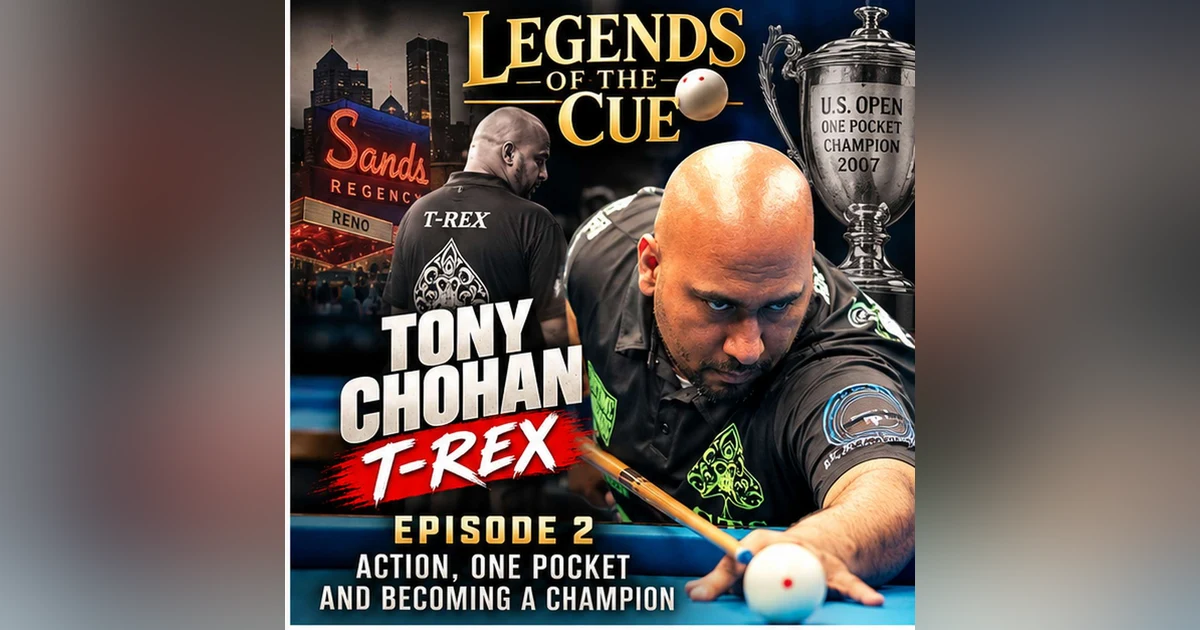
 Tony Chohan - Part 2 (Action, One Pocket and Becoming a Champion)

Key Takeaways
- Playing pool with something at stake, even a small amount like $10 or a hot dog, creates the pressure needed to sharpen mental focus and make players care about their mistakes.
- Tony Chohan earned his famous nickname "T-Rex" because a childhood friend joked that he had deep pockets with short arms.
- One Pocket is regarded as the chess game of pool, emphasizing extreme cue-ball control, risk management, and the reality that there are multiple correct strategic shots.
- The 2007 U.S. Open One Pocket Championship victory became deeply personal and emotional for Chohan because his grandmother passed away on the first day of the tournament.
- Constant high-level competition and action are vital for elite players to stay sharp, as formal practice alone cannot replicate the intensity of playing in the heat of battle.
How does a talented young pool player become one of the most fearless gamblers and creative One Pocket players of his generation?
In Part 2 of Legends of the Cue’s four-part interview with Tony “T-Rex” Chohan, Tony explains what drew him to the action side of pool—and why he believes playing with something at stake helped sharpen his game. He remembers gambling for small amounts as a teenager, putting cues up when he went broke, watching serious action in Reno and learning through trial and error how to match up.
Tony also reveals the story behind the nickname “T-Rex,” reflects on colorful personalities like Keith McCready, and explains why One Pocket became the perfect game for his mind. He breaks down the strategic beauty of One Pocket, the importance of cue-ball control, risk versus reward and why he believes there is often more than one correct shot.
The conversation then moves into Tony’s emergence as an elite player. He discusses Dennis Orcollo, his desire for constant competition and the pressure that keeps his game sharp.
The segment culminates with Tony recalling his breakthrough 2007 U.S. Open One Pocket Championship, a victory made deeply personal by the death of his grandmother during the tournament.
Then, just as his career seemed ready to take off, Tony’s life changed dramatically in 2009.
A candid episode about gambling, competition, One Pocket strategy, sacrifice and the making of T-Rex.
Give Allison, Mark & Mike some feedback via Text.
Follow our show and/or leave a review/rating on:
Our website: https://www.legendsofthecue.com
YouTube: www.youtube.com/@LegendsoftheCue-MLG
Apple Podcasts: https://podcasts.apple.com/us/podcast/legends-of-the-cue/id1820520463
Spotify: https://open.spotify.com/show/4Za0IMh2SeNaWEGUHaVcy1
Music by Lyrium.
About
"Legends of the Cue" is a cue sports history podcast featuring interviews with influential figures from across the world of cue sports—including pocket billiards, snooker, and carom disciplines such as three-cushion billiards. We highlight the people, places, and moments that have shaped the game—celebrating iconic players, memorable events, historic venues, and the brands that helped define generations of play. With a focus on the positive spirit of the sport, our goal is to create a rich, engaging, and timeless archive of stories that fans can enjoy now and for years to come.
Co-hosted by WPA and BCA Hall of Fame member Allison Fisher and Mosconi Cup player and captain Mark Wilson, Legends of the Cue brings these stories to life—told in the voices of the game’s greatest figures.
Join A...
Frequently Asked Questions
How did Tony Chohan get the nickname T-Rex?
The nickname came from a childhood friend who joked that Tony had deep pockets with short arms.
What makes One Pocket a unique and popular game in cue sports?
One Pocket is often compared to chess on a pool table, where each player targets a specific corner pocket, making it a game of high strategy, cue-ball control, and flexible risk-reward decisions.
Why does Tony Chohan believe gambling improves a pool player?
Chohan believes that putting something on the line introduces necessary pressure and emotional stakes, forcing players to care about missed shots and accelerating their improvement far more than repetitive, pressure-free practice.
As you started playing pool, what was it that sort of hooked you on the game? I mean, I know Amar was very influential and so forth. And then probably more importantly, as your story develops here, what hooked you on the action side of things?
Tony ChohanI mean, just the fact that you could go in the pool room and you could actually play $50, $100 sets all the time and 10. You know, like as a kid, I mean, a $100 set was kind of big, let's say, right? Back then. But like I would try to play for 10 in time, 20 in time, all the time. Like people don't even know how to play for that anymore. Like people don't even talk about 20 in time or 10 in time anymore. And I'm thinking to myself, like, man, and then there's people that'll say they don't want to gamble at all. I'm like, well, go play for a hot dog or something, buddy. Like, are you gonna get mad if you lose a hot dog? As long as you get mad at something, like go buy your whoever you're playing, go play someone for a hot dog. If you if you can't stand to lose $10 or $20, can you stand to lose a hot dog? You stand to lose something, stand to lose your 10 push-ups, stand to lose whatever. I don't know, stand to lose what you can stand to lose, but put something on the line to make yourself um feel the heat and be mad at yourself when you do miss a ball, let's say, right? Because people don't realize, though, and I tell people that all the time, is like if you're gonna if you're gonna play pool and you want to become better, how do you become better? You don't become better because you're sitting there practicing it and hitting a million balls. Hitting a million balls doesn't isn't gonna make you a better player. If you don't understand what you're doing and why you're doing it, then how could you ever come become better? You can't. You gotta understand how left-hand English works. You gotta understand extreme left-hand English. You get everybody, every time I do a lesson, it's always like they use left-hand English. I'm like, well, use extreme left-hand English. Well, when they go to extreme left-hand English, they go one tip from center ball. I'm like, that's not extreme left-hand English, buddy. Like, that's not even close. Like, you need to understand that extreme means that I want you to almost miss that cue ball. I want you to act like you're gonna not even hit that cue ball because that's when you really understand. You know what? I never really understood that for a while in the very beginning, either, right? And then one day I was playing somebody, and I was probably 18 years old or something at the time, but I seen a guy, and I was playing a guy in LA at the time, and we weren't down there for like a handicap turn. But anyways, I was in Hollywood Billiards in LA, and I was playing a guy $100 set or $200 set or whatever, a nine ball at the time. And when he shot at a ball, every time he stroked on the ball, it looked like he was never gonna hit the ball. And I mean, every time. It was like he aimed at air. It wasn't even aiming at the side of the cue ball, he was aiming at air. And then when he actually hit the ball, I was like, how does he even like how are you even making contact? You know what I mean? So then I started to think about it. I was like, well, maybe I'm not gonna do it to that extremes, but let's start figuring this out. Like, what is going on here? And he was a good player. Uh and here's the funny part. The guy looked like he was a bum and could play. You know, and uh and and I mean, literally, uh it was an older black guy, and I'd never thought I never heard nothing of him, never thought that he could play. I just figured he was just I figured he had to be able to play because people he was willing to bet $100, let's say, right, at the end of the day. But in my in my mind, I'm thinking to myself, Mike, I don't know this guy. I mean, I'm got I gotta play him, right? You know what I mean, regardless. So it was just I always tested myself whether it'd be something for whatever I could afford, let's say, right? To an extent. Right. I mean, I don't know how many cues I lost as a kid. I put up my cues every time I bought a cue, I put it up. I'd be like, hey, you want to play? Let's play set for this cue. Okay. Hey, I'd have a Tim Scruggs sneaky peat or Tim Scruggs uh uh Merry Widow. I I listen, we had this we had this green stained bird's eye maple uh scrubs cue that switched four people in our same in our in our area's hands because we would all lose it to each other. When we got broke, we'd all put it up. But it all it always hit good. Like it was like we all knew we wanted the queue regardless. But it was like when we got broke, we were we were gonna put it up no matter what. It just had to go. You know what I mean? It was like that was the last thing it goes, but it was like just one of those things. But no, it's just kind of uh pool was very fun. It's it's I guess you could say when the better you get, it becomes a job, and you kind of lose the lackluster of um you know, and that's why I kind of I mean I love pool and pool's giving me so much, and I can never forgive that or or take that for granted, you know what I mean. But at the end of the day, there's very few people also have to understand there's very few people that are gonna be successful at pool and make um make a living from pool. You have to still have to, I think uh as a kid, they would always say, Oh, well, if you were born and uh 20 years ago, you'd be a millionaire today. I said, Well, I'm not. I wasn't born 20 years ago, I'm born now, and you guys keep telling me about how pool's gonna get better. Well, let's just put it this way. We've had the same conversation for 40 years now, and it still hasn't really gotten that much better, really, realistically.
Allison FisherAbout 16, you went to Reno and won a USPPA handicap event. What do you remember about the trip and what did it do for your confidence?
Tony ChohanSo the Reno Open and the Reno USPPA used to happen every six months at the Sands Regency. It was the best event in the world. Why? Because the room the rooms were cheap, the entry fees were cheap, there was lots of people. Uh you know, just back then it was like the rooms, you could get the rooms for $20 to $40 a night, right? Well, you're that's unheard of anymore, right? The entry fee for the tournament was $100. Um, $12,000, I think, added or $22,000 added to the event. First place in the tournament always paid like $10,000 in the open. Uh the USPPA event paid about three or four thousand for first, let's say. So going along with the USPPA, that was the handicapped version of it, right? And it was kind of like that was my one of my first, let's say, uh good-sized wins or whatever. And you know, it just kind of showed that the the work that I put in for a year and a half or two years kind of like finally started to work out, right? You know, and I could see the the payoff as far as me getting better and playing better. So once that started to happen and I'm already in that phase, let's say I'm already all in and now I don't see nothing else. You know, I don't have no other anything else in my future because now I'm really hooked on pool and I want to play pool. I mean, you've never seen somebody come into pool and be able to leave pool. It just doesn't happen, right? So let's say once they get in the pool world or come into a pool and they're in there for a good week and they're hooked, they're never leaving pool again. It's just kind of you might leave, but you're coming back at some point, regardless. It's just one of those things. But uh yeah, I mean the USPPA kind of helped me to uh mold myself in a way from handicapped versions, let's say. Um, you know, like I said, I was as low as a a 25 speed when I was first started, and I might have gotten as high as a hundred and twenty or a hundred and thirty before it kind of dissolved, let's say, right? So but it was fun because there was always a weekly tournament two, three times a week somewhere in the area. Um, there was always monthly uh good size added money, let's say 1,500, 2,000 added events all the time. And it was something you don't you can't even get a 15. I mean, that's what showed that's what's shocks me. You can't even find 1500, 2000 added events on a regular basis nowadays. But back then they were doing it. And listen, in California, it's a lot tougher to get uh added money. And guess what? They're they were doing it. And so I come out here and then I see some events they're willing to only add 500 or a thousand bucks. I'm like, dang, man, like and then you want people to show up. So it's kind of became in my eyes, I'm like, you know, I gotta think twice about like I just bite my lip on certain things, right?
Mike GonzalezSo you know it it it is interesting though, guys, when you when you start thinking about the different regional cultures of pool around the country. You know, Mark, you were a traveler, you know that very well. Tony, you know that very well. Allie, I think you've been exposed to it somewhat. The different games, different, different uh customs, different ways of betting. Uh as you said, Tony, even different types of tables you're playing on, depending on where you are in the country. It just fascinates me.
Tony ChohanYeah, because I mean I mean, obviously when I grew up, Diamond wasn't even around, right? So, you know, we all played on gold crowns, obviously, right? So it was just kind of, you know, it was either a gold crown or it was a Olhausen or a Connolly or a Gandhi or a Redco or something like that, uh, when I grew up, let's say. But I mean over time I can say that um just the fact of playing and being in the heat of battle and stuff, and you know, like we go to Reno, you know, I would stay in action playing people all night long. So it was kind of like it was just a you would always see eight or ten tables in action all the time, you know what I mean? It was like people playing for a hundred to five hundred dollars all the time. And when I was a kid and first going to Reno, I mean I used to see like uh Ronnie Wiseman, you know, which were friends and stuff. So Ronnie would come up there and eventually first couple years, you know, he was just too good. I wasn't that good of a player, so I would just watch some guys get in action, but I would watch some guys playing um high-stakes matches, and I'm thinking to myself, man, you you ain't don't never see nothing like this. You know, they're betting three to five hundred a game nine ball. And and it was uh him and a guy from Hawaii, and I was like, I was like, dang, man, right? So they're betting three, five hundred a game nine ball all night long. So I kind of got to watch some real action, you know what I mean? Because hell, I never saw that much uh action in my life at that time, right? That's a good size bet even until this day, right? So it's kind of like it's just um I kind of got exposed to the the gambling side, and let's just say I never turned back and I was seeing the benefits of it more than I've seen the the lackluster of it, right?
Mike GonzalezYeah, well I think you know, by your late teens, early twenties, you were appearing in significant tournaments, you were developing the action reputation that uh became central to your identity. I think most of our listeners would like to understand the genesis of T-Rex. Where'd that come from?
Tony ChohanUh just a childhood friend, like basically so really the the name T-Rex came from he'd say he'd say you got uh long pockets with short arms, right?
Mike GonzalezDeep pockets, short arms, right?
Tony ChohanYeah, that's pretty much how it kind of came about, and it just kind of stuck with it. So I was like, all right, well, we'll just use it. You know what I mean?
Mike GonzalezSo yeah, you want the other guy reaching in their pockets anyway, but I like that.
Tony ChohanYeah. So it was just I liked it. Yeah, instead of being called the knit, I guess I'd just say uh they would call me Ts in a way, right?
Mike GonzalezSo you know, the first time I heard the knit was when we were interviewing Keith McCready. Yeah, and Keith. Did he come up your way occasionally?
Tony ChohanYeah, so Keith, you know, he's in LA or whatever, but he would come up to Sacramento. Um and we would hang out with him and stuff, and just kind of but he was just he was that he was that guy, you know what I mean? He just he was just funny, the sayings were funny, everything he did was funny, it was just funny just to be around. You know, you just don't have characters like that anymore, really. Like the old school characters are something that the pool world is dying of and it's not probably will never get it again, honestly. Like everybody wants to be so uh they might as well just think that they're wearing tuxedos and just they're they're not allowed to speak or something. You know what I mean? So it's kind of like you know, like watching Earl yesterday beat Kachi and then doing the even though it's Earl and Earl's crazy, but I love you know what I mean. I think it's better than anything. You know what I mean? Yeah. And I mean it's just what it is. I mean, it's you know, hair. You need that emotion, you need people to act like that. You don't want to see these robots. Man, these robots aren't what's uh what it what pool's about. I mean, if you win money and in and you're happy, you should go do cartwheels if you can, you know what I mean? Or you should you know you should do jumping jacks, whatever. I don't care, but you should show your emotion somewhat, right? And it's good to show the emotion once in a while. And especially I mean, there's humbling wins and then there's wins that bring out the emotion. I've had a few of those, and and some most of the time I'm kind of humble and I don't really make too much of a noise, and then there's a couple times where I was you know really happy and kind of you could see a little bit more. I never got really crazy with my uh antics, but I'm just saying what I mean. But to an extent, when you do actually win and it means something, you're gonna see you know.
Mike GonzalezYeah, Darren Appleton described it as on occasion I did go mental.
Allison FisherYes, exactly. Lost it and then it's fun, it's fun.
Tony ChohanAnd then I seen something about his yesterday also, so it was like about the chalk thing or whatever.
Mark WilsonLike Yeah. Yeah, that's what it is. Well, it's the same thing. It's that uh personality comes out, and uh, you know, when you get in combat and things irritate you and you got your heart on it, it's uh it hurts. And so uh I I didn't think he was out of line.
Tony ChohanThat it was just No, I don't believe he was out of line. I just think he was just showing you just Listen, I mean, we're not gonna be church mouses playing pool. I don't think anybody can ever be like, you know, I just think that they need to understand that there's gonna be emotion. I mean in golf, I think they show it a little bit here and there too. Maybe not quite as much, but it still happens in all the bigger sports also. So it's like it's you know, if you don't have realness in there, then uh then the sport and people watching don't really feel, you know what I mean?
Mark WilsonSo it's kind of like who who taught you how to match up rather than simply how to play?
Tony ChohanMatching up was kind of a thing that just happened over a period of time. I was probably one of the worst matchup uh people to match up at first. I mean, trust me, there was a lot of losses along the way before I ever made money, right? I mean, I was the guy that they were looking for when I went in the pool room. So when I went in the pool room, I I had the Walt Williams, uh, I don't know if you guys know who Walt Williams a basketball player was, but I'd wear the socks all the way to my knees, right? I'd wear the jazzball shorts with the knee with the when I was a kid, you know, they they knew if I had a bankroll, I didn't have pockets in my shorts, right? Because they're jersey shorts or whatever, let's say, right? So I would put my money in my sock by my shoe, and they would know to just look at my ankles or something to see if there's a bulls or not. Yeah, so like when I come in, I would just have it kind of twirled. You know, if I had a thousand dollars, it may not look like much, but it might have been just ten one hundred dollar bills, you know, in my in my sock or whatever. But it was just you know, that's just how I was when I was a kid because if I didn't have no pockets, I was gonna put my money in there, you know.
Mike GonzalezT T Rex is coming in with big ankles. I think we we we gotta get him tonight.
Tony ChohanOh yeah.
Mike GonzalezHe's flush.
Allison FisherSo when did one pocket become your game and what did you see in it that suited the way your mind worked?
Tony ChohanSo once I started going to like great American billiards more, I would see Monk being in action all the time, and I would see other people gambling all the time. There was four or five tables always in action playing with all these balls. So every time I walk in there, I was thinking they're playing eight ball or something because there's all these balls on the table. Eventually I started to realize, no, this isn't eight ball, this is one pocket. So now I'm starting to realize. So I would watch somebody like miss a ball all the time or barely hit a ball, and I was like, man, they suck. You know what I mean? So I'm like, they suck, right? So then I started to realize no, that's the point of the game. So now I got interest in it. I saw them betting decent size money. And here's the thing, you couldn't go into a pool room and really play people nine ball, right? It just doesn't happen, you know, because there's nine ball is just a far variance between players, let's say, and it's hard to spot. People don't really know a spot really doesn't matter majority of the time when you're spotting people that are lesser, let's say, right? So it's kind of like one pocket's a game you can always go to any pool room in the country and you can get a game and handicap it to an extent and still play it for some kind of amount of money. And that's the beauty of it, right? Like that's the beauty of One Pocket is that you can go anywhere and you can get an action. And that's what it's the only game that anybody's ever gonna give you action at, realistically, because they can make it a little more fair.
Mike GonzalezExplain the game of One Pocket to our listeners, uh, many of whom have probably not played the game much, don't even know the rules. Uh just give us a little inside baseball on the game and and some of the tricks to the trade.
Tony ChohanOkay, well, one of the easiest ways, I'm gonna just give myself a shot out here. You can go to shop.game tight onepocket.com and you can order the book that I just put out there. It's got QR codes and everything, and you'll get to see me live shooting shots, and it also tells you about the game and how to uh learn to play the game and learning certain shots and stuff. But realistically, one pocket is a game of chess on a pool table. Each person gets one corner pocket on the same side of the table, and you're basically trying to play safe and not sell out a shot, a bank at the other person's hole. You're just trying to play high, you're you're trying to play offense, defense at the same time if you can. If not, most of the time you're gonna be playing defense with the cue ball. But this is kind of a game that helps people with their cue ball control a lot, right? Because there's certain touchy shots, there's certain ways to, you know, certain speeds that you're gonna shoot. It it makes you learn the angles coming off of balls, how to play safe easier, how to use extreme Englishes, uh less English, you know, just learning angles and learning patterns of how to move the cue ball at the easiest pace.
Mike GonzalezI suspect there's a whole lot of risk reward decisions you're making throughout the game as well.
Tony Chohan100%. 100%. There's no wrong shot playing one pocket. That's the beauty of it. Right? There's no because so long as you don't sell out a shot, then it's not a wrong shot. So the difference is is there's no such thing as a wrong shot, right? So you get to put your own flavor on every time you shoot a shot. Just so long as the outcome is good for you after your opponent shoots, right?
Mike GonzalezSo do do do you want the break, Tony? Let's say you and your opponent are lagging, who wants to win the the the lag?
Tony ChohanThe the you want to win the Yeah, you 100% want to win the uh lag because you're getting to break the balls, and when you break, you're trying to hit the first and second um head string balls at the same time, using extreme English with inside extreme English and pushing through the stack. You're not shooting it really hard, you're just using a high inside or a low inside, but extreme. And it's helping just push the balls through the rack to push balls towards your hole, and you're trying to get the cue ball to go to the bottom rail and then come up towards about the second to third diamond being the highest on the long row.
Mike GonzalezSo so I mean it's it's uh uh I guess somewhat similar to a straight pull uh break in that you're in the kitchen with the cue ball. You got a full set of uh 15 balls queued up, and I as you said you come in sort of from the side, and then you're extreme inside English, first second ball, trying to bring it out uh end rail, side rail, and somewhere where you're hiding behind the pack so they got nothing to shoot, which if you're looking toward the end of the table, their their pockets then on the left and your pockets on the right if you're shooting to the left side of the back.
Tony ChohanYou just want a simultaneous uh in between the first and second. Because that's giving you the cleanest uh path of pushing balls towards your hole. Gotcha. Yeah. And also helping you to get the cue ball all the way through.
Mike GonzalezOkay. And and sometimes I guess you I mean you as Mark was trying to teach me, you're kind of you're trying to shove all that stuff down towards your pocket. I've seen you occasionally though move balls up table strategically uh as a way to kind of manage the game against your opponent.
Tony ChohanSo it just depends on your opponent. You know, you sometimes you want to play offensive and you don't want to push the balls up table. Sometimes it might be a better player and you want to uh you don't want to leave balls out in the open, so you kind of change your strategies and you push the balls up table. We call it the Nick Varner wedge in a way. You know, sometimes when you want to stick them all in one corner, that's one way of going up that way. And um do I want to play the slow game? No, but if I have to, I guess you sometimes the game speaks itself depending on the the layouts, let's say, right? So sometimes you have to and sometimes you don't have to.
Mike GonzalezYeah, yeah. Well, you had success as you kind of went into the new century. Uh you were a prominent one-pocket threat. Even before winning your first major, you beat Dennis Oracolo five to one in the 2006 Hardtime Summer Jamboree final and then won the U.S. Open one-pocket championship the following year. That had to be a thrill.
Tony ChohanYeah, I mean, you know, I kind of miss Dennis not being here because he was always competitive, and I enjoyed him being here. He brought uh action to the pool rooms and to the events, and also more Calcutta money because everybody would want to buy him. So, you know, people think that people used to tell me, Well, I bet you're happy that Dennis ain't isn't here. I said, No, I'm exactly the opposite. I'd rather him here. You know, I want the challenge. People don't realize, you know, once you get to a level like you get to a certain level, you have no more competition. Well, the heart of you is gone in a way, you know, and that's kind of where I'm standing now because I don't have nobody to play no more, right? I don't have no chance. Challenges. You know, I go and play people and give big spots and try to bet decent size amounts of money here and there, but the those are far and few between. I'm not getting to do that every week. I'm not getting to do that every month. That's like once every six months or a year, let's say, right? If I'm lucky, even then, that's not really what I'm looking for. I'd rather play somebody every single day for three to five hundred dollars in a race in a tough game and just be in the heat of action, um, staying competitive and staying on stream, you know, because if I don't have that pressure on me, I have no reason to take the game serious and to make myself play serious, right? So I'm not a big practice player, never have been. I always wanted to play with something on the line because if I didn't, I didn't feel no um if I missed the ball, I didn't feel nothing from it. If I didn't you know, if I didn't um uh let's say, if I didn't uh you know, if I if I'm not in action, I definitely cannot play my top level game, right? So I don't practice, so I don't play the only time I play is I play tournaments and I'm gambling with somebody. So let's guess what? I'm playing, probably playing once a month. Unless I'm given lessons and that's my other thing, right? So now I'm giving people lessons, and now when I get down on the ball, I'm thinking about what I told them. Now I'm gonna end up doing it's kind of you know, yeah, it helps me in a way, but at the same time it might be hurting me in a way, right? Because it's like it it works, but it's like you're starting to double uh think about everything you've done told people. Yeah, you know, before I didn't think, I just did. Right now I just now I'm starting to have to think more about what I've already told somebody else. I don't like that feeling, right? I don't want to do that, right? So it's kind of like I don't mind teaching, but at the same time, it's like I I I do enjoy the competition. I'd rather play, I'd rather play Fetter, Shane, Dennis, Alex every single day of the week and and do it repetitively once every other few days. I mean, if I could, I would do that all day long, every single day. And here's the thing, and that's what that's what I think a lot of these other players don't understand is you know, there's a fan base out there, right? This fan base, they want to watch good action matches, they want to watch people playing, they want to watch people playing whatever game it is, they want to see people play at a high level. Well, you don't get to see that if you don't play, right? So it's not just about the money, it's about also keeping yourself as a legacy alive, keeping yourself uh videos of good matches being out, you know, and being in the heat of action. Because there's gonna come a time and a day, and it's coming soon, you know. Father time is undefeated, like we said, right? You won't be able to play that same level of pool all the time, right? So eras happen, right? Eras, you know, look, I mean, you know, you had a Siegel era, you have a Buddy Hall era, you have all these different eras, right? Efren era, right? You have Shane Man Boning era, right? Shane's still going, right? Shane's physically good, he's physically going, he's it but his era is gonna come to an end too, right? And he's on the latter stages of it, he knows that, right? But he's still playing good and he's still consistent, so I can't say nothing about his, you know, that his errors anytime but he might you know be on another three or four or five years at tops, let's say, right? But Fetter, you know, Fetter's game, in my opinion, um he's young. He's still gonna be on top, right? Um, but he's working more on brand side, so he's not playing as much, so he's gonna hurt himself as far as playing, right? Because he's not in competition, because he's thinking long run game, let's say, right? He's still gonna play, he's still gonna do some stuff, but he's in the brand mobilizing, just like Alex, right? Alex had his era, right? Alex isn't gonna be able to do the same thing he once did. You know, Dennis, when he comes back, it's gonna be a little bit different from the five years he's been gone, let's say, right? It's just times changed, right? Time is Father's time is undefeated. You know, we all yeah, we all have our goods and our bads, and it's just gonna but I I would love to just be in the heat of battle all the time if I know and and you know we're gonna have physical ailments, we're gonna have mental ailments, we're gonna have financial ailments, we're gonna have whatever ailment, right? But the m the less we play and the less we don't put out there, the only people we hurt is ourselves, not not the and the fan base in general, right? Because fans would love to see good matches, it gives them something to watch, gives them something to see, it helps them to get their games better, let's say, at the end of the day, but it also helps the game of pool in general.
Mike GonzalezYeah. So when you look back on your 2007 US Open One Pocket Championship, looking back on it, was that a big deal or was it just one of many steps in your progression as a player?
Tony ChohanIt was a big deal, honestly, because um when I won it, um, my grandma had just passed away. And at that time, I was so she had just passed away like the first day of the event, and my mom and dad just said, just finish the event and then come here. So I and then so I went from right there after I won, I just jumped on the plane and flew to Sacramento and had to go to the funeral for my grandma at the time. So that one's kind of dedicated for my grandma.
Mike GonzalezYeah, kind of planned for her, I guess, huh? Yeah, yeah. Well that's a poignant memory to to have attached to what was probably your first really, really big major championship, right?
Tony ChohanYes. You know, everything's got a meaning, right? You know, and it's just some things just uh you know the you know, let's say the with the the tragedy came triumph, let's say. Sadly.
Mike GonzalezRight.
Allison FisherYeah. So Tony, in 2009, your life changed dramatically. Can you tell us in your own words what happened?
Tony ChohanSo as I was playing pool, um pool was getting tough. There was no more action. I was kind of like the head oncho, let's say, out there, and nobody was wanting to play me, no more people were coming to play me. I lived in Detroit, Michigan at the time, and action kind of dried off and it was tough to make a living, and everybody around me was making money quick, and I could kind of see I was like seeing a lot of, you know, selling drugs and stuff like that, and I kind of just fell in the realm of it because I was thinking, well, you know, while I don't have no action or while there's no tournaments, there was no tournaments going on, there wasn't nothing going on, you know, because two they uh 2008 is when you know financial crisis happened, and whether or not people realize it, it affects all walks of life, even the gambler side of it, right? So 2009 came and I kind of just started to dibble and dabble into it, and let's just say I kind of fell in the realm of it and uh landed a six-year sentence because um one of the guys I was dealing with set me up, right? So and I've only dealt with like four people and I and I dealt with four people that were pool players, and um so I knew everyone for ten plus years. I just never would have thought in a million years that somebody would do that to me, right? At the end of the day, you know, like I like I say, I mean, people will do whatever they can to save their own butt, right? They won't you know I chose to get into that life and and I felt like I should have to just pay my uh for my mistakes, right? You know, because I never I mean literally when it came down to it, they thought I was some big head honcho, right? But really I just had the I was just around the right people, right? As far as getting stuff and stuff like that. And I just I only dibbled and dabbled maybe in it for three or four months. So I wasn't the very smartest drug dealer, let's say, right? I was just kind of just somebody just trying to make a quick dollar and um let the greed kind of uh of the almighty dollar blind me and and let's just say uh that's six years of my life, I'll probably never get back, you know.
Allison FisherThank you for listening to another episode of Legends of the Cube. If you like what you hear, wherever you listen to a podcast, including Apple and Spotify, please follow, subscribe, and spread the word. Give our podcast a five-star rating and share your thoughts. Visit our website and support our four history projects until our next golden break with more Legends of the Cube.