

 Apple Podcasts
 Spotify
 Tony Chohan - Part 3 (Prison, Redemption and the Return of T-Rex)
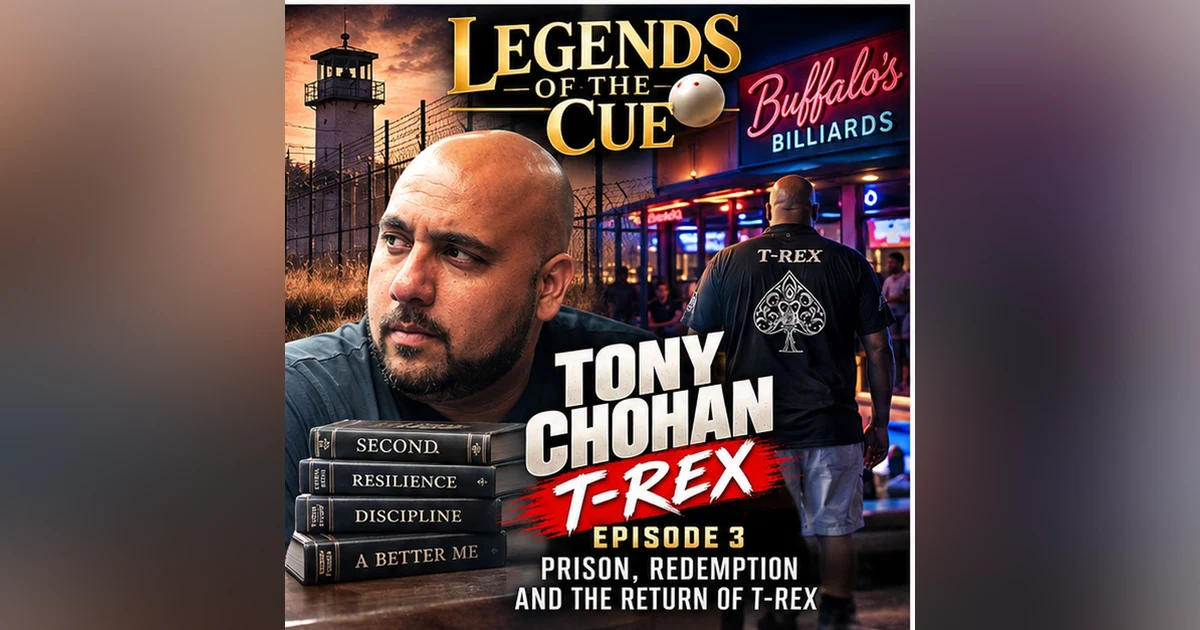

Tony Chohan’s story took a dramatic turn in 2009. In Part 3 of this four-part Legends of the Cue interview, Tony speaks with remarkable candor about the choices that led to his incarceration, the fear of losing years of freedom and prime playing time, and the lessons he carried home when he was released in 2015. Tony refuses to frame what happened as bad luck. His words are simple: it was a “wrong choice, wrong time.” He talks about surviving prison, taking college courses, staying out of tro...
Key Takeaways
- Tony Chohan reflects candidly on his 2009 incarceration, viewing it as a bad choice rather than just bad luck and using the time to stay connected to the pool world through magazines.
- Within days of his release from prison in 2015, Chohan immediately jumped back into high-stakes One Pocket action, embarking on a remarkable two-year undefeated streak in major gambling sets.
- Buffalo's Pro Classic became a cornerstone of Chohan's career resurgence, winning the prestigious tournament in 2016 and subsequent years while cementing its reputation as a premier action hub.
- Chohan shares the mental and physical toll of living with hidradenitis suppurativa, detailing his journey through severe pain, major surgeries, and his resilience to reclaim his health.
- Reflecting on his second peak, including winning the Derby City Classic one-pocket title in 2023, Chohan attributes his continued success to superior strategy and outsmarting opponents at the table.
Tony Chohan’s story took a dramatic turn in 2009.
In Part 3 of this four-part Legends of the Cue interview, Tony speaks with remarkable candor about the choices that led to his incarceration, the fear of losing years of freedom and prime playing time, and the lessons he carried home when he was released in 2015.
Tony refuses to frame what happened as bad luck. His words are simple: it was a “wrong choice, wrong time.” He talks about surviving prison, taking college courses, staying out of trouble and keeping one eye on the pool world through magazines and newspapers sent to him while he was away.
Then comes one of the most extraordinary comeback stories in modern pool.
Within days of his release, Tony was back in action. He recalls matching up with Danny Smith, rapidly recovering his One Pocket instincts and going roughly two years without losing a major gambling set. He later rebuilt his tournament career, winning Buffalo’s Pro Classic in 2016 and becoming deeply connected to the New Orleans action scene.
Tony explains why Buffalo’s became the “Mecca of Pool,” why he prefers action to many tournaments, and why competition remains essential to his identity.
The episode also turns deeply personal as Tony discusses living with hidradenitis suppurativa, the pain of the condition, a difficult surgery and infection, months of recovery and his determination to undergo another procedure and reclaim his health.
A powerful story of consequences, resilience, competition and second chances.
Give Allison, Mark & Mike some feedback via Text.
Follow our show and/or leave a review/rating on:
Our website: https://www.legendsofthecue.com
YouTube: www.youtube.com/@LegendsoftheCue-MLG
Apple Podcasts: https://podcasts.apple.com/us/podcast/legends-of-the-cue/id1820520463
Spotify: https://open.spotify.com/show/4Za0IMh2SeNaWEGUHaVcy1
Music by Lyrium.
About
"Legends of the Cue" is a cue sports history podcast featuring interviews with influential figures from across the world of cue sports—including pocket billiards, snooker, and carom disciplines such as three-cushion billiards. We highlight the people, places, and moments that have shaped the game—celebrating iconic players, memorable events, historic venues, and the brands that helped define generations of play. With a focus on the positive spirit of the sport, our goal is to create a rich, engaging, and timeless archive of stories that fans can enjoy now and for years to come.
Co-hosted by WPA and BCA Hall of Fame member Allison Fisher and Mosconi Cup player and captain Mark Wilson, Legends of the Cue brings these stories to life—told in the voices of the game’s greatest figures.
Join A...
Frequently Asked Questions
What led to Tony Chohan's incarceration in 2009?
Tony Chohan has candidly stated that his six-year prison sentence stemmed from a bad personal choice rather than bad luck, involving drug-related charges during a difficult period in his life.
How quickly did Tony Chohan return to competitive pool after getting out of prison?
Within just two to three days of his release in March 2015, Chohan was back in the pool room matching up in high-stakes One Pocket games against top players like Danny Smith.
What medical condition has Tony Chohan been battling?
Tony Chohan deals with hidradenitis suppurativa, a chronic skin condition causing painful lesions and boils, which has required major surgeries and extended recovery periods.
When did Tony Chohan win the Derby City Classic one-pocket title?
Tony Chohan officially captured the prestigious Derby City Classic one-pocket title in January 2023, marking a major milestone in his career resurgence.
Looking back 2009, Detroit, wrong place, wrong time for Tony Schohan.
Tony ChohanI I don't I can't say it's a wrong place, wrong time. It was a wrong choice, wrong time.
Mike GonzalezOkay. Fair enough. Yeah. I mean, I just listening and remembering what uh some of our guests have have uh told us about the Detroit pool scene, you know, like a Billy and Cardona, uh they certainly talked about some unsavory characters around there, and I was just wondering if that was uh entered into it at all.
Tony ChohanThe era that he's talking about is way before me, which is like the Rack days, and these guys were betting big money. It was the mob days, let's say, right? So let's just say when I was there, the mob wasn't there. It's kind of dried. It was just a different time, but yes, it was a lot of money um dispersed back in those days. Um But yeah, I mean when I was there, there was a lot of good guys. Just I mean, oh, it was just kind of one of those things, though you made a bad I made a bad choice, you know. I I chose that over um going and finding a job or finding a different way of being an entrepreneur or something to try to make a dollar, you know. I just I'm you know, I kind of uh I like to gamble, you know, in the casinos. Well, that was also detrimental to me wanting to make money faster, right? Because I needed to um get that habit, you know, feed that habit also. Only way you're gonna do that is if you got money, you know. So it's kind of just it's just bad in general. I mean, everything's an addiction, whether it's drugs, gambling, alcohol, whatever it is, you know. Everybody's got some kind of vice, and let's say gambling was my vice, and I tried to figure out ways to, you know, it's still my vice, gambling is, but I I don't I know better than to go down that road again, let's just say. So yeah.
Allison FisherSo when you realize that you were going to lose years of your freedom, years that you know, the prime poor years, what went through your mind?
Tony ChohanUh more scared than anything because I didn't know what to expect, right? You know, I mean, never been locked up for anything, I've never been in trouble. So to go and have to do six years on a first-time offense, I was like, man, sh got real, you know what I mean? Like, I was like, I didn't know. I was like, I'm I'm thinking to myself, and then I was in there with murderers, rapists, and I'm thinking to myself, man, like, how does a guy, a first-time offender, have to go and sit up here with a chomo, you know, you know, whatever, you know. And these guys got less time than me. And I'm not, and I didn't have no viol I didn't have no tr weapons or nothing like that. Um, you know, just some drugs, let's just say, right? Just in general. But, you know, they just they wanted to make an example of me, so they did, you know, let's just say. And um I kind of just had to eat it up and just kind of understand, you know, hey, time's gonna go by, I'm still young, that I can get out at a certain age and life will still go on, you know. So it's kind of like I was lucky to um have enough clear thought to realize that it's not the end of the world, let's say.
Mike GonzalezYeah, yeah. How did you try to make the best of those six years?
Tony ChohanHonestly, I mean, uh, the first year was the hardest, you know, and then after that it was kind of like getting in a routine of, you know, what am I gonna do in here? I mean, towards the last year or two, I started to work out and started to do certain things and you know, just go and w walk and do certain things and try to stay out of people's business and stuff, because that's one of the biggest things in in prison is you know, you try to stay out of people what they're doing, you know, and then you gotta hope that you know people aren't gonna try you and do all that stuff, you know. So it's kind of you know, prison life's a total different life. You know, it's kind of like it's not a life uh I think that in my opinion, I think every person in the world should have to go through it. I just don't think they should have to go through it for a long period of time, just so they can be humbled or realize, you know, when they do something stupid, maybe it'll wake them up, you know what I mean, before they do something.
Mike GonzalezRight. Just to pass the time, uh, did you take up hobbies? Did you take classes, anything like that?
Tony ChohanI did end up taking uh some college classes that they allowed, and uh I did um finish like I could basically I think I could get like my my two-year degree if I was to go to a regular They won't give you the diploma in there, they'll get you as close to getting all the credits as you can get, and I think all I would have to do is probably take a couple uh classes, you know, in a community college, and I could basically get my two-year degree or whatever. But uh, you know.
Mike GonzalezYeah. So when you when you when you got out and you and you first came home in in March of 2015, uh did you know immediately that you were going to be T-Rex again? Or did you have to figure out whether that player even still existed?
Tony ChohanWell, honestly, at the time, I don't think that they really called me T-Rex at that time. I'm not sure. I don't know if they did or not, to tell you the truth. And they might have, maybe not. I'm not I can't even really remember really, but now that I think about it they probably did, but I'm not sure. But anyways, when I first came home, I just I didn't really know I was gonna get out, honestly, because I got out on a little bit of a so I was get I got a seven-year sentence, but after five uh five years, you can file for this judicial release in the state of Ohio. And it takes them about six months to get back to you whether or not they want to let you, you know, if you have a nonviolent case, first-time offender, nine times out of ten they should give it to you, but you never know. It's still up to the judge, right? So long story short, one day they just came and you know said, hey, uh pack up your stuff, you're going to um where I caught the case, they they take you back to that um that jail, and then you're there for like a day or two before you go see the judge. And from there, they kind of they uh release me from there, right? Um so I didn't know if I was getting sent back to be denied or if I was getting sent back to be able to go home, you know, and I'm just you know, I'm just kind of like in my heart's racing, and I got anxiety now, you know, from that because I don't know if I'm going home or what. So but as soon as I um got released that day, I mean I never really looked, you know, it's kind of like you look back at time now and it's like you don't even remember that time, you know. So it's kind of just tells you, you know, that you you get through whatever you go through, you know, as you go. So it's kind of just just deal with what you have to deal with at the moment. It's not the rest of your life, right?
Mike GonzalezRight, right. Yeah.
Tony ChohanBut I mean, well, as soon as I got out, I mean, I kind of you know, people had sent me some subscriptions of like certain little pool newspapers that I would kind of keep in touch with who's doing what in the pool world as far as like who would win this event or who would win that event type stuff. So I would just kind of keep those. And you know, some of the other guys that were in there that were my friends, they're like, this f might be the only guy in the world, uh excuse my French, but but ever getting mailed uh pool magazines in the pool into the joint, right? So I'm living with them. They're like, they're like you know, and I'm just thinking to myself, like, you know, I was like, it was just something to just kind of keep me in tune with what's going on or whatever. But within two or three days of me being out, um Danny Smith was like the best one pocket player at the time, right? So before I got locked up, I was giving Danny 10-6 in the breaks. Now I come out, he's giving me 9-8-10-8. Nothing wrong with that. But I mean, it's been six years and I haven't really hit no balls or nothing, right? You know, so but I take the 9-8-10-8, and the guys that were in the pool room, they just wanted to put me in just to see, you know, they didn't care. They're like, You're fresh home, just come on, just go play. I'm set for like five or ten thousand, right? So we played and I ended up beating him nine, eight, ten, eight. Then the next day we played like nine, eight, and then within a week I was beating them even. And then maybe within a month, I was maybe giving him nine, you know what I mean? So it kind of just happened to be like that. It was just kind of just the process, just kind of, you know, and it's just you know, I guess in my mind, I just kind of knew when I came home that I wouldn't really shoot in my hole because I knew my offense would be a little bit um bad. But I figured and and it probably should have been the opposite way, because I really should have thought that my cue ball should be bad, if anything, right? But it was my cue ball that was good because I was always thinking about where to leave my cue ball more than where did the object ball go or or or so much, or you know what I mean? I was just making sure I put balls by my hole and didn't leave them a shot mostly. So but the for the first um two to three years of being home, I never lost a match with anybody playing except for five or ten thousand. And I probably played 20 matches in a row, and Dippy Dave was staking me the whole time. The first time I ended up losing after coming home was about two and a half years later. I lose to Bustamani playing a race to 21, and it goes hill hill. And we were playing in Vegas, so race to 21, he beats me 2120, and Dippy tells him we played a little set for like 10 or 15,000. And Dippy goes, Well, if you guys want to play another set right now, you guys can play a set for a hundred thousand. And he said, 'You guys don't, and he had and Boosty had a good stay course at the time.' So I'm telling Boosty, I'm like, well, come on, let's play it. Like, I mean, how could you know? But the way pool players are, most of them indeed, they want their half of that money that they just won because they don't look at the larger picture that if they win another set, they can win a lot more money, right? So it kind of just happened that way, and no match was ended up happening again after that. But who knows, right? Now we don't know because it'll never happen again, right? But it was kind of just one of those things. It was it was in a good spot, and I ran good for a long time, you know. And I mean, I I played good for quite some time and was able to win some decent money, and um then kind of the fire fell off, and um there was no more action, let's say, right? So I tried going and working for a friend of mine there in Detroit and selling cars, but it wasn't selling cars, it was just kind of like being the guy that would help him, you know, just at the car dealership. So basically the guy just gave me like six or seven hundred dollars a week just to work, and I'm thinking to myself, man, I'm an idiot. I'm not gonna go work for six or seven hundred dollars a week. That's not gonna I could go do that in the pool room, right? I'm thinking to myself, right? So so that lasted about a month and a half. And I mean, every day I was waking up at eight in the morning, I'm there till about seven, eight at night, and I'm thinking to myself, man, this is worse than slave labor, right? I'm thinking like, I'm like, I'm working 12 hour days and barely making a hundred dollars a day. Like, I gotta be a retard, right? You know, I'm just like, there's something wrong with me. Like, I need to check my mind. Like, I mean, you know, so after about a month and a half, I said, this is enough of this. I'm going back to pool. I said, I don't care what I have to do, but I'll figure it out. So here we are.
Mike GonzalezYeah, well, it sounds like uh, you know, uh coming home again back in in 2015. You answered the question pretty quickly, which was, will we see a resurgence of T-Rex? Uh, we certainly did with that stretch you reeled off uh you know those next few years.
Allison FisherIn 2016, you won Buffalo's after everything that had happened. What did it feel like? What did that title prove to you?
Tony ChohanWell, so like after coming home and stuff, I never heard of no tournaments paying decent money like that, right? So I'm thinking to myself, like, man, you know, I was ecstatic because it was a big tournament. But even better was like that pool room vibe in there with all the action guys around. It's just something that this day and age, these younger kids, they're like if you take a younger kid now, the juniors and stuff, they're never gonna stick them in a pool room and try to get them to survive. They got no shot, they don't know how, right? Because they don't learn the street smart side of it or they don't learn the certain things of how to survive in general, let's just say, right? Because kind of now it's kind of like a lot of people are kind of a little bit sugarcoated in a way, right? They're getting a lot of help from different areas, let's say. Nothing wrong with that. You know, hey, if they don't have to lead the hard life, then so be it. And that and that's a good thing in a way, right? But at the same time, you know, winning that kind of money, um, it was big, you know. And every year since then, that tournament's gotten bigger and bigger and bigger and bigger and stays good size. It's the best tournament of the year for one pocket every year.
Mike GonzalezYeah, yeah. Well, you've you've described Buffaloes as sort of the mecca of pool. Uh help our listeners understand what that late action looks like at night and and what makes it so special.
Tony ChohanYou know, and and the thing is, is anytime people come from out of town or anybody wants to come into town and and make good sized games, it's an area where we have the guys that are will that like to gamble and are willing to put some money up to, you know, and that's the thing that makes this area so great, right? Because there's those kind of people that are around to make money games happen. Without money guys, there's no money games, you know. You know, without money, there's no money, right? So, you know, so it's kind of like you gotta have that, right? And you gotta have people that are willing to um, you know, and those guys they gamble themselves, and they're not great pool players, but they're guys that enjoy gambling and they know how to match up. That's the that's the beauty of it, right? So you're gonna see you could see a set, you may not see nothing for a month, and then you may see one night play a set for 40,000, one night set for 30,000, one night you might see a set for 50,000. You know, uh there's big wigs without saying no names, a guy around your area, Mark, we won't say no names. He's come here and try to talk down to people, that same person he talked down to and tried to tell them to post. He said, Hold on one second. Went to his car, come back in, uh, one duffel bag full of 250,000. He said, You could bet it all. Then when uh that gentleman that lives by Mark, he said, No, you don't have to do it, you don't have to bring no more, you don't have to say nothing, you know. But there's people that get put in place, you know, just because they have money doesn't mean everything, right? And and it's you know what I mean. Like there's other people in this world that got money too, right? But the difference is you could have all the money in the world. Are you willing to bet it? That's the difference, right?
Mike GonzalezYeah.
Tony ChohanSo that and that's and that's what these guys will do. They will put their money in play. They have no problem doing it. And it's not their last either.
Mike GonzalezSpeaking of the art of action and and great matchups, uh we had Justin Bergman uh on the show. And uh Mark, you recall what uh he told us about uh the T-Rex?
Mark WilsonYeah, just but uh some of us already know that. You prefer action games to tournament games. So natural, yeah. Yeah. That's just that era. And uh Tony's a gunfighter. He he's not a tournament player, even though he can win in tournaments, but that's not him.
Tony ChohanWell, my thing is he's a throwback.
Mark WilsonThere's not very many of those left.
Tony ChohanMy thing is, is uh well, what did Bergman say? I'd like to hear that.
Mark WilsonTony Chohan might like matching up even more than he likes tournaments. Oh is he right?
Tony ChohanThat's all he said though. Uh huh. Yeah.
Mike GonzalezOh, he said some other stuff, but all comp all complimentary. He respects you.
Tony ChohanHere, listen, I I I like the kid. It's not it's nothing against him. I just like action and I just feel like, you know, hey, if a guy beats me, I want him to keep on pounding on me. I want him to empty me out, I want him to empty out every single contact in my phone until I say no moss. I'm like, you're gonna turn me Spanish before I turn anything else. Because I'm gonna have you say, I'm gonna say no moss before I ever say I quit. You know, it's just that you you gotta bring it out, you know, and and I've yet to find a guy that's done that, and that's what I'm waiting for, is the guy that'll bring it out of me that'll s that makes me say, All right, I'm I'm good, I don't want it no more. Right? Yeah, because I mean that's you two playing. Uh we did play. He beat me Hill Hill, and now we're never uh I guess we're never able to play again because the guys don't want to bet on them won't bet on them or something. So it's kind of just kind of been stagnant or whatever. So I, you know, and here's the difference to each its own, right? I'm not gonna downplay the kid. The kid plays good. I mean, I wish him the best. Um, you know, I just wish we could get back in the box again, that's all. You know, and I'll leave it at that, let's say, right? No, but I mean here's the difference. It's it's not it's not that I don't want to play tournaments. I'll play a tournament every single day of the week if it pays the right amount. Right? But it doesn't make sense to go chase pool tournaments and spend three, four thousand dollars in expenses at first place is ten thousand dollars. Only two guys are gonna walk away happy. The rest, that's what's wrong with pool tournaments, right? You have two hundred and fifty-six people that spent three thousand dollars to go to an event. Well, that's eight hundred thousand dollars, but first place in the tournaments, a hundred thousand dollars. Second place is forty thousand dollars. Third fourth is twenty thousand dollars. So how many people are happy out of two hundred fifty-six people? About eight? Doesn't make much sense, right? It's a very hard, you know, it's a tough living, you know, because you're gambling every time with your expenses and everything else. You have ways to offset certain things continue to do that week in, week out, you will be losing. No, not very many people are gonna win back-to-back events, first off. Right?
Mike GonzalezYeah, very few will ever do that. Yeah. You you've mentioned the names of a lot of uh uh some of your great action opponents, uh uh you know, uh just in the preceding time we've spent with you, Dennis and Alex and Scott Frost, Chris Kump, and others. Who was the hardest to make the right game with? Or were you generally just playing them even up?
Tony ChohanOh Shane's been the hardest to try to match up with. I mean, here's a guy. So we probably played like 25 times in our life, and the last two times he's beaten me, and now he won't play me no more. And I'm like, I'm like, how much sense does this make? I'm I like every time I see him, I just you know, and we're cool whenever, you know. I just like you know, I like to, you know, poke at him, let's say, right? You know, and every time I see him, I'm like, well, you ready to play a set for 10,000 here? You want to play a set for 10,000 here? You want to play a set? Uh you know, his normal you know, response is I don't need to play you, I don't care, I got money, da-da-da-da-da. I'm like, man, I'm like, you're just I'm just like, man, you're not right. You know what I mean? I'm like, who cares if you got money? I said, it's just a fact of just playing, just to play because you enjoy playing. I mean, it's competition, you know. At the end of the day, I mean, yeah, it's lovely to win the money or whatever, but at the end of the day, it's competition. I like to come I like to compete, you know, and I want to compete every single day until I can't compete no more, right? Once I mean, like I said, I can't take back, I can't go ten years back in time, right? Right. So I've only got so many more matches I can play. You know, like I said, yeah, I'm getting ready to go and do a second surgery, you know, soon, let's say, right? Well, when I go do the second surgery, I'm gonna have to probably lay down for four or five, six months. Who knows? I don't know. I might only lay down for two months, I might only lay down for one month. But from the last one, it looked like it was gonna be a while, so I don't know. I mean, I'm just I'm anticipating three months, let's say, right? So hoping hopefully everything goes well and and then I can just, you know, kind of um go on about playing and working out a little bit more and and focus on my health and get back in shape and and want to play a little harder, you know.
Mark WilsonRight, yeah. I love the positivity. Uh uh Tony, talk a little bit. You surely played uh Jimmy Spears, and known as Flyboy, because he was an action player around New Orleans. So uh tell us a little bit about that.
Tony ChohanSo uh Flyboy was a little bit before my time, so I didn't really get a chance to play him. Um but I did go to some poker games in Houston when he was out there before he passed. We would play poker and gin. And um he was just an action guy. I'll tell you what, like I I got mad respect, and I don't and I don't even know that guy that great, but every time I've ever met him, we got in the box and play, you know. What and it wasn't pool, it was it was poker and uh gin. Just because he was in his later days and he couldn't really play as much and he couldn't stand up as much or whatnot. And he was kind of into poker a lot. I mean, he's always been a gambler in general, but he was he had his own poker games and stuff, so I would kind of go and solicit his places when I when I was in the Houston area at the time and just give him some play and stuff, and he would give me some play, playing gin. You know, I I enjoy playing gin cards and stuff like that for money and stuff like that too. So it was cool. But super good guy. Um another guy that I don't think anybody will ever see bet as much money as he has in his life.
Mark WilsonWhat a character he was. He would He would call the poor room and say who's there, and they'd name off a litany of top players. He'd say, Lock the door, don't let any of them leave. I want to bust the whole joint in this game. That's just what he would do. You'd come in if you lost, you just put up more money. That's a great uh.
Mike GonzalezTony, you you had a bit of a resurgence uh really kind of coming out of COVID, almost a second peak to performance that we want to talk about a little bit.
Allison FisherYou won Buffalo's in 2021 and 2022. The 2022 season also included your second US Open one pocket title and the International Open One Pocket Championship. In January 2023, you finally captured the Derby City Classic one pocket title. Were you actually a better one pocket player at 40 than you had been at 26?
Tony ChohanUh in my opinion, yes. And the reason being because I was I was playing smarter, I was playing harder, I was shooting the right shots, I was thinking a lot more. And if I get to thinking and I'm taking my time, uh there's not anybody in the world that's gonna beat me. And I and and that's me saying that I don't I don't normally talk that high, but if I'm actually thinking, they got no shot. And the reason being because I feel like I'm gonna outsmart anybody on the pool table as far as when it comes to thinking. May not outshoot them, but I'm gonna outsmart them. And that's the beauty of One Pocket, is because I can come up with a shot that can change the game and do certain things that you know that's the thing about other players that can't think of other players kind of watch things that I come up with over the years, let's say, and that's kind of helped them, right? So it's kind of like they use my shots against me in a way, right? So it's like I try to like, you know, you can't really hide it from people because you you used it at some point, right? So it's kind of like, you know, but it's a matter of do these people remember what the shot was when I shot it or how I shot it, da da da. So, but there's a lot of different shots, you know. I mean, um, I just feel like a lot of guys would never outsmart me as far as playing one pocket if and the problem for me is I was I was I wasn't feeling as bad at the time. And over the last three to four years was when I actually started to get uh my condition started to get worse. So it started to go downhill a little bit more and more slowly. And um there was times where yeah, I don't know, and you know, there's I can say that, and I can say that's the reason why I didn't do great, but then there was still I was still winning events, you know what I mean? So I was still winning events, maybe they might not have been the biggest ones, but I was winning all the the one-pocket events wherever they were or whatever type of things, let's say, right? So I was still playing good, it's just a matter of I guess, you know, it's comfort and how I feel um tournament by tournament, let's say.
Mike GonzalezYeah. So you brought it up a couple of times. Why don't you take our listeners through what you're talking about in terms of your condition, how it affects you, what you've been doing to sort of uh combat the effects of it.
Tony ChohanSo my condition is called hydronitis supertiva. Um it's kind of uh it's like a it's like when people get boils, let's say, and you pop them, a normal person's body will heal. Uh mine will create lesions, let's say. And those lesions will never heal and they will spread further and further in those areas. And it just becomes to where it's unbearable to um, you know, wherever those pains come from, it's very hard to um live through. And when I would go to the doctors and I would ask them what's going on, because they didn't know exactly what it was, they didn't know what to call it, they didn't know nothing, right, about the condition. And eventually, all they would ever tell me was is once they knew what it was, they would just say, Listen, there's nothing we can do for you. I'm sorry. And I'm like, what do you mean there's nothing? I'm like, okay, well, I so they would tell me, listen, and they would look at me dead in my face and just like kind of soft spokenly just say, Listen, it's debilitating to your life, and I'm sorry. And I would think to myself, man, like that's something you would say to somebody that's maybe got like, you know, a death, you know, wish or something, you know what I mean? Like they're getting, you know, death on their mind or whatever, you know, like you only have a short term to live. And that's when, you know, this this disease really does do a uh uh a number as far as your mental state, and it does do a number uh emotionally and uh physically, let's say, right? Because certain ways you can't sit down, certain ways you can't lay down, certain ways you can't uh do certain things, let's say, right? Certain things you can't do in certain type of weather because it irritates it more, let's say. Um just a various and and nowadays more people actually have this condition than not. And more people actually like once I started to share about my condition, people started to message me and tell me about that they had the same exact thing and stuff like that. Because it's kind of one of those things that people don't really want to talk about, right? So it's kind of like people don't want to talk about it, people don't want to tell people because it's kind of just it's something kind of like, you know what I mean? It's not really something you want to talk about to people because it's kind of like personal in a way, right? But eventually, I mean I'm dealing with it for 10 years and the last four years being the worst. Uh eventually I just said, screw it, I don't care. Who knows? I don't care. Like, I don't give a sh, you know. It's it's just that mentality at that point. When you got doctors telling you it's debilitating to your life, what do you care about what you tell someone else? You know what I mean? Like it's just kind of come down to that at that point, you know. So it's kind of just you know, but uh so the first surgery I had last year, and um it took me about six, seven months to fully heal. Um now actually today I will go to a doctor's appointment today and try to find out when they can schedule me for a second surgery because I want to hurry up and get this done just because it's just time. I just need to hurry up and move on with my life, and hopefully this will make it better. You know, it's just you can only go through so much pain for so long because there's certain days I just break down, certain days I don't, you know what I mean? I try not to, and it's just sometimes you just you give in, you know, you're like, man.
Mike GonzalezYeah, and it was obvious too, just uh because you shared a lot on Facebook about the journey that you were on, and I could tell, particularly in the early weeks, you were quite frustrated with the pace of the recovery.
Tony ChohanYeah, it just yeah, it didn't make sense because it was like, well, I uh the first surgery, I got an infection within the first week of coming out of surgery. I had to go back to surgery. I actually went to the emergency room, and they told me I had an infection. So when they told me I had an infection, I had to go, they took me in an ambulance back to the hospital where I had the surgery at. Now the surgeon comes in the next morning, they have to unstaple all those areas, unstitch. So basically, my healing process was they didn't re-stitch or restaple me, they just left it all wide open to let it heal from the inside out. And it was like two centimeters deep in certain spots, three centimeters deep in certain spots. So that's kind of they just had to do that because if they close me back up, and what they do is they flush you out. Like they when they take you back into the surgery, they basically like, I don't know, I guess make sure there's no more, you know, infection by flushing through water or whatever they use, I don't know, saline or whatever it is. But that basically helps to get the infection gone, and then basically they just put pads over those areas where you have all the soap and skin. So for six months, I'm putting pads over all these areas. Well, that's just discomfort. I mean, it's just that just makes it miserable to live, you know what I mean? You're just like, fuck, like, I mean, when does this get better? Like, I mean, I thought the whole reason to get into surgery is to get better, not to sit here and be more miserable, you know, and just be, you know, I mean, I sat in bed for three months. I mean, that's horrible. Like, I don't think I could I I don't I mean, I'm not a person that can sit inside of uh anything for three months, you know what I mean? So it's uh let alone even a month, and I'm sitting here for three months, I'm going nuts, and you know, now I'm thinking about it, and I'm like, well, listen, uh, this would be a good time to do it because football season starts, at least I have something to watch or something, you know. It gives me something to do while I'm down, you know what I mean? Like to you know, take some of the time off or whatever. You know, I'd hate to do it during the summertime because there's no sports, there's no nothing, and it's hot as hell outside. So, you know, I mean, and and the heat doesn't help, you know what I mean? So I kind of want to do it in the colder uh months, hopefully, you know.
Mike GonzalezRight, yeah, yeah. Well, listen, thanks for sharing. Uh I think your your fans are all rooting for you that the second one's gonna go well, that you have a much uh speedier recovery.
Allison FisherThank you for listening to another episode of Legends of the Cube. If you like what you hear, wherever you listen to your podcast, including Apple and Spotify, please follow, subscribe, and spread the word. Give our podcast a five-star rating and share your thoughts. Visit our website and support our four history projects. Until our next golden break with more Legends of the Cube, along everybody.