

 Apple Podcasts
 Spotify
 Tony Chohan - Part 1 (From Sacramento Kid to Poolroom Prodigy)

Key Takeaways
- Tony Chohan, widely recognized as one of the most feared action players and a One Pocket Hall of Famer, grew up in Sacramento, California, playing multiple sports like basketball and football before discovering cue sports as a teenager.
- Tony's journey into pool began organically at around fourteen years old when he and his cousin Amar Kang visited local poolrooms and discovered free Sunday pool tournaments that awarded cash prizes for playing video games and competing.
- Northern California pool culture in the 1980s and '90s relied heavily on impeccably maintained, brutally tight Gold Crown tables with four-inch pockets rather than bar tables, providing a tough foundation for aspiring players.
- Legendary player Billy Incardona described Tony Chohan as the greatest American one-pocket player he has ever seen, an accolade that followed Tony's induction into the One Pocket Hall of Fame in May 2026.
- Early poolroom mentors and local characters like Warren 'Monk' Costanza and Bucktooth helped shape Tony's early competitive mindset, exposing him to high-stakes action and classic old-school poolroom culture.
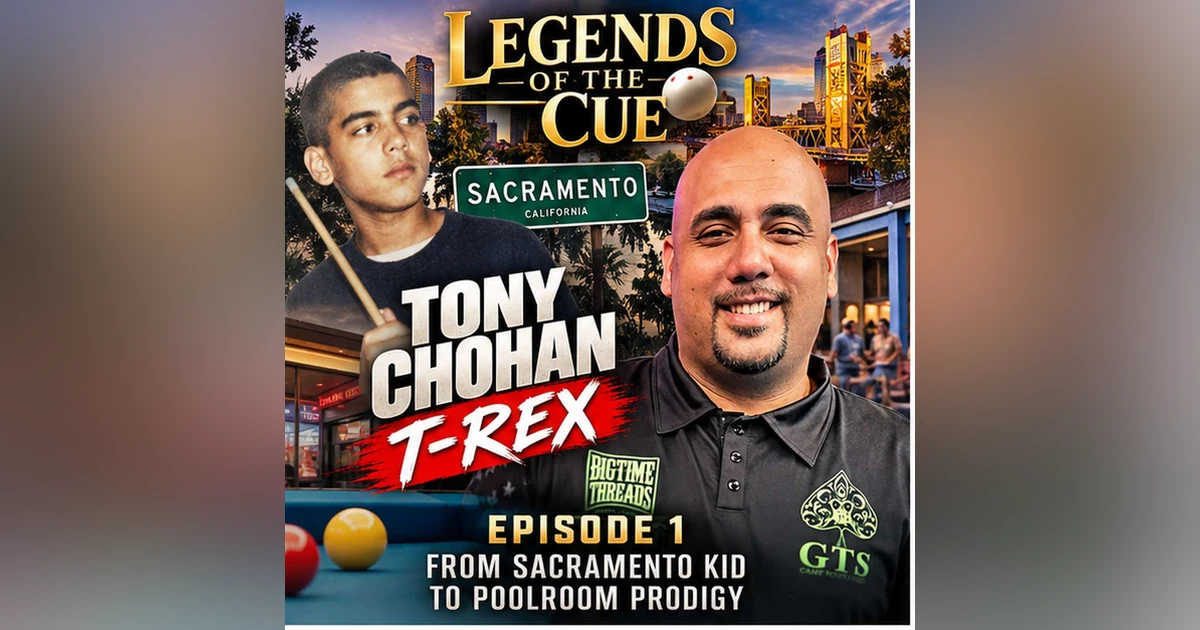
Before Tony Chohan became “T-Rex,” a One Pocket Hall of Famer and one of the most feared action players in professional pool, he was a sports-loving kid growing up in Sacramento, California.
In Part 1 of this special four-part Legends of the Cue conversation, Tony takes us back to the beginning: his Sikh and Indian family roots, childhood in the 1980s and ’90s, and the unlikely path that led him from basketball courts and video games to the poolroom. He recalls discovering pool with his cousin Amar Kang, entering free local tournaments, learning on brutally tight Gold Crown tables, and becoming immersed in Sacramento’s rich pool culture.
Tony also paints a vivid picture of the rooms and characters that shaped him—including Great American Billiards, Warren “Monk” Costanza, Bucktooth and the road players who passed through Northern California. One unforgettable story finds a teenage Tony outside a professional tournament, cue in hand, hoping to get autographs from Efren Reyes and Johnny Archer.
This is the origin story of a future One Pocket legend: family, competition, curiosity, hustlers, smoky poolrooms and a teenager rapidly falling in love with cue sports.
For fans of pool history, One Pocket, professional billiards, road players and old-school poolroom culture, this episode captures a world that helped create one of the game’s most original champions.
Give Allison, Mark & Mike some feedback via Text.
Follow our show and/or leave a review/rating on:
Our website: https://www.legendsofthecue.com
YouTube: www.youtube.com/@LegendsoftheCue-MLG
Apple Podcasts: https://podcasts.apple.com/us/podcast/legends-of-the-cue/id1820520463
Spotify: https://open.spotify.com/show/4Za0IMh2SeNaWEGUHaVcy1
Music by Lyrium.
About
"Legends of the Cue" is a cue sports history podcast featuring interviews with influential figures from across the world of cue sports—including pocket billiards, snooker, and carom disciplines such as three-cushion billiards. We highlight the people, places, and moments that have shaped the game—celebrating iconic players, memorable events, historic venues, and the brands that helped define generations of play. With a focus on the positive spirit of the sport, our goal is to create a rich, engaging, and timeless archive of stories that fans can enjoy now and for years to come.
Co-hosted by WPA and BCA Hall of Fame member Allison Fisher and Mosconi Cup player and captain Mark Wilson, Legends of the Cue brings these stories to life—told in the voices of the game’s greatest figures.
Join A...
Frequently Asked Questions
Who is Tony Chohan?
Tony Chohan, also known as 'T-Rex,' is a two-time U.S. Open One Pocket Champion, a three-time Buffalo's Pro Classic champion, the 2023 Derby City Classic One Pocket Champion, and a One Pocket Hall of Famer widely regarded as one of the greatest American one-pocket players of the modern era.
How did Tony Chohan get started in pool?
Tony began playing pool around age fourteen in Sacramento, California, alongside his cousin Amar Kang. They initially visited local poolrooms to play video games before entering free Sunday pool tournaments that offered cash prizes to fund their gaming.
What poolrooms and mentors influenced Tony Chohan early on?
Tony developed his game in Sacramento rooms like Rackham Family Billiards, Big Shots Billiards, and Great American Billiards, learning from seasoned road players and legendary competitors like Warren 'Monk' Costanza.
What is Tony Chohan's connection to the One Pocket Hall of Fame?
Tony Chohan was inducted into the One Pocket Hall of Fame in May 2026, where renowned expert Billy Incardona praised him as the greatest American one-pocket player he had ever witnessed.
Welcome to another edition of Legends of the Cue and Allison Fisher. Our guest today could arguably be the best one pocket player on the planet.
Allison FisherWell, this is a real treat for me. This game is definitely not my forte, but I'm excited to hear the story of America's top one-pocket players you said, according to aficionado a Billy Incardona. Mark, would you like to introduce our guest?
Mark WilsonI'm delighted to. He is one of the most creative, fearless, and accomplished one-pocket players of the modern era. Tarjay Tony Chohan. Better known throughout the pool world as T-Rex. Tony Chohan. Began playing as a teenager in Sacramento and quickly developed a reputation not only as a tournament player, but as one of the country's most willing and dangerous action players. He is a two-time U.S. Open One Pocket Champion, a three-time Buffalo's Pro Classic champion, and the 2023 Derby City Classic One Pocket Champion. But Tony's story extends well beyond the trophies. His journey has included enormous high-stakes matches, years away from the game, a remarkable second act at the highest level, serious health challenges, and a new role teaching the creative thinking behind his game through game tight one pocket. In May 2026, Tony was inducted into the One Pocket Hall of Fame where Billy and Cardona described him as the greatest American player he has ever seen. Today we want to go back and well before all that to Sacramento, his family, his first bullrooms, and the making of T-Rex, Tony Chohan. Welcome to Legends of the Cue, Tony.
Tony ChohanI appreciate it. Uh thank you for uh having me on. I'm just uh delighted to be here and hopefully I can tell you all a little more about my story.
Allison FisherWell thank you, Tony. Thank you. Thanks for joining us. So in May you're inducted into the One Pocket Hall of Fame at Buffalo's. When you stood up in front of that room, what did that moment feel like for you?
Tony ChohanUh just kind of like all the years you give to the game and you finally get what you feel like is one of the treasures of of being put in the elite status, let's say. So it's kind of just it's an honor, it's humbling, and it's just one of those things, just happy to be alongside with all the rest of the greats, and just being inducted into it and being acknowledged for my game is in a high standard, let's just say. Um just really appreciative and uh makes you want to tear up and cry.
Allison FisherYeah, definitely does.
Mark WilsonUh Billy and Cardona called you the greatest American One Pocket player he has ever seen. What did hearing that from Billy mean to you?
Tony ChohanI mean, that means a lot. I've been around Billy for quite some time too, and always like Billy, and always Billy's just a super good guy and very knowledgeable. No known everything about One Pocket and everything forever, let's just say. So it's just nice to hear Billy say something like that. That's I mean, his words are held very high by m all of our peers and stuff. So um just very appreciative that he really thinks that highly of my game and everything in general.
Mike GonzalezWell, we'll come back to that. It's a great tribute to you, Tony. Uh uh, you deserve all the accolades you get for that recognition in the One Pocket Hall of Fame. And uh so we'll get back to that. We're gonna talk about your playing career, but we always go back to the beginning with our guests, as we've told you. So uh just share with us a little bit about what life was like as a little boy growing up in the Sacramento area.
Tony ChohanI mean, back in the days, let's say when I grew up, we were ride our bikes and play sports in the parks and just had a good life as far as my mom and dad, they provided what they could and worked and did the normal things that parents did back. I think uh I act like I'm eighty years old, but I'm I mean I'm 45, but I was born in 81 and growing up in those eighties, nineties eras was you you grew up uh just playing sports, you were able to go out and ride your bikes and hang out with your friends on the street, playing football on the street, and get out of the way of the road when the cars coming by and stuff like that, and it's just you just did the normal things that kids would do. And it seems like nowadays you don't see that because of electronics, internet, um games, and everything else. So it's not like they kids aren't doing kid things as as they once were when we were coming up, let's say.
Mike GonzalezYeah, you know, I I I know Mark would agree with this because we kind of were uh products of the sixties as kids growing up, and you know, I don't know about you, Mark, all I did was play baseball all day because that's all there was. So we just played baseball all day. No internet, no cell phones, no social media.
Mark WilsonIt was an idyllic time, really. Right. Yeah, it was riding bikes and going to park, and uh we played basketball with pretty much everything uh sport related.
Mike GonzalezYeah.
Mark WilsonKickball, baseball, basketball, football.
Mike GonzalezYeah. So a lot of different sports, Tony, as a kid?
Tony ChohanYeah, I mean I played a lot of basketball and um occasional football, just in the park and stuff like that. Just playing a little street football, just throwing the football around, stuff like that, throwing baseball. Just played sports like the normal sports that kids would play, let's say. And just kind of let's say up until about sixth, let's say seventh grade, eighth grade is right about when I started to get introduced to pool, let's say. And that's so up until then I was kind of just playing a lot of basketball mostly. Um I enjoyed playing basketball. I was one of the bigger kids, so it was like I could be a center, I could be a point guard, I was able to shoot and stuff. So I was like when you're a kid and you're playing in elementary school, it was like elementary kids when they play these uh basketball games, like the total score might be like 25 to 20, or let's say in a full game, right? Well, yeah, yeah, let's say out of the 25 points, it was sometimes I was scoring like 20 of them. So it was like it was just I was kind of dominating. I was like a Shaquille O'Neal of elementary school in a way at the time.
Mike GonzalezI mean Well, your uh your your parents emigrated from India back in the 70s, I believe. So it's before you were born. So tell us about uh what brought them here, first of all.
Tony ChohanI think pretty much what everybody's um family wants to do. They want to come here, they want to get a good job, they want to lead a better life and with better options, let's say. Uh started working for the state of California for engineering for Caltrans. Um he's retired from that now. And um my mom, her family um lived in uh Yuba City, which is like about an hour from Sacramento, and they uh pretty much uh farmed. So they had a big farm and stuff down there, um, doing like walnuts, peaches, stuff like that. Um and still till this day, I mean my family's got my dad and then got a farm and my dad's got a trucking business that my him and my uncle kind of share.
Allison FisherSo Tony, how important were your Sikh faith and Indian heritage to your childhood identity?
Tony ChohanI mean it was big, but it wasn't like I wasn't like totally just did I go to church every Sunday with my parents? Yeah. Which was the temple, right? So we go there, we sit down, we you have you just kind of sit there, you pray, and then you go to the the like the lunch hall and just go eat lunch and then kind of the family just goes home after that kind of stuff. But Sundays were more or less like I was going to the temple every Sunday, no matter what. That was the one thing it's like if if my parents they were like, Well, you're coming with us, come on. And I was and I'm going, so it wasn't no up until about probably about twelve years old, and then after that it was kind of like you started to fade off, and you were like, once in a while you would go, or once in a while it was something that you had to go, and it was like, All right.
Mike GonzalezYeah, yeah. Were there a lot of Indian traditions and customs and and cuisine and so forth in your home though?
Tony ChohanYeah, my mom always cooked um Indian food, but she would cook American food also, but but my dad, he likes to eat more Indian food, but not that he won't eat American food because he does still, but like he's had some uh health issues also as far as like like he had stroke, he had um he had bypass surgery and stuff too, so uh and this has all happened in the last three, four, five years, let's say, but he's kinda gotta watch what he eats and stuff now, salt intake, stuff like that. So right, yeah. Um yeah, yeah, and I'm most of my family's been kind of oh a little overweight, so it's kind of like you kind of got wa gotta watch what you eat to an extent. We're all bigger, we're not like super obese, but we're above where we need to be, right? So it's like you know, you kinda gotta watch what you do.
Mike GonzalezRight. Right.
Tony ChohanFor me, it's like kind of like I was always been hovered at a certain weight range, let's say, and um once I quit smoking, um I'm starting to gain some of the weight back. I can kind of feel it, let's say, right? So I try to get out and I try to walk and I try to do certain things, but living down here in New Orleans and trying to walk isn't the greatest because it's a little bit uh muggy and kind of like heckish, right?
Mike GonzalezSo yeah, it's really hard to get out there and get motivated to do outdoor walks this time of year in New Orleans.
Tony ChohanYeah, plus with my skin condition and stuff, it kind of makes it even worse. So it's kind of like I gotta take the good with the bad. And I try to minimize there for a while. I was really losing weight. Um, whether it was good weight or bad weight, I don't know exactly how I was losing weight, but that was more or less when I was smoking, let's say. But um now I've kind of seen that I gotta just kind of watch what I eat. I need to cut out a lot of sugars, I need to um cut out a lot of things. So it's kind of like um just gotta start to feed myself just meat and and just try to stay on water and stay away from sodas as much as I can, just to try to make myself feel a little better.
Mike GonzalezYeah. Yeah, I think when when people start viewing uh your intake as body fuel and not just something to satisfy a craving or something you like because it's sweet or whatever, yeah, it kind of changes your mindset a little bit, you know, particularly with you with uh post-surgery and surgery prep, right? I mean, the more that uh you can do and develop that discipline, the more it's gonna help you, probably, right? 100%.
Tony ChohanAnd like my dad would always tell me as a kid, he would be like, uh, without health, there's nothing. And well, I'll tell you what, at this point, health is wealth, and wouldn't care if you gave me a million dollars, I'd rather have my health right now.
Mike GonzalezSo that mark.
Mark WilsonTake us to the first time pool really grabbed you. Where were you, and what made you want to keep playing?
Tony ChohanWell, so like me and my cousin, we started playing pool. I was probably about 14 and he was about 16, maybe 17. And we just kind of got into pool, like we were bowling actually before that, before pool came into our lives. And bowling just kind of got boring within a month or so because it was like you go to the bowling alley, but there was nobody there, it was kind of dead. It was fun, but it wasn't fun because it's like competition-wise, it wasn't really like there was it was competitive, let's say. So, and we were kids. I mean, the games, let's say um Mortal Kombat and Street Fighter 2 had just come out. So we kind of got into that big time, let's say, and we wanted to go play every time we we had any money. I was like, we wanted to go run and and the pool hall was actually like maybe three-quarters of a mile from our house. But like my house was three-quarters of a mile from there, and my cousin, uh Amar and his family lived a few houses down, and my other cousins lived another few houses down. So we were kind of all in the same uh block of house uh area, right? So we had three different family homes that are on the same block. So me and my cousin, we would just kind of walk up to there or go to the ride our bicycles, and we so there was like a round table pizza place, and they had the new games there, so we started going there. Then in the same shopping center as the pool hall, and we were like, well, let's go over there. They got the games there too. So we start going there, and we go there and uh start playing there, and then the owner of the pool hall um he goes, Hey, you kids, you know. I mean, he sees us coming in there quite often to play the video games. Like, you know, hey, on Sundays we got a free pool tournament. If you guys win, you can win $15 for first place and five dollars for second. So we were like, well, we got quarter money there. If we can win this money, you know, we can go play more games, right? So that's kind of where the pool started for us, realistically. So we kind of got into pool just kind of bought humbug, really. You know, it wasn't like it was pushed on us or anything like that. It was just kind of we saw a way to make a few dollars and kind of liked it and went from there, let's say, right? So it was like, I don't know, it was just kind of so from there it was like that tournament happened, then um we started to like it. We started to like the competition. We started to see a little bit of gambling in the pool hall here and there. Um, there was a snooker table, we would play the snooker a little bit. Um, because out there it was like most pool rooms didn't have we didn't have bar tables. The bar tables were no such thing in California. Um no pool room in California has bar tables, just not a thing that happened. And all the pool rooms most of the time had nice tight gold crowns, let's say. And like when I say nice tight gold crowns, you go to a lot of places. Like, I mean, I go to places on the East Coast and stuff all the time, and their gold crowns aren't nothing compared to like what we grew up on. Like we go to gold crowns, Ernesto Dominguez worked on them, four-inch pockets, new cloth. Like if you broke and ran four racks on it, you did something, you know. It was like, you know, it was like especially as a kid, and we loved watching it. And as a kid, so let's say I wasn't really a great player for a long period of time, let's say, right? I was just I liked the game, I like playing it, I like the competitiveness of it. There was handicap events and stuff, but the handicap we had out there was called USPPA, which it rated like a bad player, let's say, was like a 25 speed, let's say, right? And the highest speed a person would get is maybe 140 speed, let's say. So 140 speed equivalent to a Fargo, let's say this day and age, would be like a 780, let's say, or 790, right? So it just kind of uh happened like that. And so started playing the handicap events, let's say, in the pool rooms, and they would have weekly events all the time all throughout California. You would go and do certain things and stuff like that, and um, it just kind of escalated from there. And let's say the first couple um months I really started to enjoy playing it. So I would go there and try to just knock balls around here and there, and then we would and then my cousin really kind of got heavier into it. My cousin Amar Kang, he passed away a few years ago, so and uh but me and him kind of were competitive. He was the one that kind of pushed me as um playing and stuff, and and we kind of pushed each other, but he was always the one kind of always pushing me, let's say, more than anything, right? Because I was the younger one and he just wanted to he wanted me to get into it also because everything we did as kids, we always grew up and we did together, whether it be basketball, whether it be football, whether it be baseball, whether it be bowling, now pool, right? So pool was kind of our thing now. And um, like one of my first road trips, let's say, for instance, was he took me and we went to I flew to we flew to Austin, Texas, and that was one of our first road trips, and um we were in Austin for a few days, then went to Houston, Texas, and when we were in Houston, ended up living there for eight, nine months, and that's how quick it was like that's just kind of like one of those things. It's just kind of just one thing trickled to another. But as a kid, um another thing that happened was like uh they had the BCA Junior Nationals at the time, and for the area where I was, there wasn't very many juniors, let's say, right? So I kind of won an automatic pass to go to the BCA Junior Nationals, let's say, right? Because there wasn't enough people like that were to even compete into the right. So and at the time, I don't and I want to say I can't really remember his full name, but he um was a guy that worked for I don't know if he owned cousins cues at the time, and I don't know if you guys remember cousins cues, but there were nice cues, nice custom-made cues. But anyways, he gave me a cousins cue when I got like the BCA Junior Nationals, and that kind of like escalated me to go to Vegas, and and then me and my whole family got to go to Vegas. So actually, me and my whole family, and then we took uh my cousin and more with us, and I mean what a trip that was. Like we went to Vegas from Sacramento to Vegas, it's like an eight-hour drive, and we went in a uh van, and it's 130 degrees going through Death Valley, and we're like and the car and the van starts overheating, and you're like, Oh my god, like out in the middle of that or so. My parents they don't gamble at all whatsoever. So it was kind of like they just enjoy just to go just to hang out, circus, circus type stuff, let's say for the kids.
Mike GonzalezYeah, yeah. Well, your your your road trip stories, you know, uh Vegas, Texas. I don't know about you guys, Allie and Mark. It takes me back to all this road stories we were hearing from Mary Keniston in the same areas, right? Yeah.
Allison FisherBut I drove through uh Death Valley with my parents, and it's awful. If you get stuck there, that's it. You're a gunner.
Tony ChohanOh yeah, like they used to have like this thermostat that was like at the very top of it. I just remember that as a kid, they would tell you the the degrees and was like 134 degrees is what the thermostat read. And I was like, 134? How do you like I didn't even think it could get that hot? And I'm gonna tell you what, like I've lived down here in the south now, and um that dry heat almost hits me harder than the this heat down here in a way sometimes. When I go to Vegas, it's that hot.
Mike GonzalezYeah, yeah, like I've you don't want the wind to blow, you don't want to breeze because you feel like you're in an oven, don't aren't you?
Tony ChohanI went to uh like Lake Habasu like a few years back or whatever, and boy, when that heat wind heat hits you, you'd be like, What is this? Like, I mean, this is really bad. Like, this is it's a whole different type of heat. This isn't I'd rather be in New Orleans in about 100 degrees humidity than be than to be in that almost. So I was like, Yeah, it was just a trip.
Mike GonzalezI don't know. Yeah, uh Tony, take our listeners back into some of those early Sacramento pool halls where you learned the game. Just what it looked like, what it smell like, what did it feel like? Talk about some of the characters you remember, how you, you know, how you developed your game in that kind of scenario.
Tony ChohanSo for me, it started at a pool room called Rackham Family Billiards, which that pool room's not there anymore. And it was a father, a son, and a grandfather that owned the pool room. So those are the ones that kind of exposed me uh us to the free tournaments and stuff. And it was just a family billiards that it was smoking in there, so you wouldn't really see a whole lot of kids in there. I mean, we weren't smokers or nothing at the time, so it was kind of like I think maybe that's what turned us into smokers a little bit after a while, right? Is being in the smoking uh facilities. But then from there, we kind of went from that pool room to Big Shots Billiards in Roseville, which that pool room's also not there at this point now, and then over to Great American Billiards in Sacramento, which was probably the spot where majority of action happened. Um me growing up, like so. Like I said, Amara was mostly uh taking it more seriously than me because I was in school and I was kind of still trying to go to school. And every time I left school after uh the school day was over, I'd try to run to the pool all every single day. And then some days I might try to skip if I could, but um I wouldn't skip too much. You know what I mean? Just be Here and there, but it was like but he was the one that was traveling and running around and going from pool to pool and staying in action and getting and it kind of just drove me to want to do the same stuff. So it's like you're watching the older brother type situation, and you're gonna follow in their footsteps kind of stuff, right? So it was kind of like yeah, yeah. So I just kind of uh but growing up in that area was uh there was good players, um like Warren Costanza, which is the monk, not the monk that writes these uh books or whatever. I I don't know who that is, but this is the real monk, this is a real player, this is a guy that really does play good and was a cre and he was a great one pocket player, and he was actually a very good uh nine ball player too. So I think Mark would know he played Mike Siegel in like 1988 or something like that at Caesars, and I think they have a YouTube video about it, or Tropicana. And he played Siegel in the finals, and he w beat Siegel, and then he passed out right after he beat him in the finals. And I think it's on like video or something like that. Like it was like uh it was his thing, but it just was a dream come true, I guess, in a way, kind of stuff, right?
Mark WilsonSo it's kind of like well what happened is that uh Mike was a huge favorite in the match, and uh Monk uh Warren Costanza need two games, Mike needed one, but Mike was running out and hooked himself, he got the cue ball inside the side pocket on the ear and couldn't hit the nine. So he kicked at it and left Monk a super tough, long, end rail to end rail thin cut that looked a cut nine impossible. However, it wasn't a bank because it would double kiss. And he got down and he thin, ultra thin sliced the nine in. It was an incredible shot, and then made the nine on the break to beat Siegel right behind it, and then passed out on the floor as the crowd. And and if you ever talk to Siegel, he will never forget this match. He will talk about uh you know, he you know how Mike is, he'd be like that. Whatever happened there, it's incredible. But it was it was an amazing match to watch.
Tony ChohanYeah, so as I grew up, I kind of grew up around Monk. And so, like, once I kind of left the smaller staples of pool halls and got to Great American Billiards, right? I got to the so there was a midget that owned the pool room, Great American Billiards, and they were twin, they were twins. So it was kind of like and their names were Wayne and uh Wayne Iseri and Wayne had a brother that was twin identical brothers, and they were midgets, and they both had the Foom Man shoes that were very long. So it was like and and you and they looked exactly the same, right? So what their hustle was that Wayne played better than his brother, and what they would do is they would switch in the bathroom. When one went to the bathroom, the other one would come out and and get the money. So I don't know.
Allison FisherI love that.
Tony ChohanI don't know if Mark, like if you ever went to um did you ever go to Great American Bears? No, I didn't. I knew about it, I read about it. This pool room was kind of like it was just kind of like one of those things. It was uh there was pictures galore all across the back room. It had theater seating in the back. It was open pretty much 24-7. Um so the this is where Hard Times Billiards is now, where Oscar owns now, right? And so before this, this was called Great American Billiards, and that back room is where the back room is now. But this back room had full of pictures, like little old Polaroids everywhere of every single pool player that ever was anyone, let's just say, right? And it would show their names on the on the pictures and stuff. So it was kind of cool. It was just kind of like one of those nostalgic things, let's say, of players that came around. And like road players didn't come to California because they couldn't make it from Denver back across because of the expenses, because there wasn't much places to play in between, right? If they did go, it was just because they were trying to get to California and they didn't really care about in-between, let's say, right? So it was kind of like it was just one of those things, and it's just kind of like um, so the good players that are around when I was there was Monk, uh Todd Marsh, um Bill Crest, um Billy Aguero, there was uh other good players. Uh Bay Area had some good players like Day Piona. Uh I'm gonna miss, I'm gonna not remember a lot of people's names, so I apologize. But but there was Chris. Yeah, Chris McDonald would always come around. I mean, there was uh Paul Brienza, there was um God, I could think I mean I could name a bunch of names, but uh right now I'm gonna draw a blank real quick, right? So but there was one guy like so there was one guy that was really, really good, and he played in San Francisco, right? And he was uh God Asian guy doesn't even play no more, right? And it's funny because I'm about to tell the story, and somebody just told me that he he came in the pool room. The Asian guy, um God, I wish I could remember his name. Anyways, he played at Delberwong's pool room, Family Billiards in San Francisco on Guri. It's still there, the pool room. And he was a really good player. So let's just say this good player is uh I go in there when I'm like 16 years old, and we went to go watch a pool tournament. It was the Camel Pro Billiard Tour happening at um it was happening at uh Chalkers in San Francisco and Rincon Center at the time. And I'm just a kid and I just know about Efren and I know about all these other guys, right? Chalkers is happening. I'm down there, me and my cousin, we're young, we can't get in the pool room because it's 21 and over. The whole pool room is in this Rincon Center and it's all glass around. But the Camel Pro Tour series had all these little drapes set up so you could see past the drapes through the glass, but it was like shadowy, you couldn't really see it real good. But as a kid, I'm just like, I just want to look and no, they won't let us in, so I'm gonna wash from the outside somehow or another, right? I'm gonna watch some of these matches. Whatever I can see, I'm gonna see. Long story short, the door opens, and I'm standing out there, and I kind of see Efren, Bucktooth. Um, Bucktooth was another guy from around our area, which to most most people may not know him, but he was a bit he was a big gambler, but he was a big uh shit talker, let's say, right? So and he was just one of those guys that knew how to get people to to do something, but he had a lot of money and would make people bet good money. So Efren, Bucktooth, Johnny Archer, Tony Ellen, and one other good player, I think they're all standing, they're all sitting there, and I'm like, I'm kind of like star study. I have my pool stick, I have my players cue, it's this $50 cue, one of my first cues. I'm like, hey, I want, I'm gonna um, I'm gonna have Efren and Johnny sign it. And I didn't really know Tony Ellen at the time, so Bucktooth kind of makes fun. When the guy at the security, he's like, I I just told the security guard, I said, Listen, can I just get those guys autographs and I'll leave right back out, right? He's like, Yeah, come on. So I was surprised. I was like, because I really thought he was gonna just gonna shun me and I was gonna be like, oh my god, you know what I mean, or whatever. So but so luckily you let me go in there, I get Efren's signature, I get Johnny's signature, and then Buck too looks at me looks at Tony Ellen. He goes, He don't even know who you are, Tony. So I look at Tony, I said, Well, if you're a good player, can you please sign this too? You know what I mean? So I was like, so luckily I got their three signatures. It was just another story as a kid, you know what I mean? So it's no different than you see kids these days, and I'm like, I I was that same person. So it's uh it it's all kind of 360, let's say, right? So it's just a different era.
Allison FisherThank you for listening to another episode of Legends of the Cube. If you like what you hear, wherever you listen to your podcast, including Apple and Spotify, please follow, subscribe, and spread the word. Give our podcast a five-star rating and share your thoughts. Visit our website and support our four history projects. Until our next golden break with more Legends of the Cube comes along, everybody.