

 Apple Podcasts
 Spotify
 Alan McManus - Part 1 (Glasgow Beginnings, “Angles,” and the Making of a Snooker Mind)


Key Takeaways
- Scottish snooker great Alan McManus discusses his early years in Glasgow, discovering the game on a miniature Christmas snooker table, and watching Cliff Thorburn win the 1980 World Championship.
- Unlike natural-born prodigies like Alex Higgins or Jimmy White, McManus leaned heavily into structured coaching, discipline, and fundamentals under instructors like Jim Donnelly.
- The episode explores the grassroots snooker and pool culture of the 1980s, including school lunchtime tournaments at Gus's Pool Hall and joining a local adult team as a teenager.
- Co-hosts Allison Fisher and Mark Wilson compare the structured coaching culture of UK snooker with the more informal development path of American pool players.
- McManus reflects on Scotland's golden snooker era, the evolution of the professional game in the open era of the 1990s, and the origins of his famous nickname 'Angles'.
In Part 1 of our extended Legends of the Cue conversation with Scottish snooker great Alan “Angles” McManus, we begin where every cue-sports life story should begin: at the first table, with the first cue, and with the first signs that something special might be happening.
Alan joins Mike Gonzalez, Mark Wilson, and Allison Fisher for a warm and thoughtful opening chapter that traces his early years in Glasgow, his first memories of cue sports, and the childhood moments that helped shape one of snooker’s most respected thinkers. He recalls being the “sporty one” in the family, playing football as a boy, watching Cliff Thorburn win the 1980 World Championship, and discovering the magic of the small snooker table at home.
From school lunchtime pool tournaments to Gus’s Pool Hall, from realizing he could beat older players to being invited into a local snooker team as a teenager, Alan paints a vivid picture of the grassroots snooker culture that formed him. The conversation also explores coaching, discipline, technique, and why snooker players of his generation learned early that talent alone was never going to be enough.
Allison and Mark add their own perspectives from the worlds of snooker and pool, comparing the structured coaching culture of UK snooker with the more informal development path of American pool. Along the way, Alan explains the origins of his nickname “Angles,” reflects on Scotland’s golden snooker era, and shares how a young boy with a cue in his hand slowly became a serious student of the game.
This episode is essential listening for fans of Alan McManus, Scottish snooker, cue sports history, coaching, fundamentals, and the early making of a world-class competitor.
Give Allison, Mark & Mike some feedback via Text.
Follow our show and/or leave a review/rating on:
Our website: https://www.legendsofthecue.com
Apple Podcasts: https://podcasts.apple.com/us/podcast/legends-of-the-cue/id1820520463
Spotify: https://open.spotify.com/show/4Za0IMh2SeNaWEGUHaVcy1
Music by Lyrium.
About
"Legends of the Cue" is a cue sports history podcast featuring interviews with Hall of Fame members, world champions, and influential figures from across the world of cue sports—including pocket billiards, snooker, and carom disciplines such as three-cushion billiards. We highlight the people, places, and moments that have shaped the game—celebrating iconic players, memorable events, historic venues, and the brands that helped define generations of play. With a focus on the positive spirit of the sport, our goal is to create a rich, engaging, and timeless archive of stories that fans can enjoy now and for years to come.
Co-hosted by WPA and BCA Hall of Fame member Allison Fisher and Mosconi Cup player and captain Mark Wilson, Legends of the Cue brings these stories to life—told in the voices of the game’s greatest figures.
Join Allison, Mark and Mike Gonzalez for “Legends of the Cu...
Frequently Asked Questions
Who gave Alan McManus his nickname 'Angles'?
Alan McManus attributes his nickname to fellow Scottish snooker player Marcus Campbell.
At what age did Alan McManus hit his first century break?
Alan McManus scored his first century break on a full-size snooker table when he was 14 years old.
Who was one of Alan McManus's early snooker coaches in Glasgow?
Alan McManus took group tuition from former Scottish professional player Jim Donnelly at a snooker club on the high street.
What prompted Alan McManus to stop playing football and focus entirely on snooker?
As a teenager around 14 or 15, McManus chose to dedicate his time to practicing snooker rather than hanging out and drinking beer in the park with school friends.
Mike Gonzalez
Welcome to another edition of Legends of the Cue and Mark Wilson. We have ourselves today another proper snooker player.
Mark Wilson
I'm really excited about this because uh his career path seems to parallel mine in terms of broadcast, playing, uh, teaching. So uh really glad to have him here today.
Allison Fisher
Today we're joined by one of Snooker's great thinkers and storytellers, Alan "Angles" McManus, a man whose career has spanned the golden age of Snooker, Scottish snooker, a famous master's triumph over Stephen Hendry, three crucible semifinals across three different decades, and now a second career helping all of us understand the game a little better. Welcome, Alan McManus. How are you this morning?
Alan McManus
I'm really good, thanks, Alli, and Mark and Mike. It's it's really, really good to see you. We we were chatting before we came on. Ali went with the last time that we I actually, you know, as we and you you rightly said it was it was at a kind of snooker event in Chengdu in China, wasn't it?
Allison Fisher
But it was on the red carpet, wasn't it? Yeah, it was the first time I'd seen you in news.
Alan McManus
Yeah, that's right. But it's really good to see. And I will say at the start of this, I'm kind of a I know that I, you know, my journey at like Ali's was in the early days is snooker, but I'm kind of excited about talking a little uh about the pool side of things, you know, because that's what you you know that you I I kind of get not sick of talking about snooker, but I do it all the time. But pool fascinates me in some ways, you know. But I'm looking forward to having a nice conversation with you all.
Allison Fisher
Wonderful. Wow. Mike, would you like to get us started?
Mike Gonzalez
Yeah, Alan, we've been looking forward to this uh for a while. Welcome to Legends of the Cue. Before we get into your career, uh maybe let us know how it feels to be on the other side of the microphone as a guest rather than as the analyst or host.
Alan McManus
Well, the pressure's off, isn't it? You know, you you you know well yeah, uh it's really nice, actually. Um I mean I uh we'll maybe get to it, but I have been doing a podcast myself now for I think over two years, um, and it's just kind of little old me doing it on my my own, which has kind of been fun. Um it takes a bit of time, as you guys will know a lot better than I do, but um is uh it's the kind of medium that at the moment or in recent years that is very popular, isn't it? I have listened to uh some of you guys' podcasts previously, uh obviously having known for the last couple of months that we were gonna do this. So um yeah, it's been I yeah, I enjoy it and and uh I I think I'll enjoy this one more than I do my own one, let's say.
Mike Gonzalez
Uh well we'll uh I'm sure we'll talk about your uh your podcast too as we go through this. Mark?
Mark Wilson
Alan, you become known as one of the game's great explainers. Is that something that's always in you? Uh were you always a teacher?
Alan McManus
Um no, I I d I don't think so. I think I came from a background of I uh similar, and I'll probably keep repeating this, but similar to Alison, where coaching was an important thing in the let's say mid to late 80s. Um as a snooker player, Steve Davis was in his pomp at that time, and so you know he obviously came through in the early 80s, he came to prominence, and by the time the mid-80s came along, he was the standard bearer, and everyone thought, right, you've got to get a good technique and have a good coach, and and that's kind of the road that I went down. I had maybe I would say two coaches as a as a teenager, and um course I think back then the the natural players that uh we had Alex, we had Jimmy, but there weren't too many of them, so a lot of certainly as I say coming through as a youngster, it was it was all based around coaching and getting the rudimentary parts of the game in place and then you can become a better player and and I think it just you carry on from that. I actually think as well that I I kind of went down that route because of a lack of talent in some ways, you know, and I'm not being I'm not being, you know, self-deprecating or I I I think that is the way that you have to go, unless you're Jimmy or Alex or Ronnie or you know, we could mention a few others. You have to go down that road. I don't know if Ali sort of agrees with any of that.
Allison Fisher
Yeah, no, I do. I I mean you you've obviously been a winner and everything, but it's not easy, is it, staying there and doing something consistently? And I think both you and I and Mark and people like us have been lucky in that we've added strings to the bow, so to speak. It's not just about championships and competing. But you know, we have a fascination with learning and technique, and uh you're always a very solid, consistent player.
Mike Gonzalez
Yeah.
Allison Fisher
So moving on, the nickname Angles fits perfectly. Do you remember when it first stuck and did you like it right away?
Alan McManus
I d I don't really like it. I I think I I think the person that's guilty of giving me that silly name is someone that I th someone that I think you'll uh well I'm pretty sure you'll you remember. Alison at Marcus Campbell.
Allison Fisher
Rings a bell.
Alan McManus
Do you know Marcus was a fellow Glaswegian um player, uh played at the Crucible, beat Stephen Henry 9-0 famously in the UK championship. Yeah, yeah. And so Mark I think it was him, so I I've never collared them for it. Marcus still lives in Glasgow. He doesn't play anymore like myself, but I think it was him, so I'm going to blame uh Big Marcus as we call him. It's pretty good though.
Allison Fisher
It's a good name.
Alan McManus
Well, I don't know about that, but it it's it's a name I've been called.
Allison Fisher
Yeah, we've all been called We've all been Coldworths, I'm sure, right?
Mike Gonzalez
Absolutely. When when when people now today hear Alan McManus, do you think they remember the player, the tactician, the commentator, or the storyteller first?
Alan McManus
Oh, I don't know. I I I you would like to think partly, you know, playing I I you you mentioned a kind of golden age or golden period. I and I I don't know how I would describe the nineties and the the noughties, but it certainly was it it was the it was almost the the Hendri age where you know the 80s was obviously Davis. The nineties was different, wasn't it, where Henry was sweeping all before him. Um and I guess it was a bit of a golden age. I think I think the nineties was when the game started becoming really serious uh on a professional level, the game opened up and then everyone saw the opportunity. I think in the 80s, up until the very end of the 80s, it was some the professional game in snooker, it was it was very much a closed shop. So even like when Alison was becoming a very, very good snooker player in the mid to late 80s, you you were never you you couldn't see a pathway onto the main tour, maybe. Um yes, we had the pro tickets and stuff, but not many people came through that system. But of course, then they opened the game up in in the summer of ninety-one and and so it became different then. So that it was a golden age, I think, and and the I would call it the open era. Yeah the nineties when that came along. But Alison which I know I I'm gonna keep asking about pool. When did you go to the States? Was it mid-90s or Yes it was, you got it.
Allison Fisher
It's 1995. Was it right? Okay. I just couldn't see the future in the in my side of the game in Snooker. I was just, you know, a little done with it, I think. I couldn't see the next five years, and that's why I made that decision. I wasn't motivated anymore. But um I think there would have been a lot of opportunities for me, like probably possibly doing what you're doing now.
Alan McManus
Yeah, absolutely.
Allison Fisher
You know, because I did talk to Sky TV about that at some point, but a long time ago.
Alan McManus
Who gave you the moniker Duchess of Dun?
Allison Fisher
Well, like you, not my favourite either, because who wants to be a duchess when you can be a queen or princess, right? But but those monikers are already taken by a couple of the people like Jean Belukas and Laurie John. So I I got demoted to a duchess. It's the British royalty with what I inflict on the opponents at the table.
Alan McManus
See, I I I think that's an awesome name, the Duchess of Buman.
Allison Fisher
Well, I like yours, you like mine, so okay. Thank you for that. I appreciate it. So you know, in the Legends of the Queen we always like to get started at the beginning, and what we'd like to know from you is what you were like before Snooker took a hold of you as a young boy. So let's take take take us back to that time in life.
Alan McManus
Pierre, I um probably going back to the age I mean, I've always been quite sporty, I think. You know, I have an older brother, um, and it's funny, I was always the sporty one. My brother was the the music, he was into music, you know, when when you know, seven-inch singles and things he I remember him buying a seven-inch seven-inch single and uh getting a Sony Walkman, and I was I had no interest. I wanted a golf club or a snooker cue or whatever, you know. But I'm going back to when I was probably five or six, and uh my grandfather made us a cricket bat, you know, that and um and uh a golf club, and that was my that wasn't my path, but I I was always fascinated with I suppose hitting a still ball and and but and then Snooker came along yeah, I I played football or soccer, if you want to call it that. I played that with a school team uh all through primary school, you know, the latter part of primary school when I was nine, ten, eleven, twelve. I played for the school team at football. Um I played on the right wing. I wasn't a flying right winger, but I was a right winger. And so I played that. I loved the football or soccer. And I got to the age of about I think well, the first memory I have of Snooker was was Cliff Thorburn in 1980 uh winning at the Crucible, so I would have been nine at that time, but I I I I have a vivid memory, obviously in the the lounge at home with my parents or whatever, and I remember seeing it and it was definitely Thorburn winning at Sheffield, and I thought oh no no do you know actually no sorry prior to that which this story is the almost the same for every snooker player and I'm sure Alison would be the same, um my older brother being the older one got the miniature snooker table at Christmas time and so I th that this would have been around 79 I would guess So then in 1980 Maybe only six months later after Christmas I I saw Cliff Thorburn on TV and that snooker table and I remember vividly saying oh that's that thing that's that thing that's in the room you know that's that lit that's that table thing but but so even before Thorburn uh before seeing Cliff Thorburn win, I I vividly remember also getting the small table. I think it was only I think it was five foot by two and a half or five by three and I I still remember the first time going to plate and pick up the little queue and I remember doing that and you know and it and it and it it it it I straight away I've had the same bridge since perfect end we just saw, didn't we? Well, you know, you have that thing, and then obviously I saw Thorburn and without knowing that obviously because I hadn't seen it before, I thought, oh that's that thing. So I thought, I wonder what that and I didn't then start watching it, I just kind of knew that that was that thing, and then after that I would have played it for a year or two on the small table at home. And I I also remember and I I kind of knew that I could play. You know, I you you say Mallie, you know you can play, don't you? Yeah, and so I remember going to the golf with my father, I would have been 11, 10, 11, and we went to the golf club, and I was I I wasn't playing, he was playing with uh two or three of his friends, and after the they finished the round, I would walk round with him, we'd come in, and I remember there was a pool table in the clubhouse, and they went on to play pool, and so I'm just sat there with you know a can of coke and a packet of crisps um or chips as you say in the States, and um I I remember watching them play, but of course when you're only ten, you can't say anything. But I'm watching them and I'm thinking I I'm I'm better than them.
Allison Fisher
I was like that with my brothers.
Alan McManus
Yeah, of course you would be. I it's the same, and I thought I know that I'm but I can't say because I can't embarrass you. You can't embarrass them, I'm a little kid, you know. But I yeah, I can't, and I but I always kind of knew that I was able to probably play a little bit, and then so that was that, and it but I didn't I didn't say anything. Do you understand? You know, because you you just you basically you're told to sit sit in the corner and eat your crisps and your can of coke. And so that was fine. So but then when I would then when I went to school um well or secondary school, um obviously around the age of what would it be, 11 um 11 or 12. And I remember I remember the first week at school, and obviously you don't know too many of your classmates, and one of them said to me, He says, Well, how you do, you know, what do you do at lunchtime? And I said, Oh, I don't know, you know, I'll do whatever. He said, Because some of us go down there there's this pool hall. Uh we go and play pool and uh we play a tournament every lunchtime for you know 10 pence or 25 pence a corner or whatever it is, and I thought, ding I thought I thought you know, like the good times roll. And so, but again, you I I think I secretly could play, but I didn't I didn't play anywhere. I I didn't play against anyone. So we went to the the the I still remember this pool hole. It was called uh Gus's Gus. Uh it was called Gus's pool hole. So I'd go down there and of course I was cleaning up, you know, almost literally, and and so I was picking up money and you know, like like you know, a couple of pounds or maybe not f 50 pence, whatever, you know, a long time ago. And I thought this is good fun. And then of course you then get a bit of a reputation in school through because Snooker was the boom that this would have been this was 1984-ish. Yeah, I would guess 83, 84, and Davis had just won his third uh second or third crucible, and of course and it's a big th everyone watches it like they watch the US Open tennis or the golf or whatever it was a massive sport in the UK certainly. And you then get a reputation as that's the that's the guy that can play pool, you know, in school.
Allison Fisher
Yeah.
Alan McManus
And so I guess I I thought, well, I I I guess that's not bad. And then I became known as the guy who can play that that game.
Allison Fisher
Well, you play English, the English soul pool, like the small snooker table, six by three, I think it is, isn't it?
Alan McManus
Yeah, reds and yellows or yeah, just so yeah, yeah. Yeah, uh English pool or whatever we call it.
Allison Fisher
You still have to be very accurate, right, down the rail and stuff, because it's like a snooker table, a mini snooker table.
Alan McManus
Exactly. Um the reds and yellows or whatever, not the not the spots and stripes, but yeah. And so I had that thing, and then I remember uh a few of my classmates at school, you know, through the as the months and and a year or two go on, there was this other guy apparently in our school that this was high school. And I can't remember his name anyway, but he was apparently a good snooker player, and and I remember a few of my pals saying, We need to get you to play this. There's this guy who's supposed to be good at snooker, and he's the best snooker player in the school, but he was in he was in like fourth year or whatever, I was only in maybe first or second year, and they they not egged me on, but they said you need to go and play him. I said, Well, whatever, you're fine, whatever. So we we went and played snooker on a full-size table, and I absolutely murdered the guy. You know, I not not that I was and you didn't have your own did you have your own cue at this point or not? Yeah, I had a queue, and I I I went and played this guy, and I remember he was quite a tall guy, and and he he looked like he could play a little bit, but the minute I saw him play, I thought, nah. I thought I thought I I that this is this is not gonna be any problem. And so I think at that time my highest break would have been maybe because I had my first century at 14.
Mark Wilson
Oh wow so wow.
Alan McManus
So I I I maybe my highest break was about 70 or 80, but I could play a little bit, you know. Right, yeah, for that age. I could I c I knew kinda what I was doing, although I'd never really played on a full-size table, so I guess you you you wouldn't have any breaks because you didn't play in them, but it kinda made sense to to play it, and then I beat this guy, whatever his name was, I can't remember, Stephen something. And um and then I a guy in the club saw me play, uh it was a guy, uh still a guy who uh a guy called Jim uh O'Neill, and uh he he he said to me, I would have been what 13. He said, Listen, I've been watching you play. Do you fancy coming and playing with a team? You know? And I said, Oh that'd be fantastic, you know, that would be wonderful, and I'd love to try it. And so I came and played that, and that there was an A team and a B team, and actually so I get dragged into the B team, which was perfect, because they it was all older guys and it, you know, it was men.
Allison Fisher
Yeah, league, yeah.
Alan McManus
Yeah, and I and and they would have a pint, and I would I would just again I would I just wanted to play. Exactly, and and I would play and and you would get because you were in the team, you got half price tables. Yeah. And so that helped, and then I was able to play some, and then you know, I sorry I'm ranting on here, and and you know, but that's kind of how it sort of started, and I stopped the football, I stopped all the other stuff, and although I will say as well, and and I'm d this this is the truth, is that when I was about maybe 15, 14, 15, a lot of my friends, and I guess this might be common for a lot of people, my friends from school and one thing and another, they would, you know, on a Friday or a Saturday evening, they would go and get what we call a carry-out, like two beers, you know, and go down the park and drink a beer and you know, trying to pretend that you're an adult. And of course, no, and of course, uh you you get dragged along with that, right? You you know, look, we weren't doing anything wrong, we were having a pretending we were drinking beer, basically, you know, pretending we were adults. And so the good thing was that and and I truly this is young, I was maybe 14 and I saw that and I thought, no, no, no, no, no, no, no, no, no, I no, that's not for me. I'm gonna go and play snooker. So I'd I made a decision, although uh uh not consciously really I made a decision of what path I want I wanted to try and follow, if that makes sense. You know?
Allison Fisher
How much how much a role did your parents play in that? Because they were they seeing that you had a little neck for snooker and did they push you anyway?
Alan McManus
Kind of a because I remember I was in town with my mum. I would have been I think 13 going on 14 and there was a snooker club um on the on the high street, the the main shopping uh park, and there was a sign outside the door that said uh group tuition, snooker coaching. And I said to my mum, and I thought, oh there's that look at that. And she said, Well, do you want to do you want to go? I said, Well, that would be a that'd be amazing. And so it it was uh it was a guy, it was an ex professional, Scottish professional, uh Jim Donnelly, who played at the Crucible actually. He played at the crucible in nineteen eighty two so he did this group coaching and it was only I think It was £1.50 every Sunday. And you went, and there was about 25 maybe young. Unfortunately, it was only boys. And I went to that. And I thought, alright, these will all be good players. So this is quite intimidating. And I went to that. And after about maybe the third or fourth week, it dawned on me that I was kind of a little bit better than all of them. And I I was a little bit surprised at that. And so I I I remember the good thing about what what and this is maybe what I was like, and I like this that Jim Donley, the aforementioned, um he before you before the the the lesson finished each week, he used to give us a shot to practice, or you know, say like a low black going in and out of bulk and back down for whatever. He said, I want to see you play that shot next week when we come back. So I would go away and practice it all week, just that one shot. Because I wanted to impress you know, when we so we get back in and right, okay, have you got it? I said, I think so. So I would put it up, I would play it, not wouldn't get it right every time, but I would get it right, you know, pretty much most of the time, and he would he was like, Oh wow, that's good, right, okay, and then he'd give you something a little bit more advanced and so on and so on, and then you become and and so then but I think that by that time, of course, you don't really know it, but you're improving just by the fact that of what the guy's telling you to do, and and so that opens up a whole I've spoken about this in the past, it opens up a world that you didn't know existed, and that that was the fascination for me. And again, I'm hacking back, Ali, you'll be the exact same.
Allison Fisher
Oh, yeah, a lot of similarities. So it's in that is interesting. I did the same thing with the children's club, but if you relate that to Paul over here, Mark, we don't have a lot of that. So I'm hearing from you, Alan, that in the way back when you were young, back in the 80s, 90s, there was a lot of coaching going on, and that's really lacking in the pool world over here. We have coaches, but not necessarily, hey kids, go along to the local club and join some kids' programmes. We don't have that. And so they're not great queuists over here like snooker players are, technically.
Alan McManus
Yeah, shorter muck, yeah.
Allison Fisher
Yeah, so that's what I just go on, Mark. Do you want to add to that?
Mark Wilson
Well, certainly uh some of the things that you said, I I always dreamed that there would be coaching because it would be such an inspiration for people, instead of just trying to go by the seat of your pants and try to um and then oftentimes there's negative influences that tell you it's just about money and it's some small amount of money is is a priority, and that's how you measure success. So the attitude of it being a sport versus a way to skip working or scam out some money would be just that would be such a wholesome, refreshing thing. But certainly interesting the way you got started. And one of the things that you said, maybe even at the very beginning or just before we came on air, was uh you didn't feel like you had talent. And uh I can relate to that, but also when you look at the top players, natural ability means very little, and work ethic trumps all that, meaning that uh when you look at like a guy like Shane Van Boning or uh uh Vetter Gorst, for instance, a couple of our top-tier players, that's just sheer determination and hard work. And there's very rare exceptions to where natural ability means much, and even if you did have some, it would require quite a bit of effort. And so you maybe demean what they've accomplished if you say, Oh, natural ability guy here. I don't think that's really the case. I think that's just a small portion of it, and you can overcome natural ability with just sheer work ethic. So I think that's maybe where you fall.
Allison Fisher
Yeah, I think and we can also look at if you take that into the snooker world, if you look at the work ethic of Stephen Hendry, who was obviously great natural player too, but he worked really hard, didn't he, to dominate, as did Steve Davis. Um, and then you look at Jimmy, who natural ability and probably you know liked the other side of life too.
Alan McManus
A little too much. I I can tell you, you know, uh almost for the benefit of snooker people or snooker players or snooker fans, but but more so for the benefit of uh pool fans, which that this is uh mostly about. I can say throughout those throughout the nineties, now I turned pro 90. Throughout the nineties, and I would say this to Jimmy if he was sat next to me, I didn't at tournaments I didn't see Jimmy on a practice table at a tournament, at a venue, more than a handful of times in ten years. So that just shows you that look, he might have he might have been practicing six hours a day back home. I don't know because I wasn't there, but I was at tournaments and Jimmy did not go in the practice room. I found that really strange, albeit he had the benefit of being insanely gifted. So was that what I I obvious only he could answer that, as Ali said, and and you know, he his lifestyle was a bit different then, but um, so maybe there was that. But I was always, I thought, why did why don't you go in the practice room? I you know, I lived in the practice room. What what else are you gonna do? Yeah, that's what you're there for, yeah. I mean, I I there wasn't anything else to do anyway. I wouldn't have wanted to do anything else, but I guess everyone's different. I just on a on an art, if I could ask yourself, Alison, this is a thing I've thought for years, okay? Is that and and you guys will know better than myself, obviously, but see when you went to the States in '95 and you quickly were winning everything, right? See, am I correct in say see the loop bridge, you know. Did the loop bridge disappear because of you?
Allison Fisher
I don't it's possible. It's possible because 99% of the time I was using an open bridge because visibility is you know over a 12-foot table.
Alan McManus
Yeah.
Allison Fisher
We can see what the tip is doing all the time. So the loop bridge was very little used by me. You know.
Alan McManus
An open house.
Allison Fisher
Yeah.
Alan McManus
So it it I I I thought and I I'll be honest and say this, and it not just because we're we're speaking right now. I remember when you went, I th I said to myself, Alison's gonna absolutely clear up here. Because you've got the snooker back and don't be um, you know, don't be embarrassed by it because and I and I just I thought, oh my god, she's gonna absolutely destroy the you know because of the snooker background. Yeah, it's training was so different.
Allison Fisher
Yeah. Technically, you can't have a flawed technique on a snooker table. You can't get away with it, can you?
Alan McManus
Anyway I I and and then I I wonder if now everyone pretty much, I think you you could correct me, pretty much everyone uses an open bridge, don't they?
Allison Fisher
Yeah, I'm I think the other thing too, regarding that is yes, probably they do. It's more seen now. But also the equipment changed over years. We use carbon fibre a lot for cues, so it's less effort to manoeuvre the ball. We use new cloth, so it's quite fast. So there's probably not so much need for that closed bridge. When you say Mark, probably the same.
Mark Wilson
I think yes, that's true, but I think the biggest thing you brought was discipline. I I I didn't see people as disciplined as you in terms of the structure with your practice and your your stroke delivery time after time.
Allison Fisher
Yeah, thank you. But it's not about me, it's about Alan.
Alan McManus
No, but the same what you brought. The the thing about it uh you make a good point there, Mark, I think about um the sort of dedication of and and the the discipline. But but for a snooker player with my background and for Alison's background, that's just a given.
Allison Fisher
Yeah.
Alan McManus
That's just the way that a snooker player has to be, isn't it, from from the start. So it's you knew you had to do that.
Allison Fisher
You had to do it. Otherwise, forget it. You're not gonna be good at it, and then it's just more of a hobby. But if you want to do well at it, you have to put in the effort.
Alan McManus
Yeah. It's funny no, sorry, um very quickly you mentioned cues. I remember when I first got a chance to play, I and I'd hadn't really played nine ball, but I remember getting a shot of a predator cue, a good a proper cue, and that you need a good cue to play pool, don't you?
Allison Fisher
Yeah, yeah. You know, it changes a lot, you know, less deflection and everything. Once you try a few, yeah, you would definitely see the difference. Thank you for listening to another episode of Legends of the Cue. If you like what you hear, wherever you listen to your podcast, including Apple and Spotify, please follow, subscribe, and spread the word. Give our podcast a five-star rating and share your thoughts. Visit our website and support our full history project. Until our next golden break with more Legends of the Cube. So long, everybody.
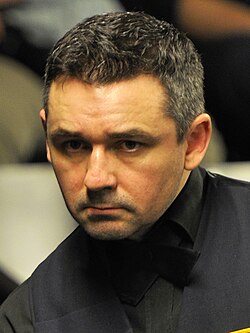
Snooker Professional and Commentator
Alan “Angles” McManus has spent a lifetime seeing things on a snooker table that others simply miss. Born in Glasgow, Scotland on January 21, 1971, McManus grew up in an era when snooker was not merely a game in Britain, but a national television obsession. Long before he became a Masters champion, World Championship semi-finalist, television commentator, and podcast host, he was a young boy fascinated by the sound, shape, and discipline of cue sports.
His earliest memories are wonderfully ordinary and revealing: a miniature snooker table at home, Cliff Thorburn winning the 1980 World Championship on television, football with his schoolmates, and the quiet realization that he had a natural relationship with a cue. As a child at a golf club, watching adults play pool while he sat with a Coke and a packet of crisps, Alan remembers thinking he was better than them—but being too polite, and too young, to say so.
That blend of confidence and restraint would become part of his cue-sports character. At school, lunchtime trips to Gus’s Pool Hall gave him his first taste of competitive action. By his early teens, he had moved from the small-table world of English pool into full-size snooker, made his first century break at 14, and found his way into local team play. His mother helped introduce him to structured coaching, including group lessons with Scottish professional Jim Donnelly. For Alan, coaching did more than refine technique; it opened “a world” he had not known existed.
McManus’s route to the professional game was shaped by discipline as much as… Read More