McManus, Alan
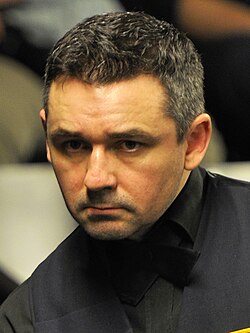
Snooker Professional and Commentator
Alan “Angles” McManus has spent a lifetime seeing things on a snooker table that others simply miss. Born in Glasgow, Scotland on January 21, 1971, McManus grew up in an era when snooker was not merely a game in Britain, but a national television obsession. Long before he became a Masters champion, World Championship semi-finalist, television commentator, and podcast host, he was a young boy fascinated by the sound, shape, and discipline of cue sports.
His earliest memories are wonderfully ordinary and revealing: a miniature snooker table at home, Cliff Thorburn winning the 1980 World Championship on television, football with his schoolmates, and the quiet realization that he had a natural relationship with a cue. As a child at a golf club, watching adults play pool while he sat with a Coke and a packet of crisps, Alan remembers thinking he was better than them—but being too polite, and too young, to say so.
That blend of confidence and restraint would become part of his cue-sports character. At school, lunchtime trips to Gus’s Pool Hall gave him his first taste of competitive action. By his early teens, he had moved from the small-table world of English pool into full-size snooker, made his first century break at 14, and found his way into local team play. His mother helped introduce him to structured coaching, including group lessons with Scottish professional Jim Donnelly. For Alan, coaching did more than refine technique; it opened “a world” he had not known existed.
McManus’s route to the professional game was shaped by discipline as much as talent. He has often described himself as someone who had to work, learn, repeat, and think his way forward. At 16, while briefly employed as a trainee car mechanic, he stepped off a bus on a snowy Glasgow morning, looked across at the workplace, and made a quiet decision: he was going to the snooker hall instead. There was no grand plan, no five-year promise, only a commitment to try.
By 1990, that commitment had carried him into the professional ranks. McManus turned professional on June 1, 1990, and quickly proved he belonged. Early success in the Benson & Hedges Championship, the Masters qualifying event, gave him a place at Wembley and confirmed that the thoughtful Glaswegian could compete with the best. He would become a fixture in the world’s top 16 from 1992 through 2006, reaching a career-high ranking of No. 6 and building a reputation as one of the game’s most resilient, tactically astute competitors.
The nickname “Angles” followed him for good reason. McManus was admired not only for potting and break-building, but for seeing the full geometry of a frame: the safety shot, the containing shot, the percentage choice, the shot that changed the psychology of a match. In an age defined by Stephen Hendry’s ruthless scoring, Steve Davis’s professionalism, Jimmy White’s genius, and the rise of John Higgins and Ronnie O’Sullivan, McManus carved out his place as a thinking player’s player.
His defining moment came at the 1994 Masters at Wembley, where he defeated Stephen Hendry 9–8 in one of snooker’s great finals. Hendry had dominated the event, winning five consecutive Masters titles and going unbeaten there for 23 matches. McManus ended that run with nerve, craft, and belief. It remains the signature victory of his career: a Scottish player beating the greatest winning machine of the era, on one of the sport’s grandest stages, in a final-frame finish.
That same period also brought ranking-title success. McManus won the 1994 Dubai Classic, defeating Peter Ebdon in the final, and the 1996 Thailand Open, where he beat Ken Doherty 9–8. He also represented Scotland with distinction, winning the 1996 World Cup alongside Stephen Hendry and John Higgins, and the 2001 Nations Cup with the same golden Scottish core. Those team victories reflected a remarkable national generation: Hendry, Higgins, McManus, and later players such as Graeme Dott and Stephen Maguire, all part of Scotland’s deep contribution to modern snooker.
At the Crucible Theatre, McManus authored another major thread in his story. He reached the World Championship semi-finals in 1992 and 1993, then, more than two decades later, produced a remarkable late-career run in 2016. That year he defeated Stephen Maguire, Ali Carter, and John Higgins to reach the semi-finals once again, proving that his mind, nerve, and match craft still belonged on snooker’s most demanding stage. His quarter-final against Higgins was especially meaningful: two Scots, two lifelong competitors, the Crucible curtain raised, the room packed, and the silence heavy with pressure.
After 31 years as a professional, McManus retired from competitive snooker in 2021. The transition, however, was not an exit from the sport. If anything, it revealed another of his gifts. As a commentator and analyst for BBC, ITV, TNT Sports, and Eurosport, he has become one of snooker’s clearest and most trusted voices. Calm, precise, curious, and generous with insight, McManus explains the game without flattening its mystery. He understands both the shot and the person playing it.
He has carried that same voice into podcasting through The Snooker Breakfast Podcast with Alan McManus, offering news, views, and opinion from around the World Snooker Tour. Like his commentary, the podcast reflects his love of the game’s details: the stories behind matches, the changing standard of play, the emergence of Chinese talent, the evolution of technique, and the enduring value of snooker history.
On Legends of the Cue, Alan McManus emerges as more than a champion. He is a storyteller, analyst, competitor, humorist, and custodian of cue-sports memory. He speaks warmly about Glasgow, honestly about fear and insecurity, admiringly about Hendry, Davis, Higgins, White, O’Sullivan, Ding Junhui, and others, and with genuine curiosity about pool, Allison Fisher’s crossover influence, American pool rooms, and the wider family of cue sports.
Alan “Angles” McManus earned his place in snooker history with titles, longevity, tactical brilliance, and one unforgettable night at Wembley. But his larger legacy may be this: he helps us see the game more clearly. Not just the pots and frames, but the choices, pressures, personalities, and lives behind them.

Alan McManus - Part 6 (The Future of Snooker, Pool vs. Snooker, and Alli’s Rapid Rack)

Alan McManus - Part 5 (From Professional Snooker Player to Commentator, Analyst, and Podcaster)

Alan McManus - Part 4 (Beating Stephen Hendry, Winning the Masters, and Crucible Memories)

Alan McManus - Part 3 (Steve Davis, Jimmy White, Technique, Talent, and the Rise of “Angles”)

Alan McManus - Part 2 (Pool Rooms, Road Players, Turning Pro, and the Discipline of Safety)
