

 Apple Podcasts
 Spotify
 George Ashby - Part 2 (High Runs, Hard Lessons, and Chasing the World’s Best)
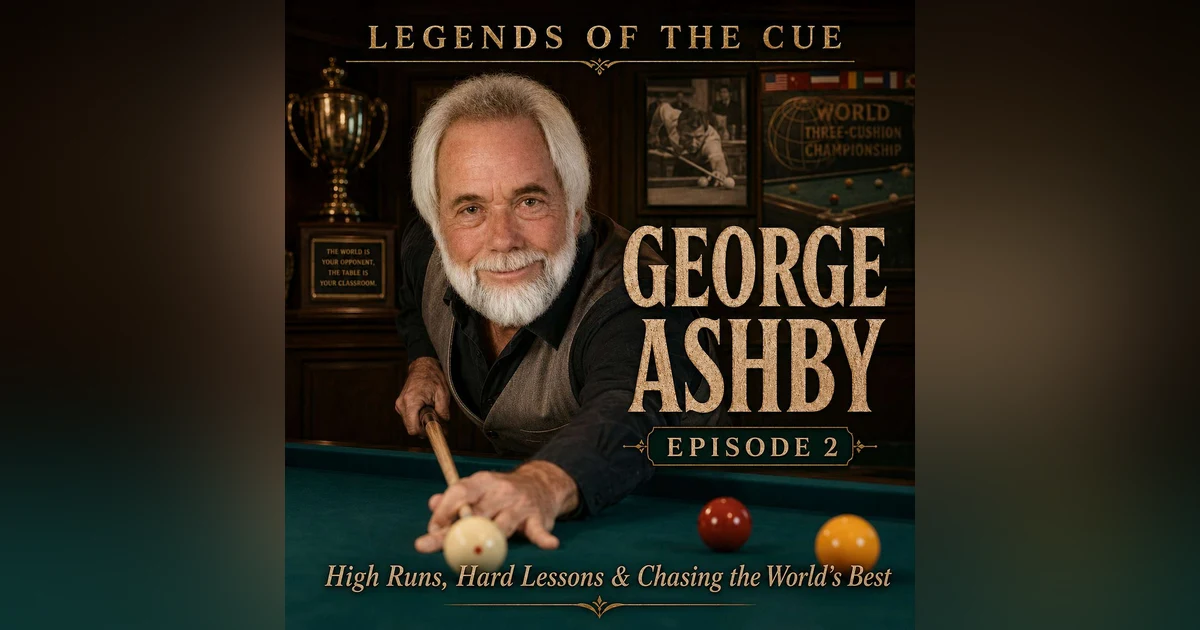

Part 2 of our conversation with George Ashby moves from the room to the arena, as George takes us inside the thought process, discipline, and competitive fire required to become a world-class three-cushion player. This is the episode where the game opens up. George explains the importance of scoring average, position play, shot selection, and concentration, giving listeners a rare window into what elite three-cushion really looks like from the player’s chair.
Along the way, he reflects on high runs, the satisfaction of controlled scoring, and the moment he realized that offense — not merely defense — would be the future of the game. He speaks candidly about studying his own matches, identifying weak spots in his concentration, and developing a more aggressive, television-friendly style built around scoring in bunches. It is a fascinating portrait of a player thinking several shots ahead while also thinking years ahead about where the sport itself needed to go.
George also shares the enormous influence of the European masters, including Raymond Ceulemans, Ludo Dielis, Nobuaki Kobayashi, and the systems and stroke variations that transformed his understanding of three-cushion. What he learned from international play forced him to rethink everything: equipment, tempo, speed control, and even how a champion should approach offense.
This episode captures the stretch where talent becomes craft. George is no longer simply a gifted young player from Illinois — he is becoming a student of the world game, measuring himself against the very best, and building the style that would define his championship years. For anyone who loves the deeper strategy of cue sports, this is a master class wrapped inside a life story.
Give Allison, Mark & Mike some feedback via Text.
Follow our show and/or leave a review/rating on:
Our website: https://www.legendsofthecue.com
Apple Podcasts: https://podcasts.apple.com/us/podcast/legends-of-the-cue/id1820520463
Spotify: https://open.spotify.com/show/4Za0IMh2SeNaWEGUHaVcy1
Music by Lyrium.
About
"Legends of the Cue" is a cue sports history podcast featuring interviews with Hall of Fame members, world champions, and influential figures from across the world of cue sports—including pocket billiards, snooker, and carom disciplines such as three-cushion billiards. We highlight the people, places, and moments that have shaped the game—celebrating iconic players, memorable events, historic venues, and the brands that helped define generations of play. With a focus on the positive spirit of the sport, our goal is to create a rich, engaging, and timeless archive of stories that fans can enjoy now and for years to come.
Co-hosted by WPA and BCA Hall of Fame member Allison Fisher and Mosconi Cup player and captain Mark Wilson, Legends of the Cue brings these stories to life—told in the voices of the game’s greatest figures.
Join Allison, Mark and Mike Gonzalez for “Legends of the Cu...
Mark Wilson
In your prime, George, what what would your uh score per inning be on average?
George Ashby
Well, I think most of the time I was around high num. I don't think I ever I had tournaments where I did where I did play better. I know a billiard digest open. We had three of those in Chicago at uh Chris's, and I think it was the third one I played in that in the semifinal round, I played a 1.3 average, which uh that's probably the best I had ever achieved. But uh I think most of the time uh I was around 990 or 980, and uh a few tournaments, 1.1.
Mark Wilson
Exceptionally good. Yeah, Kuulemans would be, you know, oftentimes around 1.3, 1.4, and he's kind of regarded as the all-time best, so.
George Ashby
Yes. And then they of course Blumdal came along uh and he raised everybody's game average, including Kulimman's. And Blumdal would actually shoot too hard for Raymond Kuliman's position play and go past the position and come into another position zone. So uh, and he was playing where Kuliman's was would score five cushions off a certain edge side of the ball, left or right, long or short off the ball for the next position, and Blumdahl didn't care how he scored the ball. He played more zone position play, I think. So uh which gave him more margin for error. I think he he proved that shot making was more important than you know, playing exact positions and exact speed. Of course, now we have these what I see of these South Koreans, they're playing a lot of center-of-the-short angle center-of-table positions and trying to see how many short angles they can make in a row rather than what Kulimans did with five cushion shots.
Mike Gonzalez
I think you guys are uh talking about an aspect of the game that most pool players can barely conceive. I mean, as a pool player, you recognize position play is very important, but when you just casually watching a three-cushion game, you know, the the only thought I ever have had at the table is can I score a billiard? Can I make a point? I mean, what happens to the balls and where they are all going and end up? I have no clue. But to think about then you guys actually playing the speed, the angles, and the position. You said something, George, which I was going to ask you about, which was the level of precision now in terms of scoring a billiard, isn't just hitting that last object ball. You talked about hitting the correct side of the object ball to leave yourself shape.
George Ashby
Yes, exactly. And to score on a certain side avoids playing defense on yourself, and it also opens up to where you can play your next shot off of either ball, the one you just scored on, or the one that's down the table, you know. So it gives you like sometimes six or eight choices for your next shot, where if you score on the incorrect side of the ball, you're left with maybe one choice only and a difficult shot. Just that I remember the first time I scored my first controlled run of four in billiards. I was so elated. And then I had a certain set off the break shot of four, and then it usually produced a cross table, like a either a running English cross-table or a reverse English cross-table, which then would produce another four run. So I figured if I could make a couple of cross-tables, which I used to practice a lot, I might have a 10 or a 12 or a 16 run, you know. If I can, and you you would try to score in groups of four. I did try to score in groups of four. I don't I don't know how these guys score twenty-eight, a high run of twenty-eight now that uh five people have done it. Yeah. It's astounding. It's amazing. I had uh two high runs of twenty, one at Chris's billiards in my 10-minute warm-up before I played Louis Compost. I had a 20 run in a practice warm-up session. And then I had one in a Jacksonville local league play tournament, which wasn't sanctioned. But uh then a couple of 19s, but uh I could get over 20. I'm so jealous of those guys.
Allison Fisher
Never too late. It's a very it's a very beautiful game when it's played well, when you see people who know what they're doing. And how do you go about, you know, when you're learning this game, are there specific tracks you need to learn? I mean, how does that happen?
George Ashby
Well, it helps if you have somebody somebody show you. It takes so long to learn three cushion on your own, but to get a leg up from somebody that, like you say, knows the tracks, the connecting diamonds, and the sympathetic positions. Renee Vingerhoot from Belgium was world champion, retired with a title in uh, I think '62. He was Raymond Kuliman's three-cushion billiard teacher. Kuleiman soccer player to begin with, and he couldn't decide if he wanted to be a professional soccer player or professional billiard player, but anyway, he he went with billiards. So he had a pro, the former world champion teach him straight rail, carum, and then a former world champion taught him one cushion and then and balk line. Then he had Renee Binger, who teach him three cushion, the world champion. And when Renee finished with him, he retired with the title world champion. He quit playing. He says, I know I can't beat Raymond next year in the but Renee Binger, he had the 32 offensive position play shot charts uh that I was fortunate when I was in the United States Army in Nuremberg, we had a uh Peter Spohr come up from Munich and gave us a clinic on Rene Vengerhood's position play, and then gave us copies of it, photocopies of it. And so I brought that home. And because I knew I knew that the future of an American player, because we didn't have the environment of Europe for competition, the future American player would just to play in world tournaments would be just be the best offensive player in the United States. You didn't you didn't have to necessarily be great. You just had to be better than everybody else. So that was my goal in my dream to become a professional world professional player. Yeah.
Allison Fisher
It's just like the the question really was, are they are there standard shots that you need to know just to begin with?
George Ashby
My first world tournament, I really learned it from watching Yoshihara from Japan and Ludo Delas from Belgium. Ludo was born with a down-through stroke. You know, he was world champion in Cairo, Egypt in 1981. Because Raymond Coolimus didn't come to the tournament, I always say.
Allison Fisher
Maybe we'll get him on and ask him.
Mike Gonzalez
Well, you mentioned Renee, he wins it in 1960, someone else wins it in 61, 62. They don't come they don't contest the world tournament. And Raymond comes Raymond comes along and wins it in 63 and 64 and 65 and 65, on on through like 73. I think he won about 11 in a row just to get started.
George Ashby
Right. And so it was 60 when Renee uh won his last title. Okay. Yeah. Now it's two years off.
Mike Gonzalez
Yeah. Yeah. Well, so so as your game develops as a kid, I mean, before you even uh compete and win in the uh you know, winning your first U.S. championship in 1976, how were you sort of gauging your game against others? Uh you just traveled in tournaments? Were they coming through town? What what was going on back then?
George Ashby
Well, yeah, we had a lot of tournament play around the Midwest, you know, Chicago, Milwaukee, uh Rockford, Illinois, uh in Indiana, South Bend, Indiana, the Elks clubs all through Illinois had tournaments, state tournaments every year in St. Louis, Kansas City, Missouri. Uh there were two rooms in Kansas City after the Kling Room closed, you know. Uh what was the he had a partner? Kling and Allen. Kling and Allen, yeah. So those two rooms were uh Don Brink and Room, and uh there was another one out at Raytown suburb. But uh we went to Lawrenceville, Illinois, Decatur, Illinois, Springfield, Illinois. You could there was a time there you could go in a car every weekend to a sanctioned billiard tournament somewhere within driving distance. So uh, but my game, I learned from watching and a few tips from the old players that played Ivory Ball billiards, ivory ball-style billiards, and that was full ball hit or half ball hit, drive the object, first object ball to the end rail to play position and avoid kisses, you know. But so it had long strokes, big 13 millimeter tips, and heavy, heavy balls. When I went to my first world tournament, I saw that everything was on fast tables, fast cloth, and shorter strokes and thinner hits, speed control. So I had to completely change my game to be competitive.
Mike Gonzalez
So you were mentioning, George, that uh you go and uh first of all you win your first national championship, which had to be quite exciting for you, but that gives you a chance then to do a little traveling and see some players and some styles of play from around the world that probably you had never been exposed to, right?
George Ashby
Well, uh Ivory Ball Billiards, that style. Uh, and the old men that taught me to play that I learned from as a little kid, you know, they played, they they took pride in their defense. And when I went to California, San Jose for my first national championship, these guys played dirty. I mean, they they were the epitome of defense, you know. If they they would rather play a play you frozen on the end rail than score a billiard, they got more satisfaction out of that. And of course, I uh I knew that that was just boring to watch wonderful defense. And I knew that if I if if we were gonna make it a living at three cushion billiards, it was gonna have to be on television with sponsors. And the people, the audience is gonna want to see scoring. And absolutely. They made fun of me at the national championship because I had the highest scored against defensive average points against me of any player in the tournament. A lot of times I would average 1.0 or 1.1, and then the uh my opponent would average in the 900s. And I told them, well, I said, that's fine. You know, I applaud them if they can play that good, you know. Uh, but my plan is I'll let them make four in a row and I'll make eight or twelve. And, you know, and I'll be the I'll be the winner and I'll be playing on television.
Mike Gonzalez
Sounds like a good strategy.
George Ashby
Yeah. So that was my strategy. And coming back from Europe, from the army with that 32 position shots from uh Renee. Renee, yeah. Renee Binger. Uh that was that was my new plan. And I was I got more satisfaction in a in a high run, you know, and and uh more like I told you, I was so happy when I had my first controlled run of four where I scored on a certain side of the ball, which I had seen from Raymond Coolimans and the other players in that time. So then I remember having a seven run, controlled seven, and uh a lot of that 20 run I had in Chicago in practice, warm-up practice, had about maybe three groups of seven in it, you know, of controlled billiards, which was really nice. And uh I was more about when I played tournaments, self-satisfaction than I was trying to impr uh impress the audience, you know. I wasn't I was always kinda shy as a person and uh I didn't I've never made a good public speaker or uh or uh or a show off or um you know exhibitionists, I guess is the word. So uh but anyway.
Mark Wilson
If you w uh George, if you won the lag, what would you estimate the break is worth to you points wise?
George Ashby
Off the break, win the lag off the break, uh I had four shots, a sequence of four shots that I practiced, and normally I could make those four shots if I knew the once I got the speed of the table or how it how the ball kicked off the end rail, whether it was opened up or was sharper off the end rail, you know. Yeah. Pretty big edge. It's a slight advantage, it's a slight advantage to have the to win the win the break only because win the lag, because if the player's sitting in the chair, he can't beat you. But I never looked at it as the end of the game if I didn't win the lag. And like uh I was playing in a national championship, one of my last in Chicago playing Sang Lee was in my in my bracket, semi semifinal bracket. We had like brackets of four players or whatever it was, four four brackets of four, and Sang Lee was in mine. So he's world champion, and I gotta I gotta beat the world champion in a 35-point game to go to the final in the nationals. Now that's a terrible position to be in, but so he wins the lag, and he runs a 12 off the break, going to 35, and I gotta beat this guy to get in the final. So I said, okay, well, I'm not playing good enough to run a 12, but I could maybe run two sixes. So that's kind of the mentality that you always had to have when you didn't win the lag, you know, no matter what it was. But if if the guy made two or four or five or six, you know, it was no big deal. You figure I'm gonna get my turn. But so anyway, Sang Li runs a 12. So I go to the table and I say, okay, I'm gonna run a six, you know. Well, I miss and he runs a four, and and uh, okay, now I'm gonna run a six. Well, I miss and he runs a two. So now he's got me 18 to nothing or whatever anyway. But finally the next inning I run a six, and then he's in the one hole, and I need six. And uh I beat him 35 to 34 with a with a run of six. Wow. And I had to, you know, it was so funny, I'll never forget it. But then I get in the final, and of course, the good thing about being the final is you make a little money and you have a lot of fun, you play all the best players, and and uh you get a chance to be national champion and go to a world tournament. So is it but all that's on the line when Sang Li runs at 12 from the break, you know, all that stuff that happens on Sunday.
Mike Gonzalez
Well, and just for our listeners, we're talking about a guy that uh kind of took U.S. three-cushion billiards to another level. He wins 12 national titles in a row.
George Ashby
Yeah.
Allison Fisher
Sang Li, yeah.
George Ashby
He was so gifted. And Kuliman's recognized it in an exhibition match. He played with Sang Li in New York City. Um, and I can't remember what year that Sang Li was accepted into the world uh tournament program, the World Cup back then it was called.
Mike Gonzalez
Yeah, well, he won it in 1993.
George Ashby
Okay. But Kuulemans told him, he said, uh Kuulimans did win that exhibition. It was over uh they had it every night after the tournament, and they played, I think, 500 points. They'd play uh 100 points a night or whatever it was. And and Kuulman's did beat Sang Lee in that. But he promised Sang Lee he would put a good word in for him and get him into that World Cup Grand Prix or whatever it was called back then. Uh I think it was the one that was started by Mr. Bayer Bayer out of Switzerland in about 80, anyway.
Mike Gonzalez
Well, Sang Lee, when he when he won it, he he beat uh Torbjorn Blomdahl, is that how you pronounce it from Sweden? A guy who had himself seven world titles. Of course, uh number one Ray Kuhlman's at at 21 from Belgium, and then Willie Hoppe had 15 to his name. Would those be uh three of your top world players ever?
George Ashby
Well, yes, yes. Kobiashi, Torbjorn, Raymond Kuulman. Um Coulomans has gotta still be my number one no matter what, because maybe because I I got to play with him so often and study his game from courtside.
Mike Gonzalez
I think I remember talking to you once about coming back from Worlds, and you just kind of shook your head at that and marbled at the level of talent that existed, particularly with Kulimman's, that he he was just on a whole nother plane, kind of like a Michael Jordan in basketball.
George Ashby
Yeah, and Kuliman's he was a master of all facets of the game. Three cushion billiards, which of course, Europeans they start out playing billiards. They they start out in kindergarten, and that's what he told me to do. You know, when I went back home, practice kindergarten in first grade and second grade, play the small games, and become more proficient at at uh one cushion. And he said it will strengthen my three cushion game enormously. But he saw promise in me at one time. He said, I think you I think you can be uh the next, you know, the future world champion. But I never I never had enough. If I had moved to Europe, Renee Winger, who wanted me to move to Europe and take lessons from him for 30 days, and then he would bring in other people too to help me. But my mother and father weren't for it, and it was it'd be a big move. And I didn't speak the language, of course, but I spoke the language of billiards. That would have probably been the smartest thing I could have done was was go see Renee and live with him for 30 days or more.
Mike Gonzalez
Yeah, you probably don't remember this, but at one point you did give me a copy of some billiard diamond system diagrams.
George Ashby
No, I don't. I don't remember.
Mike Gonzalez
Yeah. And it was just I I I would sit and watch George play at the Drexel and just marvel at the skill because I I knew nothing about the game, but I I wanted to learn and and uh see how it applied to improving the pool game. Of course, Mark, uh, you and I have talked about this, and and probably your advice to a young pool player would be hey, you need to play some three-cushion because there's a lot of carryover that would help you with your pool game, right?
Mark Wilson
Absolutely right. The uh my question was, but Allie, you had a question, why don't you?
Allison Fisher
I did have a question because you talked about the lag earlier, and I just wanted, for the listeners' sake, to find out how the balls are positioned at the beginning of the game.
George Ashby
Okay. Yeah.
Allison Fisher
There's uh the red ball, the yellow ball, and the white ball. So if you're coming in, you've just won the lag, let's say. How are the balls positioned?
George Ashby
So there's three uh three spots at the head of the table and one spot in the very middle of the table where uh if it had side pockets, it would be there, and then one spot at the foot. The foot spots for the red ball, an object ball, and then uh the center spot at the head of the table is for the opponent's cue ball. And then there's a spot on each side of that spot for your cue ball, left side or right side, whichever you prefer to which side you prefer to shoot the break shot from, and then you're required to hit the red ball, shoot to the red ball first, and then get uh three cushions minimum back to the opponent's cue ball.
Allison Fisher
Is there a standard way to do that? Does everyone have a standard way?
George Ashby
No, it varies extremely different for the conditions of the tables and of course if the balls are clean or dirty, sticky or slippery, but under world tournament conditions are always on new cloth. I remember there was one year in New York at St. Lee's Billiard Room. The old one before Carum Cafe, about 93, I think. Players from all over the world couldn't make the break shot because it was too slippery. The balls were too slippery. So if they won the lag, they would give their opponent an offensive move would be give your opponent the break shot. Interesting.
Allison Fisher
That is interesting.
George Ashby
Probably pretty unusual, too, huh? First time I'd ever seen it.
Allison Fisher
And there's always a heater, isn't there, under a uh three-cushion table, the tables heated.
George Ashby
Yes, yes, and Sangli's tables were heated. Of course, our old tables I grew up on were not heated. When we learned about European heated tables about 1985 or something, maybe they had some imported into maybe before that, into Vegas for a tournament. Then we started trying to heat our old Brunswicks with gutter heaters or whatever, space heaters of some kind, to try to take the humidity out of the cloth and keep the rubber cushions warm and supple and to achieve a more consistent play from the table, no matter what the weather was outside.
Allison Fisher
Yeah, I used to have a heater under my snooker table, because in snooker environments, um like professional environments, it's heated.
George Ashby
Uh-huh.
Allison Fisher
Um but I it's always struck me like snooker, it's very much a gentleman's sport. I did watch that tournament in Vegas, um, not s well, it was a long time ago, but there was a three-cushion that had all the masters of the world in it, and everyone's in tuxedos, right? And shirts and bow ties. Is that correct?
George Ashby
Yes. I'm not sure about the tuxedo part, but we played black sweaters and white shirts and ties, and that went away. Kuulemans was he ended the necktie thing and the tuxedo thing. I think he might have played one year in a tuxedo, and then he came in and said, I'm world champion, and we're not gonna do that anymore. And so then they went to the black uh black sweater with the white shirt with the collar out. Sounds more comfortable. Flexible and comfortable.
Mike Gonzalez
So, George, your first world event would that have been in 76 after you won the U.S. championship? Yes, it was. Uh-huh. So it would have been in Belgium and Brussels or where? Sten Belgium, yeah. A fishing village on the North Sea there. Mm-hmm. Cross from England. Had you been to Germany in the Army by then? Probably so, huh?
George Ashby
Before that, yes. Yeah, I was in uh that was 76 a tournament, and I was in the Army 72 to 74. Okay. So and that was nice because I had a contingent of 75. 75 people came up from Nuremberg, Germany to watch the tournament. And so I knew them, you know, most of them.
Mike Gonzalez
Yeah. Yeah. So how did you do in that first world tournament?
George Ashby
Well, the first thing I did was Kamori felt sorry for me, and he came over with a a shaft for my cue. He took my screwdriver and took my cue apart and took all the weight out of it and gave me a real much shorter shaft with cone-shaped taper for me to put on my butt and play with that. Uh-huh. I was completely lost with what I had. I had a 60-inch Q-stick. I thought it I could reach, you know, I was a short guy, so I thought maybe I could reach more shots with a 60-inch Q-stick and a 13 millimeter shaft and a professional pool player professional taper, which was entirely different than what they were their equipment was with the 55.5 inch Q and a 10 millimeter tip and a cone-shaped taper with a professional relief at the last eight inches is what Kulimans used. But uh completely different. And then instead of 20 ounce, they were using 17 or 18 ounce. So so I played with my Kamori modification, and by about the sixth game I I was kinda enjoying myself. But of course, when you're number 12 seed, I think I was 12 seed. According to your national championship average is how they seed you into the world tournament. Twelve players. One from each country. And sometimes two. But uh they seed you. So what I'm number 12. I played Ray McQuilliman's first game on TV with three TV cameras. You talk about scared to death.
Mike Gonzalez
Little kid from Jacksonville going up against the oh my.
George Ashby
I got a cameraman next to my player's chair, and I got a camera coming down from overhead, and then one that's back, you know, to follow me around. And so it was it was pretty scary. And then the table light was uh one maybe twice as big as Mark's, or twice as wide, mounted up near the you know, 15 foot over the table, but with high intensity Rhe stat on it for television.
Allison Fisher
Yeah.
George Ashby
So it was like I almost needed sunglasses to play.
Mike Gonzalez
A little different than playing at the Drexel, huh?
George Ashby
Yeah, it was a lot different. Uh tournaments around the United States with the old Brunswick tables with the three individual globes hanging over with a light bulb in them, you know. 75-watt bulb in each one of them. Some pool rooms, they only had like 60 watts in there because they were trying to save money.
Allison Fisher
Thank you for listening to another episode of Listen to the Cube. If you like what you hear, wherever you listen to a podcast, including Apple and Five and Five.
3-Cushion Billiard Player
George Ashby’s story belongs to a special chapter in American cue sports: the family-run room, the long counter, the old Brunswick tables, the smell of chalk and tobacco, and the kind of education that came not from formal instruction but from watching great players, listening closely, and learning one shot at a time. On Legends of the Cue, Ashby comes across as exactly what the finest figures in cue sports often are—part champion, part historian, part craftsman, and part keeper of a disappearing world. He was introduced on the program as an eight-time national champion and one of the greatest American three-cushion players of his era, a reputation he earned through decades of excellence and deep devotion to the game.
Ashby grew up in Jacksonville, Illinois, where his father first operated a grocery store across the street from the poolroom that would later shape George’s life. When competition from a new supermarket forced the family to move on from the grocery business, his father purchased Drexel Billiards, a combination pool hall, restaurant, and tobacco store near the Morgan County courthouse. George was still a little boy. His first jobs were simple and age-appropriate: stacking toilet paper in the grocery store, then washing Coke glasses and root beer mugs in the restaurant because the sink was low enough for him to reach.
What makes Ashby’s childhood so memorable is how naturally the room became his school. Drexel was more than a business. It was a living classroom. The restaurant made up most of the revenue, but in the back were the billiard and… Read More