

 Apple Podcasts
 Spotify
 Hydred Goldberg - Part 3 (From Wheelchair Pool to World Champion)
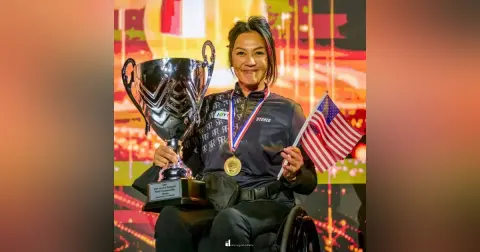
Key Takeaways
- Playing pool from a wheelchair requires highly tuned sensitivity to table height, flooring surfaces, wheel positioning, and customized stroking mechanics like tucked elbows or sidearm strokes.
- Transitioning from American 9-ball to Heyball—a hybrid discipline played on tighter snooker-sized tables with distinct rails and cloth—demands a shift toward strategic maneuvering rather than power shooting.
- Hydred Goldberg made history as the first women's champion and a two-time WPA Parasport Heyball World Champion, despite having no prior competitive experience or regular access to a Heyball table before her first world event.
- Both elite able-bodied players and world champions like Allison Fisher and Hydred Goldberg frequently experience imposter syndrome, questioning their historic achievements long after securing major titles.
- Defending a world championship introduces unique psychological pressures and an ego-driven desire for validation, proving that a second victory solidifies a player's true credibility and sense of belonging at the elite level.
How does a lifelong 9-ball player enter a world championship in a game she has barely played—and leave as the first women’s champion in its history?
That unlikely journey is at the heart of Part 3 with Hydred Goldberg on Legends of the Cue.
Hydred joins Allison Fisher, Mark Wilson and Mike Gonzalez for a detailed exploration of what elite pool really looks like from a wheelchair. She explains how table height, flooring, wheel position, abdominal strength and stroke mechanics affect every shot, why draw can become particularly demanding, and how wheelchair players develop different patterns and solutions around the table.
She also remembers the atmosphere of old-school Southern California poolrooms, watching Keith McCready perform an outrageous draw shot at College Billiards and looking up to top female players such as Tina Pawloski.
Hydred then traces nearly two decades working in makeup before stepping away from that career and recommitting to pool. Her return led her into the National Wheelchair Poolplayers Association, where she became increasingly aware of just how few women were competing in wheelchair billiards.
Then came a phone call about something called Heyball.
Hydred had never seriously played the Chinese-origin discipline and had no regular access to a Heyball table. Yet at the inaugural 2024 WPA Parasport Heyball World Championship in Los Angeles, she kept winning.
Her championship battle with Catherine Schneeberger eventually came down to a spot-shot shootout—the second shootout the two had contested during the event.
Hydred won.
Six months later in Brisbane, she did it again, defeating Schneeberger once more to become a two-time WPA Parasport World Champion.
Hydred discusses the pressure, the friendship, the rivalry—and the lingering imposter syndrome that made even two world titles difficult to comprehend.
Give Allison, Mark & Mike some feedback via Text.
Follow our show and/or leave a review/rating on:
Our website: https://www.legendsofthecue.com
Apple Podcasts: https://podcasts.apple.com/us/podcast/legends-of-the-cue/id1820520463
Spotify: https://open.spotify.com/show/4Za0IMh2SeNaWEGUHaVcy1
Music by Lyrium.
About
"Legends of the Cue" is a cue sports history podcast featuring interviews with Hall of Fame members, world champions, and influential figures from across the world of cue sports—including pocket billiards, snooker, and carom disciplines such as three-cushion billiards. We highlight the people, places, and moments that have shaped the game—celebrating iconic players, memorable events, historic venues, and the brands that helped define generations of play. With a focus on the positive spirit of the sport, our goal is to create a rich, engaging, and timeless archive of stories that fans can enjoy now and for years to come.
Co-hosted by WPA and BCA Hall of Fame member Allison Fisher and Mosconi Cup player and captain Mark Wilson, Legends of the Cue brings these stories to life—told in the voices of the game’s greatest figures.
Join Allison, Mark and Mike Gonzalez for “Legends of the Cu...
Frequently Asked Questions
What is the WPA Parasport Heyball World Championship?
The WPA Parasport Heyball World Championship is an international cue sports tournament featuring athletes in standing and wheelchair divisions, utilizing Chinese-origin Heyball rules on tighter snooker-sized tables.
How do wheelchair pool players adapt their shooting mechanics?
Wheelchair players often adjust by utilizing a tucked-elbow or sidearm stroke to maintain stability and generate power, compensating for table height variations and limited vertical shoulder movement from a seated position.
Who is Hydred Goldberg in cue sports?
Hydred Goldberg is a pioneering cue sports athlete and a two-time WPA Parasport Heyball World Champion, known for making history as the first women's champion in the discipline's history.
I just wanted to have you talk about that a little bit. I'm sure uh you would be very, very welcomed over there as a world champion, uh going to the Philippines uh uh with your pool persona and experiencing some of the things that Mark experienced over a period of time. And and uh uh you know, some of our other guests, Darren Appleton I'd mentioned, had spent several months over there, and I think he came out of there a world beater just from that experience.
Hydred GoldbergYeah. That's what I heard, right. You know, um when I was talking with Henrik, uh we were in Rome, he we talked about the Philippines and how huge the the interest is with Paul there. And then we we uh he brought it up, which was what are the chances, you know, that Paul is so popular, like what about the disabled community out in the Philippines? And I just thought, oh, I never even thought of that. Yeah, I mean, it's uh I heard, you know, certain areas is really difficult. Uh there's difficulty in getting around. Um, you think about playing conditions with the heat and uh sort of the the overcrowding stuff, bugs. So I was curious to find out, you know, what if there are other wheelchair pool players out there and women who women pool players. It's it's funny because there there really aren't that many. And uh, you know, with the world championships that we had for Hable recently, uh both divisions of standing and sitting were lumped together. So we only had one division for women, uh, while the men had both standing and sitting. That would be I'd be curious to see what other places.
Mike GonzalezYeah, yeah. Well, let's take you back then to the development of your game as you started getting more serious about it. Maybe for our listeners uh who couldn't even fathom how the game is different, or somebody playing from a seated position, help them understand what's different. What did you start noticing about what's difficult, what's not so difficult? How did you tend to then find ways to overcome the challenging shots on the table? How did you change your pattern play to leave balls a bit more accessible to you? All that kind of stuff that you had to learn, uh, because it didn't sound like you had people necessarily mentoring you on the finer points of seated play. How did you get through with all that? Just what what do you recall about that whole process?
Hydred GoldbergI and I may be able to speak on behalf of all seated wheelchair players, is we are highly sensitive to things like height, uh the kind of floor that we are working on, if it's a very thick carpet or concrete uh leveling of the floor. Um Hable tables uh as you all might know are slightly taller than say American pool tables, you know, um about that maybe an inch and a half. So adjustments to your playing chair, if if someone has a playing chair would uh you know make them taller, you'd uh start simplifying uh your game more. Um and I'm I'm speaking mostly with hay ball because you you're not I'm not going to be busting out like power shots or anything. You know, it'll be more maneuvering um outmaneuvering my opponent rather than um shooting them if I'm if I'm not seeing my aim quite nicely, you know? Um so yeah, I'll I'll be seeing things like the the height of the table, the way they roll, the rails. Um it won't be too different from uh able-bodied players, but definitely sensitivity to height and the floor and you know how you're aligned to the table are crucial.
Mike GonzalezWhat was the toughest shot you found uh early on that you really had to work on to get good at?
Hydred GoldbergOh, that's great. Uh I'll say uh draw shots. Um I found because of uh my stroking arm uh I shoot slight uh more traditionally kind of underarm. Uh I've changed my stroke a little bit where I've got my elbow tucked for sustainability now because I can't be doing this with um, you know. So we you know we have some uh different articulation of the shoulders. We can move this around in so many different ways, but in terms of uh lifting up high, um I had to adjust to a side uh stroke. And um that yeah, that's just one of one of a few things that we'll all be uh trying out differently. Like I do know that a lot of wheelchair port players do s shoot sidearm um and and that is helpful for almost any table height.
Mike GonzalezYeah. That worked pretty well for Keith McCready, by the way, and maybe Ralph Reeley.
Hydred GoldbergYes, yes. Yeah. Um that's that's true. Yeah. I remembered seeing Keith McCready at College Billiards. It was such a it was sorry, that just kind that that was one moment that was really wonderful. It was the 2000s and um, you know, money was thrown around a lot, you know, there were a lot of games going on, and he was playing a local guy, who's probably one of the best in San Diego around that time, um, along with like Victor Castro, um was San Manoli, and they were playing on this table that was right next to the bathrooms. And there's this wall that's just horribly or the table's horribly positioned to this wall, and you had to do this crazy shot, Keith McCready, where you know, he hit the wall, he looked back, and it was a crazy draw shut and just went at it, and it was just the coolest thing. There's a banister at college billiards, so people were kind of looking over, and there's another area that you're kind of seated up high. So it it's just back early in those days, it just seemed like it was really alive and colorful. We're a lot of barking, as you know, right?
Mike GonzalezYeah, yeah. Yeah, of course, we've had Keith with us on the show and he helped us relive some of those years. Of course, Mark lived them, and so Mark relishes in uh in talking about that era in terms of how how different pool was, wasn't it, Mark?
Hydred GoldbergYeah.
Mark WilsonSo college billiards was your primary room in San Diego, and that would would you say that was your most formative pool years?
Hydred GoldbergEarly on, yes, yes. Um and then on Q billiards. Mark, did you did you ever go to Palace Billiards in Vallejo? I I was just wondering.
Mark WilsonI don't think I did.
Hydred GoldbergNo, okay. Yeah.
Mark WilsonI didn't venture out there. Uh On Q is an incredible place, too. I really like that. Uh it's a very comfortable room. They have a 6x12 alley. And it's uh they have serious players, and I love the owner, Clyde. He's a uh Clyde Padre fan. Yeah, he has season tickets, so I'm always watching his posts. Yeah. He's awesome. Yeah. How about Tina? Did you know Tina Polaski? Uh oh I know Tina. Yeah. Yes, yes. So she had to be someone that would be an inspiration for you then.
Hydred GoldbergAbsolutely. Yeah, back in uh back when I was starting off in uh the pool scene back then and doing more APA uh league, I remembered Tina Pulowski um was definitely one of the top women out there. Um and uh yeah, they used to call her Filipina Tina, you know, because she had um which has since you know been changed a little bit, she says. I saw her on her birthday not too recent. Uh well, kind of recently, um, out here at Bluegrass Billiards um in New Jersey. That was that was a nice reunion moment for us there.
Allison FisherThat's lovely. Did being a woman present a different barrier from being a wheelchair player? Or did the two become inseparable?
Hydred GoldbergThese are great questions. Who's coming up with these questions? Certainly not me.
Mike GonzalezWe have no idea.
Hydred GoldbergI love it. It is uh they became fused. Um mostly it kind of like a double whammy. You know, if I'm playing pool with someone and it's you know, like for shits and giggles, you know, and I'm beating them, and it's sort of it's a guy, let's say, and you know, it does it's it's kind of um not awe-inspiring, but there is something about it that is also giving me a secondary high from it. So I I think being a woman and then in a wheelchair is sort of uh if good, combined together, it's kind of deadly and cool. Huh?
Mike GonzalezMm-hmm.
Hydred GoldbergYeah.
Allison FisherFirst date nights, take them by them pool.
Mike GonzalezRight.
Allison FisherAnd then never see them again.
Mike GonzalezYeah. So help us with the with the chronology, because you you kind of you kind of start getting serious about pool, you're playing in some professional qualifiers and so forth. And then um at some point, I think you went into the the more the makeup career, right?
Hydred GoldbergYeah, I did. I did.
Mike GonzalezAnd then occupied a period of time. And then was it something then that you you kind of came back to pool after that period?
Hydred GoldbergThat's correct?
Mike GonzalezOkay.
Hydred GoldbergYep. I uh after good like nine years with San Diego Comic-Con, practically 20 years in all kind of makeup endeavors, everything from moulage, like simulative inju injury-based um prosthetics, to um like bloomingdales and Mac um counters, you know, doing more retail with makeup and weddings. Huge, that was really huge for me. I I did uh retire from pool um and that was roughly around 2019. Um But yeah, it took out a good chunk of my life and I I I love every moment of it. Um Th there was a point with my employer where there was some burnout too with makeup and uh as a trainer for a very large company um that didn't come to fruition. That really it burned me, you know. So I I felt like uh I just made the choice to uh to leave that world. You know, there's also upcoming makeup artists and just kind of making room for them, making way for them because I also didn't find myself as passionate about uh makeup. You know?
Mark WilsonWhen you returned seriously to the game, how much of the player you had been was still there?
Hydred GoldbergI knew how to hold a cue. Uh hot hot and cold. There was a lot of hot and cold feelings of uh, you know, I can do nice runs, have have a good pattern on the table, and then suddenly I'll be shooting where I you know I'm like a diamond away from the hole. And so it I felt like I was starting over again. Um frankly when I was the most relaxed was when I would be shooting more concentrated and um definitely more uh I guess focused. I felt like I've I've I'm just kind of can be very distracted, but but I can also hyper focus and and kind of uh practice uh whether it's pool or painting or guitar, I can practice for a very, very, very long amount of time.
Mike GonzalezYeah.
Hydred GoldbergSo I think it's more qualitative now.
Mike GonzalezIdrid, when you got back into the game at this point, then is that when you sort of discovered there was a Parisport wheelchair pool community out there?
Hydred GoldbergYes, that uh I'd heard about it, you know. I was already in APA and I wanted to do more tournaments and I'd learned about the um National Wheelchair Pool Players Association. I did uh do quite uh a few of those events. Um I didn't stick with it because of well, you know, my makeup job, but I found myself with a a niche of maybe promoting a little bit more uh women's wheelchair sport be uh cue sports because there were only maybe two or three in the NWPA uh women who were active players at the time. Um so it was a very uh it's it's something that I know I'm in a very small niche, uh uh tiny sliver of the demographics, you know, we already see that women's pool is is already quite it it's getting larger, but it's it's smaller, definitely smaller than men's pool. And just imagine an even smaller sliver of that is wheelchair women's pool. So it's uh that's something that uh I've been thinking about a lot, you know.
Allison FisherUm sorry, go on. What did finding other elite wheelchair players give you that competing primarily against able-bodied players could not I uh have talked to some of my other wheelie friends about this too, because there is something quite different.
Hydred GoldbergWhen you are playing in a wheelchair event, I think we're all thinking, oh, we're gonna do really good, because I play only with able-bodied people. You know, because uh typically I'm the only one in my, you know, in my town. And lots of the other wheelchair players are also the only ones in wheelchairs in their pool hall. Yeah. So you get good, great, and but then there's this weird mental block when you play other wheelchair players, and it seems to be harder. I don't know if it's just another mental aspect.
Allison FisherUm an analogy to that could be like I remember Jasmine growing up or myself playing with men, and you think, oh look, I've got an advantage, I play with men all the time. But then you go and play with women and you get beaten. Yes, yeah. It's the same psychological thing as well.
Hydred GoldbergIt's the same thing, it really is. Yeah, yeah. That's that's true. And then, you know, I'm I'm I played in uh Dubuque, Iowa.
Mike GonzalezUm That was the the uh USA Q Sports tournament?
Hydred GoldbergThat's correct, yes. Uh, it was it was an incredible event. It was the first time I did more than two events at once.
Mike GonzalezUm You did five, didn't you?
Hydred GoldbergI did. Yes, I did. Wow. It is uh two um uh yeah, two women's events, uh where uh and then uh two wheelchair events as well, and then another sort of exhibition match uh on the TV table there. Uh and it really pushed me. I I enjoyed it, and sometimes I wonder, wow, how do people do this? You know, like play in so many events at once.
Allison FisherAnd I don't know, I wanted to ask you that, Ali, but it's like I don't think I have, but I mean I I've I'm gonna start I want to start playing in seniors and things like that. And I can't play in juniors anymore. I tried to, but they won't let me in. Maybe amateurs, amateurs and seniors for me now.
Mike GonzalezYou did two, Allie, as recently as December. Two was bad enough, wasn't it?
Allison FisherIt's very difficult, especially with that predator series with the way it was. I'd write the doubles and the singles, and that was very exhausting.
Hydred GoldbergIn Jacksonville, is that the one?
Allison FisherYeah, about nine in the morning to eleven at night. It was very difficult.
Hydred GoldbergBut I was watching, yeah, I think I I'd watched some of your match with Jesus. Oh, yeah. Scotch doubles. Oh, it's incredible. It's just intense and yeah, it was almost back to back to play.
Allison FisherThat was the first time I connected with you again in many years.
Hydred GoldbergYou and your mum, yeah, yeah, that's right. Meeting in the cafeteria. That's right.
Allison FisherI'm still in the tournament. Yeah, that's right. That's right. Oh dear. But if I wasn't, I'd have joined. That's right.
Mike GonzalezYeah.
Allison FisherYeah. It's always great though. But yeah, what's Devana Easton, the juniors get to play in the female event, the under 19, under 21, under you know, all these open events, the juniors, yeah, lots of lots of events.
Mike GonzalezYeah.
Allison FisherHow did you hear that the WPA was going to stage a Parasport Hayball World Championships?
Hydred GoldbergI learned about it from Charles and Tarrante, who is uh uh the lead for the National Wheelchair Pool Players Association. And he told me, he said, Hi Jan know if you're interested. I was in I was over here in the East Coast in New Jersey. He he doesn't live too far from me, but he's much closer on the east side here. Um and he says, you know, to I don't know if you're interested and come and check it out. I said, I don't I don't know. He said, Um have you played Hayball before? I said no. And so that's how uh it started. Uh it so happened that uh maybe a couple days later the event was happening and I'd just landed back in San Diego from being out here, so it I I did it out of one curiosity and um convenience, but I was still kind of skeptical. I didn't know anything about Hable. I just knew that it was like on a snooker table. Um did you ever play snooker? No, no, I've practiced trying to shoot shots and those types of pockets, but never a full game. Yeah. Yeah. Don't do it to the book.
Allison FisherBut with an English accent, you should. Yeah, I should.
Hydred GoldbergAnd then if I wore my glasses too, I could look smarter. There you go.
Mark WilsonWhat was your reaction to the tables?
Hydred GoldbergOh my gosh, it was um a little bit not infuriating, but something along the lines of, oh my god, this is a hard game. Why would we do championship on this? Or how how did this come about? And it was it was pretty amazing, especially with when you think about the way the the pool tables are made, uh the the type of rails they have, uh the cloth, what we're not used to. Uh a lot of us, you know, we're new to this game, so y you got these bouncy rails, you can't really do rail shots. Um unless you, you know, of course you're you play on those tables all the time. Uh So I I found my game to be more strategic as opposed to potting. I I just I I couldn't, you know, it was it was a hard I just think hard game for everybody.
Allison FisherBut um your early years in chess became important.
Hydred GoldbergAh, you know what? That's I do see a correlation between the chess and and uh Hable. Yeah. No, because it's a good thing.
Mike GonzalezI don't think that Yeah, I don't think that God ever intended to have a human being use American balls with English pockets. Just saying.
Hydred GoldbergI I gotta ask right now. Allie, Mark, this question is for you. Like I mean, I know you you've played some hable. Mark, do you play?
Mark WilsonNo, there's not a I mean I played it on a snooker table, American snooker table, which would be as close as five by ten. Yeah.
Allison FisherI think it's a great hybrid game. I really do, because I obviously grew up playing snooker, so I think just a smaller table is really nice. I think it's a really good and it makes you much more focused. Especially with your eyes, Mark. You know, we talked about the eye pattern. I tend to when I play on small pockets of anything, doesn't matter what the table is, I tend to have a longer hesitation, a longer gaze at the object ball before I strike.
Hydred GoldbergDo you find yourself lower on the table as well? Like I mean, more in uh focused.
Allison FisherIt's a I'm always low on the table anyway.
Hydred GoldbergYeah.
Allison FisherBut it's much more comfortable because it's like a snooker table because it is a little bit taller.
Hydred GoldbergYeah, that's true. That's right. Yeah.
Mike GonzalezBut should the game be played with the English balls size, the stucker ball size?
Allison FisherIf you need that little bit of extra pocket size, Mike, yeah, of course.
Hydred GoldbergFine. Right.
Allison FisherYeah, go back to your little stick. Yeah.
Mike GonzalezClosed bridge. Closed bridge.
Allison FisherI think it's a great game, but it's so popular in China. Millions of people play that game and they're fantastic at it. They're all experts. It's like Snooker in England. You go into a club, an amateur player is a very good player. It's the same with Chinese broad in China. Only multiplied by a huge population.
Hydred GoldbergYeah.
Allison FisherOh, I wanted to ask you if you have access to a Hayball table. You know, how much access do you have to practice and none at all?
Hydred GoldbergIt was uh no, I um I did learn that Sandcastle had a table. It's about an hour away from me. Edla Down. I wasn't correct, yeah. But I never uh got to go there. I was going to practice with um Emily Duddy because I would see her on occasion at the Amsterdam Billiards Cafe in um in Manhattan area. But uh no, I haven't had any practice on the hay balls prior to the tournaments.
Allison FisherThat's very, very difficult then to try and play on the table you never get to practice on. It's so different.
Hydred GoldbergIt it is. It is. And like you said, uh I'm I was taking more time, can't power balls or you know, I I'm super careful, like uh I'm more strategic, but then also slowed uh a rack down, you know, just because we didn't really know what we were doing either, you know.
Allison FisherWell it's new, it's a little more difficult.
Mike GonzalezYeah, I mean hydrid really what what you did in that first heightball championship reminds me a little bit about what some of the things we heard from Chris Melling recently. You know, he'd turn up at a tournament and all of a sudden somebody hands him a cue to use and he'd win the event. So here you are walking into an event and you've never played the game before. I mean, how many sports on the planet do people walk into a venue to a world championship having never really played the game and winning the world championship? That's pretty cool. That is pretty cool. So as you went through matches, you know, from that early match until the final against Catherine, did you feel yourself getting a little more clever and a little smarter about uh how to approach the game?
Hydred GoldbergUp until that point, I'd not lost one match at all. Uh and so it was also very encouraging to you know to to get to that point. I was finding that I were yeah, I was uh I I guess honing in or uh working more on the strategy side of it. But it's a hard game, right? It's not easy, especially come across some really skilled players, so it's yeah, it's tough.
Mike GonzalezSo you you go to the final against Katherine Schneeberger. It goes to a spot shot shootout. Now, this is something Allie loved these, these she loved these spot shot shootouts.
Allison FisherDo you really? Yeah, my face says it all, doesn't it? Look at that giant smile that's not there.
Mark WilsonRight.
Allison FisherI'll tell you, I'm about a 50-50 with a shootout. I am in my realm. Honestly, it's not a it's not a guarantee. There's no guarantees in it.
Hydred GoldbergIt's not, it really isn't, especially with a spot-to-spot shot as opposed to say like on a predator shootout. Right. You've got uh, you know, where you could actually see a little bit more of the angle. So uh yeah, it was it was great. I was behind in this match with with Catherine in the uh first world championships, and then uh yeah, we tied it up and then went to the shootout and did the lag uh I believe I got the lag and how to go first. Uh and then yeah, we're going back and forth with the shots I remembered making the eight ball and then uh scratching I always went for the left pocket. Um to to be honest, I I didn't I didn't practice it but I I don't know, it was it was I was able to see it so much better. It was like a very, very weird my brain uh it was just very focused in on I put a little bit of uh top right English so that I wouldn't scratch the next time and it and uh did that two in a row, I think, or three in a row.
Mike GonzalezDid you know going into the event what the tiebreaker format was?
Hydred GoldbergI'd read about it, yeah. I just I didn't think I'd get there, but yeah.
Mike GonzalezSo it was spot to spot.
Allison FisherThat's very difficult. It is, right?
Mark WilsonOne of the oddest things about that is that spot shots, for whatever reason, so everybody has a more dominant side. I I can't explain it. Yes. And people would try to say, well, it's your dominators why I don't think so, but anyway, for whatever reason. It was an integral part of pool way back when when spot shots were and so you had to be adept at both sides of the table and playing position from them, you know. So that's something that's lost today, but I do recall vividly that uh the right side of the table was my better side.
Hydred GoldbergAh, yeah.
Mike GonzalezYeah.
Hydred GoldbergRight.
Mike GonzalezSo d do I recall correctly that you met Catherine in an early round go to a shootout?
Hydred GoldbergYeah, that's actually that's true too. We did.
Mike GonzalezAnd then that repeated itself in the final. So you win both shootouts.
Hydred GoldbergYes.
Allison FisherThat's very difficult psychologically, isn't it, when you've won the first one and then you play again in the final. How did that feel? Did you feel like, yeah, I've got the advantage, or were you feeling, ooh, you know, I've won the first one. Um this is gonna be.
Hydred GoldbergIn the the finals match, Catherine is uh she was shooting really uh she was on on it and um she was she was running out uh and I felt very uh the pressure was there, even though I got her in the first match that we played, which was I think the very first match was I mean Catherine to the very last match. Uh and she was shooting much better too in the finals round. Um you could tell that there were some shots that I just didn't know what to do with um where I should have moved them away from the rail uh to get an easier shot out in the open. And I just did not see it. I was watching it and and others had told me too. And I was like, ah, yeah, why didn't I do that? But again, just inexperiments.
Allison FisherBut if you're if you're a nine-ball player, you don't think of things like that because you shoot balls down the rail, but on a hayball table, you need to get them out so you can make them easier. You can't just shoot them down the rail.
Hydred GoldbergYes.
Allison FisherSo it's just a different thinking. Yeah. Okay, what did it mean to become not merely a world champion, but the first woman ever to hold the championship?
Hydred GoldbergIt oh jeez. It it's funny because I've been asked this question so many times, and I don't know why it hasn't really it's settled it's set in uh and there's social proof, you know, like with um social media and stuff. But I uh I feel maybe it's like this weird imposter syndrome that it's not quite true yet, you know.
Mike GonzalezYeah, we we smile only because you'd be amazed how often that's this has come up in our interviews with people.
Hydred GoldbergRight? Yeah.
Mike GonzalezNot just pool players, right? Mitch Lawrence, wonderful actor, who had this had this this feeling all the time that God, what am I doing here amongst all these stars?
Hydred GoldbergRight exactly. We touched on that yesterday, right, Mike?
Mike GonzalezYeah, it's it's it well, I'm not sure it's surprising that to to hear that, but uh you you have some like-minded fellow competitors out there.
Hydred GoldbergI wonder why that is though. I don't know how how did uh how did you feel about your first alley?
Allison FisherOh, I loved it. I broke I broke down in my mum's arms crying after I won it. This was later on in the hotel because of the pressure. I put so much pressure on myself. And then to finally get over it was the big deal. And then obviously to retain is something else. But my brother and me always talk about that imposter syndrome that we don't feel like we've had the careers that we've had. It's like, wow, did that really happen? Did it really feel a little bit like that? I do. We're like, wow, we faked it well, didn't we? We got away with it. We're like that.
Hydred GoldbergIt does, it it feels that way, a little bit of a happenstance kismet moment of uh like you said, uh kind of like that Chris Melling moment of I've never played hayball before, never done a sh shootout like that before, but it it just simply it fit. Um and my mind was in the right place at the time. And everything comes together. It came, yeah, it came together.
Allison FisherBy the way.
Hydred GoldbergYeah, possibly I actually I believe in Geneva or somewhere close. Um yeah, I th I believe they they have something around there. She's got something there.
Allison FisherYou better better work on that. Yeah.
Hydred GoldbergWell, I currently uh own um a predator table, predator arc. My pockets are four and an eighth. So it's kind of in between uh, you know, regular professional size and then 3.89 from the Hay Ball's tables, but it's it and it's still hard, you know. Uh it it's still I think it's better to shoot on really on a little bit tighter pockets with confidence rather than Exactly, yeah.
Mike GonzalezYeah.
Mark WilsonWas defending a world championship harder psychologically than winning the first one?
Hydred GoldbergYes, it was it was important to me. The the uh uh little bit of an ego situation because shortly after I wanted to uh Henrik and I are uh ambassadors that are helping the poor federation in Romania, uh Bucharest Romania with Irina Bulkarian who is she's been putting on for for now ten years uh a wheelchair tournament and it's become highly popular through the years and we you know we're trying to get support from the government to help out and so um I wanted to return to uh Bucharest with another win. So it was more of a a little bit of an ego thing, but it was also um the the pressure of, you know, being on the spotlight but now having to follow it up um was definitely weighing heavy on me.
Mark WilsonYou know, validation too, when you're when you're when you're talking about if you win one, okay, but if you win two, now you really feel like you belong at that point.
Hydred GoldbergYes. Uh and still the the confidence wasn't really there. But yeah, that that is really the validation, the credibility that I'm actually I can actually call.
Allison FisherThank you for listening to another episode of Legends of the Cube. If you like what you hear, wherever you listen to your podcast, including Apple and Spotify, please follow, subscribe, and spread the word. Give our podcast a five-star rating and share your thoughts. Visit our website and support our full history project. Until our next golden break with more Legends of the Cube, salon everybody.