

 Apple Podcasts
 Spotify
 Jeanette Lee - Part 7 (Allison Fisher Arrives, Women’s Pool on ESPN, and a World Games Gold Medal)
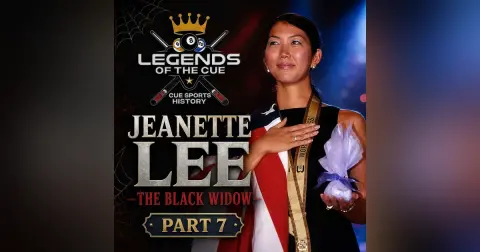

In this episode of Legends of the Cue, Jeanette “The Black Widow” Lee opens up about one of the defining rivalries in women’s pool history: her battle with Hall of Famer Allison Fisher. With both legends on the show together, the conversation becomes a fascinating look back at an era when the women’s game was thriving, ESPN was broadcasting pool to a national audience, and rivalries helped elevate the sport to new heights.
Jeanette and Allison reflect on their contrasting styles, competitive personalities, and how their matches became some of the most compelling television in cue sports. Jeanette shares her perspective on being seen as intimidating, why she never viewed another champion’s success as a threat, and how her mindset was always rooted in accountability: if someone raised the bar, she believed the answer was to work harder.
The episode also dives into the broader state of women’s pool in the 1990s, from televised events and growing audiences to the chemistry and tension that came with a golden era of competition. Then the story shifts to one of Jeanette’s proudest accomplishments: representing the United States and winning gold at the World Games in Japan. She recounts the pain she was battling physically, the surgeries she had undergone, the pressure of the moment, and the last-minute training breakthrough that helped her find another level.
What follows is classic Jeanette: vulnerable, driven, funny, and unforgettable. From elite rivalry to international glory, this episode captures the heart of what made that era of women’s pool so special — and why Jeanette Lee was at the center of it.
Give Allison, Mark & Mike some feedback via Text.
Follow our show and/or leave a review/rating on:
Our website: https://www.legendsofthecue.com
Apple Podcasts: https://podcasts.apple.com/us/podcast/legends-of-the-cue/id1820520463
Spotify: https://open.spotify.com/show/4Za0IMh2SeNaWEGUHaVcy1
Music by Lyrium.
About
"Legends of the Cue" is a cue sports history podcast featuring interviews with Hall of Fame members, world champions, and influential figures from across the world of cue sports—including pocket billiards, snooker, and carom disciplines such as three-cushion billiards. We highlight the people, places, and moments that have shaped the game—celebrating iconic players, memorable events, historic venues, and the brands that helped define generations of play. With a focus on the positive spirit of the sport, our goal is to create a rich, engaging, and timeless archive of stories that fans can enjoy now and for years to come.
Co-hosted by WPA and BCA Hall of Fame member Allison Fisher and Mosconi Cup player and captain Mark Wilson, Legends of the Cue brings these stories to life—told in the voices of the game’s greatest figures.
Join Allison, Mark and Mike Gonzalez for “Legends of the Cu...
Jeanette Lee
I never really put it. I feel like people try to frame it in the way that I should have been jealous. Trying to get reaction, probably, right? Maybe. Or or true or true cu curiosity. Like, how are you feeling about it? You know, you're the black widow and you have all this stuff, and here comes this woman, and she's, you know, starting to win stuff, and you're not dominating, which people said I was dominating. I never felt like I was dominating, but I was definitely winning and and showing assertiveness and whatever it is. But I really always felt that way in competition. Period. It's not about the person that's outrunning you. It's if it bothered you, work harder. You know, kind of always I always put it on myself. So it was for me, it was never about you. Although I did feel that you didn't like me too much. To me, that was that was very clear to me. Because I felt like I tried to be friendly in my, you know, way, but I can say I didn't work real hard at it because I'd been burned so many times by WPBA players, I wasn't trusting anyway. But I did try to be friendly to every person that I met, and some were receptive and some weren't. But yeah, but I didn't have any kind of like hatred or anger or anything like that. And I would say so. But I was asked a lot.
Allison Fisher
Well, I mean, it's rivalries at the end of the day. I mean, if quite a few of us were when we got out there, we wanted to fight.
Jeanette Lee
Yeah, yeah, yeah.
Allison Fisher
We wanted to beat each other.
Jeanette Lee
Yeah, but I was I'm talking about the the feeling I got when we were off the table. Because on the table, I just felt like we're just two bulls locking horns, and there's nothing wrong with that. I thought that part was great for me. I thought it was you know, I like challenges, you know, I like being pushed. I tend to kind of get excited because it just pushes me to be better. I guess I'm just not the jealous type in that way where somebody gets something that I don't have. And maybe that's too confident of me, but I feel like, well, if I really wanted it, I could get it. I just need to go in there and do the work.
Mark Wilson
I think that adds to your strength the ownership and the accountability that you accept. And I think, you know, a lot of times we hear Jeanette express herself in such a defensive way. And uh but the reality is this, okay, I know her quite well. So she she's got the New York brass side that people assume, and they think there's an outer shell that she's tougher and stuff like that. But then when you really find out she's actually manic and uh uncertain and uh has tremendous talent and has always had to rely upon herself. And then when you really get to know her, she's the most loyal friend, the most generous person, and and that softer side or the other side of it that doesn't necessarily come across people just immediately get turned off or assume they know her. And I I also was guilty of this to the to the extent when I first met her that I wasn't sure what I was dealing with. But then when you get to know her and find out, it's quite a different thing altogether, and that's she's bright and she's uh you know, I always kind of think of her as you know, a modern and technology she gets put stuff in your car instantly and uh never figure out how she did it. But anyway, uh she's got those other dimensions, and then but people are just put off and never give her a chance. And when you when you see the loyalty and you see the generosity, and you see how she is with her daughter stuff, and it really portrays you know what quality parenting is that was way beyond anything I ever expected. And then that goes to a person's personal character. And so I don't think there's any need to be defensive at all whatsoever, Jeanette. You are what you built, and and so uh it's just that most people don't get to see that side of it like I do.
Allison Fisher
Yeah, and I think also, Jeanette, with your personality, I was a little intimidated by you back then because you're very forthright and to the point, and I think I found that a little bit intimidating or annoying. No, I don't know, intimidating, really, but you were a go-getter and you were doing it right. You did everything to possibly do the best out of your career and you know, and play, compete, and be a star in your own right. And I just I think I found that at times a little intimidating.
Mark Wilson
Everybody. Yeah, I agree.
Jeanette Lee
I've been told I I hadn't been asked, I'd been divorced, I don't know, 10, 11 years now, and I've been asked out on a date once. Really?
Allison Fisher
Wow.
Jeanette Lee
And and I've told a few friends, I'm like, what I'm not desperate for it. I mean, if I found somebody I was interested in, I would probably like, you know, at least try to say something or whatever. But it was, it's just interesting that there's all these people around and people talk about how amazing I am, but nobody wants to date me. And the one word that everyone has used is, well, you're intimidating. And I'm going, I'm the nicest person. You have no idea. I'm friendly, I'll go up to a stranger. We have rookies, I'll introduce myself, I'll invite them to coffee. Like, what is intimidating? I'm honest, I'm not deceptive, I'm, you know, I'm not manipulative. I'm just, I am what I am. Arms on my sleeve, you know what you're getting when you're getting me. Like, what is so intimidating? But I've heard that one word forever and it boggles my mind because I don't feel like, well, one, I don't see, I feel like I'm such a mess. Like, what's there to be intimidating? Like, you see someone that's a hot mess, you're not gonna be intimidated by them. And I feel like I can't hide. Yeah, so the word intimidating, and or you're trying to be intimidating. But I know I'm not trying to be intimidating because all I've ever wanted to be is liked and accepted, you know. So I know I'm not intentionally intimidating.
Allison Fisher
I think it's a persona at the table. Yeah, but that's different because But that's all we got to see though, as a as a player. That's all you get to see is your workspace. Yeah. And that's what you brought to the table, which is what you're supposed to do.
Jeanette Lee
You know, you're doing your job. But it's also because the women didn't give me a chance to get to know me off the table.
Mark Wilson
For all of our listeners interested in dating Jeanette Lee, please send in a resume along with $10. We will go through these.
Mike Gonzalez
We're gonna post all your personal contact info.
Jeanette Lee
No, I I have met some wonderful people.
Mike Gonzalez
Well, one one thing you did do earlier on, you did answer a question I was gonna ask, which which was, you know, when you had a new rival come on the scene, how did you react, right? Because there's a number of ways that can go. And I think what I heard you say was, well, I knew I needed to work harder.
Jeanette Lee
Yeah, I mean, to be fair, you know, when I say she she pushed us to grow, I'm not saying that the women that were playing back then, Lori John could actually play. I mean, you know, she takes 18 strokes, but she could play and she does have a good amount of knowledge. She it's not that I didn't find the people competitive or tough for me. I wasn't just running over everyone. But what Alison brought was different.
Allison Fisher
I think I come from a game where I was already successful, so I wasn't winning wasn't to me, I knew it was gonna happen, it was just win. So I had that sort of mentality, I think. I think it's so it was already a champion for my. The touching ball is different, you know. We play away from that, you play into it, you know, just different things you have to learn.
Mark Wilson
One of the things background-wise for Jeanette was that she has that background in three-cushion beards and caroms. And much like with Efron, he he also has that background, and that's a dimension other pool players do not possess. Yes. They're good breakers, they're good shot makers, but when it comes to moving the other balls around, secondary object balls. Right.
Allison Fisher
Yeah, the kicking. I always found that with Guy and Kim too. Fantastic. I enjoyed it.
Jeanette Lee
Yeah, but also with three cushion builders, your focus is what the cue ball is doing. And with pool, cue ball is secondary. Making the ball is primary. Where the cue ball ends up exactly is not as important as make sure you make the ball. Make sure you execute what you're trying to execute where the cue ball ends up as second. But there's things like just like in nine ball, you you tend to try to avoid hitting the other balls and just pick them off one by one. But in straight pull three, because you're always you're hitting, you're trying to bump, you're trying to move and nudge and not just smash the pack. Because if you smash them, you might make three, four more clusters, you know. You just need to open them up and make sure your cue ball doesn't up on the rail. So you always want to be able to, if there's a trouble area, you want to be able to just glance it enough to where there's open pockets and get the cue ball to come off of them where it's not stuck on a rail so that you you can continue your runs or whatever, things like that. Punchlight sneak, I think.
Mike Gonzalez
Yeah, yeah. So, ladies, as we get into now '96, this would have been Allison's first year on tour. And what was what was happening with the ladies' game? Describe for our listeners the state of the ladies' game in 1996. Television, money.
Jeanette Lee
Well, we were at the top. I thought we sh we represented it well, don't don't you think, Allie? Yeah, I think we did a fantastic job. Yeah.
Allison Fisher
No, ESPN had come into it. It was really great times. It was a great era for women's pool and pool in general. We had multiple tournaments, all televised, getting to know the players, I think, through interviews, you know, and it it was a fun time to be in pool. Definitely the atmosphere, the audience in the stands, the venues that we played at, it was all fantastic.
Jeanette Lee
But I also think that the rivalry between her and I, so ESPN needed programming, right? ESPN2 needed programming. And we offered something different on ESPN, these women with class, beautiful, great competitive spirit, showing what they can do. But then when Allison and I got together, because before that it was me and Laurie John or me and Vivian or whatever, and we had only just had that, I think that started in '94, the TV rounds. Started in '94. That's when our first contract was signed. And so 94, 95, people were getting to know me, but it was mainly me. Me and whoever, but they didn't stand out as much. So it wasn't me and somebody. When Allison came, she went to the top, but she stayed there. And so her and I were, and I was already there, right? So she and I are going like this. But I think our contrasting styles and the fact that we both showed confidence and competitive spirit, but still class, and we just would, I mean, her more than me, because I've still got a little Brooklyn in me. But either way, I think that there's a lot of people that were able to connect and follow it. And I think, well, I I don't think I know that it was great for WPBA ratings. The TV ratings were at its highest when she and I were playing compared to the other matches. That's a fact. Because back then I was doing a lot of commentary, you know.
Allison Fisher
I think you're right, because it's the actual contrast in styles, I think, was really good.
Jeanette Lee
Yeah. Because everyone I had my Black Widow fans, but Allison had her fans. And they're they're our fans for a reason. They appeal to this style versus this style, you know? Yeah. And so you inevitably had a a bigger audience that had more vested, you know, with who they connected with. And so, yeah, I think that was one of the best rivalries in billiards or in sports in general, was that back and forth and getting the attention and and ES Penn were doing all those uh Black Widow Marathon weekend classics. They were just putting a lot of extra pool matches on TV, not just during our airtime, but they would replay. Do you remember that? How they would replay the WPV matches? I don't know if you remember that, but there's our airtime, but then random times you'll see us on the channel because they would use our stuff to feed those empty slots, which was great for us. Yeah. Because we didn't have to pay for that extra, but they gave it because they they needed programming, they needed fill space, so they would use our matches to do it.
Allison Fisher
And it had good ratings.
Jeanette Lee
Yeah, exactly.
Mike Gonzalez
Jeanette, you alluded earlier to an opportunity you had to represent the USA in the world games, winning a gold medal in Akita, Japan. That must have been in the nine-ball discipline, I assume.
Jeanette Lee
Yes. That was I'm telling you, that was such a cool experience, just um just being in that village with all the different sports and athletes and going to Japan. And my sister, who really hadn't been very much a part of my life since we were kids, lives in Hong Kong. So she was able to kind of fly from Hong Kong to Japan pretty easily. So to just kind of have her involved, George came with me, so it's cool for him to be able to be there. I really wanted my mom to, but my dad was sick, so she wasn't able to go. But yeah, it was a really, really a lot of fun. And it was it was also very unexpected for me to win the gold because I had been avoiding back surgery since I was twelve. But my experience when I was twelve was so horrible that I committed in my mind I was never having back surgery again. I was never ever, no matter what. But because of it, I would take on a lot of pain because I I wouldn't have the surgery. But I had these real problems. So then I was starting to hide it because I was worried people thought I was making excuses or um and I didn't want to be pitied. I was like, this is an excuse, I'm still gonna do it. And I don't wanna I felt like if I was to share it, it was gonna sound like I was weak or scared or I don't know. I don't know why I hid it so much. It was dumb, but I really tried to hide what I was going through but it kept getting worse to the point where you can't hide it after a while.
Mike Gonzalez
Like you just can't. Well, you you you played through it nonetheless. You said people not expecting you to win the gold medal.
Jeanette Lee
I don't know if you know, but I had delayed, delayed, delayed through the 90s, the early 2000s, you know. I'm just I'm going through it physically, but I'm also having children and trying to manage the business side and play pool, which is my passion. Because I was never satisfied because even though I was good enough to become number one, I knew I had a long way to go. It was really obvious because there's too many top men players that would destroy me, right? So I I wasn't done, but I was getting distracted by income and children and physical things, and it was I was struggling with that because I just wanted to play pool. That's all. I just want to play pool. So in May, I have the next surgery, shoulder surgery, back surgery, I'm in the hospital and I get a phone call from Steven Dukhoff of the BCA telling me that guess what? We did it, it worked because I was with him in '96 when we Steve Dukhoff and I talked to the IOC about becoming an Olympic sport. In 98, it was announced that we became an Olympic sport. But we were told that probably the best we might ever do is be an exhibition sport. You're probably not gonna get to compete for a medal. And then in May, I get told, guess what? We're gonna actually be able to compete for a medal. It's gonna be at the 2000 World Games Compete Japan. You're the top American. We want you to represent the you know, maybe it was the BCA that caught it, I don't know. But anyway, super exciting. But it's this year, I'm in a hospital bed. I had three major surgeries. The first one since I was 12. Now, since then, I've had over a dozen more during my career. But, you know, through my career until that point, I had not had a surgery yet. And I have three back-to-back surgery, which lengthens my recovery time. And I'm like, okay, so when is it? Like our world championship's usually in November or December. So I'm hoping it was November, December. I'm like, so when is it? And they're they said July. And I'm like, next July, right? Because this was May. This was May. Like, how do you put on a World Games event and give two months notice? And I'm in a hospital bed. I hadn't played for four or five months because I couldn't move my neck. I couldn't stand anything for those months, you know? So I just thought, oh my God, my dad has bugged me every year since I became a professional pole player. When are you gonna be in the Olympics? Hey, hey, when are you gonna be in the Olympics? I'm like, I don't know, Dad. And we're finally gonna be able to compete for a medal on an international state among all these sports, and I'm in a stinking hospital. And my friend Bob Carmen, who was my coach, more of a training coach at the time, said, I'm gonna ask you one favor. Because I was like, how am I supposed to prepare? We've got three weeks left before, or I think it was like five weeks we had. So we're playing for a few weeks, and I'm still not there because by then it was 2001. I had already started playing less and less and less. The bat the battle with my body was yeah, I was losing. And so I wasn't playing a whole, I was still going to the tournaments. I have all these contracts, I've got to go, but I'm not able to train as much as long as I was by 2001. And he's like, I need us to take a trip. And I'm like, where? And he said, It's just a few hours. I'll drive. You can make a bed in the back. I'm like, where? For what? I said we only have two more weeks at this point when he and I had this conversation. It was two weeks before the thing. I was not ready. I'm not ready, I'm not ready, I'm not ready, I'm not sure, I'm not ready. And and he's like, take a drive. So two weeks before the event, he drives me out to Jerry to meet Jerry Brista. And I get there and and I said, Listen, I'm only here. I said it respectfully, but I said, I'm only here because Bob Carmen thinks it's so important that I meet you, that I have two weeks to train for this event. I can give you as much of this time as you need, but don't mess with my stroke. Teach me whatever you want, teach me whatever tricks, I will work harder than any student you've ever had. I will not question you, I'll do the work, don't mess with my stroke. Because I felt, why would you change up weapons right before battle? This is the biggest tournament of my life from my point of view. It's the world games. I don't want doubts in my mind. I don't want to be in between a phase of changing from this type of stroke to this type of stroke. And he was like, deal, no problem. And I said that on the phone. Well, Bob said that on the phone because they said if he doesn't agree to that, we're not going. Then when we got there, I said it to Jerry directly by face. And both times he said, Yep, sure, no problem. Okay. Liar.
Mike Gonzalez
Yeah. I was just gonna say exactly. Gotta do what you gotta do. I mean, Mark, what would he do if not stroke, right? Mm-hmm.
Jeanette Lee
So, of course, he brings me to this pool room and he's like, I've got a series of shots. I just want to kind of uh what do you call it, analyze or whatever you're, you know, gauge your game and stuff. He's like, so, you know, you got your acoustic. So he puts the ball on the spot, the cue ball on the spot, and he's like, shoot this shot, shoot this. I'm nailing him. I got this, you know, I'm showing him. I can play. I'm not number one for no reason, right? I'm like, okay, because the stuff he asked me didn't seem that, you know, just make this stroke of three rails. I was, it's not the power or the shot making, because he didn't give me extremely difficult shot making things. It was speed control and direction. Can you get it to go here and come this? And I felt confident with that. Because my straight pull and, you know, just whatever. My work. And he does all this stuff, and then he has me shoot some shots where the cue ball's resting on the rail. You know, some things where the cue ball is not on the spot, but 90% of them, the cue ball is on the spot. And he's like, all right. And he did tell me, he said, okay, if we take a video, and I see a video camera. So I figure he'd and and we're and I I was looking forward to it. So I sit back, I'm ready to watch this video of him showing me nail this, nail that, nail that. This in my head, you know. I'm like, I did well. And um, we watched the video. You don't even see the pool table. You don't see any of the shots that I Made. You see this small six-inch area of the cue ball on the spot and my tip. And I can't even see what shot I'm shooting. But he made me sit there and watch where with one shot, my tip goes down, the other shot, the tip goes to the right, the other shot, the tip goes up in the air, the other shot, my Q sticks elevated like this. And I'm like, what? They should all be the same. And he's like, interesting. That's correct. And I was like, yeah, but what is this? Who did this? This is, and he's like, I'm pretty sure that's your pool glove. That's your, it was so clearly my hand, but I'm like, I don't shoot like that. I don't, I don't, I don't do that. I I no, I'm like, I've worked on my fun and mouse. Look at my alignment. Look at it. Look at my bridge. It's solid. Look at, you know, I'm like, what is that? This is not true. It was huge. It was huge. And even though I was scared and frustrated because I'm discovering this two weeks before the most important tournament of my life, mainly because it was something my dad had always mentioned, right? About Olympics, whatever. I had to see for myself. I would have never believed that I was that inconsistent. And I think that was the biggest difference between Alice and I that I saw right away that I didn't see. I knew I wasn't like her. I didn't think I was like that.
Mike Gonzalez
So camera never lies.
Jeanette Lee
Now he wants to work on this other stuff. And I'm like, screw that, we're fixing this. Where are you? You gotta do this. And he's like, I'm okay with this, but you didn't, and I said, No, we got what do we need to do? That was also the thing that I didn't notice about the clenching aspect of it, because I always hold the cube stick loose, and he's saying that I'm clenching, but it's very clear on my practice. You could see how loose my hand is. Just one moving part. You don't need the wrist or the fingers or any of that. Take that out of play. That's not what I saw on that tape. On that tape, I was clearly, and the way that you saw it was from a distance, you could see the cue stick and you could see the inlays, the points on my cue. And when I'm practicing, you could see it do this, and on my stroke, you would see it do this. The the the um thing. And I'm like, it's turning. I'm like, what I hold it so loose, and it's when you hold it, okay. When you hold it like this, acoustic, like let's say like this, very loose. Then when you clench, right? So it's resting here. When you clench, you clench like this. So the acoustic that was here, when you clench, it's doing this. So I've been watching it for years.
Allison Fisher
Shut up.
Jeanette Lee
I wasn't aware. I wasn't aware. So that was that was a big thing for me. It was like an epiphany. It was just, it was like, wow. But I mean, even though it was scary because it was right before the world championship, for me, it was really exciting because I felt like I did all the work to get myself set up for success. I basically watched when I was trying to become a better player. I mean, way at the beginning, I would just study the top players. And even if I couldn't play like them, I was gonna look like them. I wanted my alignment right, my stance, my grip, my bridge, my butt. And my improvement, even though it was fast to everyone else, for me, I wasn't fast enough. I just found a shortcut because I didn't realize that part of my everything I had right was hugely broken. You know, I didn't realize that there was this giant chink in my arm, or I would have taken care of it. So by him telling me that, I'm thinking, how good am I gonna get now? You know, it was exciting. During that time, I had also just finished really working training, like hours of training, of building in a pre-shot routine. I was reading, I just finished reading the book called uh Game Golf is not a game of perfect by Dr. Bob Rotella. It's a great book. And I'm I don't play golf. And there's only really one section that's technically golf, but otherwise it's really about mindset, visual, you know, mental imagery and and pre-shot routine, and that's when I started using decision picture target shoot. So when I'm standing and I'm, you know, addressing the shot, I make a decision, I visualize as as precisely as I can the cue ball striking the contact point, exactly where it's gonna hit the rail, where it's gonna bend, at what point is it gonna break off the tangent line, come here and the speed in which it rolls to a stop exactly here. This kind of visualization. Then I find the target. If I need to, I'll go back and look at it. Then I lock my chin in front of the shot, and then I get in, and then there's a shooting system, right? Which I learned from Mark. Before you even get down, if you'll make sure that you make and are fully committed to a decision and you fully visualize it, then when you get down on the shot, all you got to do is work worry about trusting yourself. So I used to say decision picture target shoot. Now I say decision picture target trust. Trust yourself. Because when you get down, you shouldn't be thinking about the speed anymore. You shouldn't be thinking about should I give it high or low or left, shouldn't be thinking about your wife or your husband or work or laundry. You should just be making sure that you get down and you trust yourself to execute whatever you need to do. And it it quiets the mind, especially somebody with ADHD. And it made me more consistent. And I remember at the World Games, I was never more disciplined than I was during that event about making sure that I was very decisive. That I, no matter how simple the shot, I visualized exactly what was gonna happen, you know. So I would say it worked. I would say that worked and the jet lot, jet lag. There was a on the way back from the tournament halls, you're in this, you know, Olympic village type of thing where all the players are and there's all these little bars on the way back to the hotel and all this other stuff. And there would be these bar owners that you kind of have to go down a few steps into their bar. It was like not ground level, it was a little bit below. And there would be a guy at the top of the stairs, come in, come in, come in, sake, sake, sake, come on, come on. And I had been there two days. I'd flown in a couple days early because the jet lag was, oh my gosh, three in the afternoon, four in the afternoon. I just really was like, my head was, I mean, I was very, very impacted by jet lag, which I I generally don't, but for some reason, again, this was early in my career, but it really affected me. And so I don't remember if it was George or I, but we're like, why don't we just have a couple quick shots? He's offering it. He, I think he knew who I was, but he was offering free sake, maybe thinking we'd buy more. Uh so we came in, he gave us a bottle, and George and I polished off the whole bottle. You know, not very big bottles, but you know, just a small bottle of sake. Didn't take me very much because I'm kind of a lightweight. So we had it. Went to the hotel, just a little, not drunk, just a little bit buzzed. Went to the hotel, slept all night like a baby. Went out the next day, played my match, destroyed them. So every night for that whole week, we went to that same bar and had sake. And it and it really helped. I typically will never drink during a tournament or anything else for that matter. I just focused on the tournament. If you want to have some drinks, have it after. Right now, it's still business, but that was the one time I did something different.
Mike Gonzalez
Drink sake and you too.

Pool Professional
Jeanette Lee did not simply become one of the most famous players in billiards history; she changed what a pool champion could look like, sound like, and mean to the wider world. To sports fans everywhere, she became known as “The Black Widow,” a magnetic champion in black, a fierce competitor with movie-star presence, and one of the rare cue-sports figures whose fame broke far beyond the poolroom. But behind the iconic image is a far deeper story: one of pain, resilience, rebellion, craft, and relentless self-invention.
Born in Brooklyn, New York, on July 9, 1971, to Korean immigrant parents, Lee grew up straddling cultures while trying to find where she belonged. In the stories she shared on Legends of the Cue, she speaks candidly about racism, loneliness, and the emotional toll of feeling like an outsider from an early age. She also describes the values that came from her Korean upbringing: discipline, respect for elders, family obligation, and toughness. Those tensions, between rebellion and duty, would shape much of her life.
A defining challenge came in childhood, when Lee was diagnosed with severe scoliosis and underwent major spinal surgery. The physical pain was immense, but the emotional impact may have been even greater. In the podcast transcripts, she describes how the surgery, body brace, and feelings of isolation darkened her view of herself and the world. Yet those same experiences also forged the stubborn will that later became her trademark. Long before she was a champion, Jeanette Lee was already learning how to endure.
She atte… Read More