Lee, Jeanette
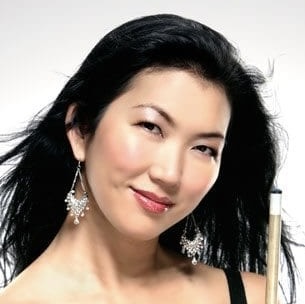
Pool Professional
Jeanette Lee did not simply become one of the most famous players in billiards history; she changed what a pool champion could look like, sound like, and mean to the wider world. To sports fans everywhere, she became known as “The Black Widow,” a magnetic champion in black, a fierce competitor with movie-star presence, and one of the rare cue-sports figures whose fame broke far beyond the poolroom. But behind the iconic image is a far deeper story: one of pain, resilience, rebellion, craft, and relentless self-invention.
Born in Brooklyn, New York, on July 9, 1971, to Korean immigrant parents, Lee grew up straddling cultures while trying to find where she belonged. In the stories she shared on Legends of the Cue, she speaks candidly about racism, loneliness, and the emotional toll of feeling like an outsider from an early age. She also describes the values that came from her Korean upbringing: discipline, respect for elders, family obligation, and toughness. Those tensions, between rebellion and duty, would shape much of her life.
A defining challenge came in childhood, when Lee was diagnosed with severe scoliosis and underwent major spinal surgery. The physical pain was immense, but the emotional impact may have been even greater. In the podcast transcripts, she describes how the surgery, body brace, and feelings of isolation darkened her view of herself and the world. Yet those same experiences also forged the stubborn will that later became her trademark. Long before she was a champion, Jeanette Lee was already learning how to endure.
She attended the Bronx High School of Science, but her path was never going to be a conventional one. By her own telling, her teenage years included rebellion, survival jobs, emotional turmoil, and an insistence on figuring life out for herself. Then, in 1989, everything changed when she walked into Chelsea Billiards in Manhattan and saw pro George Makula playing. She was captivated. In an instant, she found something that demanded total concentration and offered something priceless in return: purpose. Pool was not just a pastime. It became her language, her refuge, and eventually her future.
Lee developed quickly in New York’s tough room culture, including at Howard Beach Billiard Club in Queens, where Gabe Vigorito became an important early supporter. There, the foundation of the “Black Widow” legend took shape. Vigorito recognized both her work ethic and her presence. Lee has recalled how the nickname initially struck her as odd, even funny, but it stuck, and over time she transformed it into one of the most memorable identities in modern sport. The image drew attention, but the game backed it up. She was not pretending to be dangerous. She was dangerous.
By the early 1990s, Lee had become a major force on the Women’s Professional Billiard Association tour. Her rise culminated in a breakthrough 1994 season that included victories at the WPBA Baltimore Billiards Classic, WPBA Kasson Classic, WPBA San Francisco Classic, the WPBA U.S. Open 9-Ball Championship, and the WPBA National Championship. That same year, she was named Billiards Digest Sportsperson of the Year, confirming what fans were already seeing: Jeanette Lee was no fad, no novelty, and no marketing invention. She was a world-class competitor.
Her career unfolded during a golden period for women’s pool, and one of its defining storylines was her rivalry with Allison Fisher. In the Legends of the Cue episodes, Lee describes that rivalry not as personal bitterness, but as pressure that sharpened both players and helped elevate the women’s game. Their contrasting styles and strong personalities gave television audiences compelling drama just as ESPN was expanding cue-sports coverage. Their matches helped bring women’s pool to a wider audience and turned them into two of the era’s defining figures.
Lee also played a part in another key moment in cue-sports history: the inaugural 1994 Mosconi Cup at the Roller Bowl in Romford, London. That first edition featured both men and women, with Lee and Vivian Villarreal representing Team USA and Allison Fisher and Franziska Stark representing Team Europe. Team USA won the event, and Lee’s memories of that week, including competing against celebrated snooker stars Steve Davis and Jimmy White, underline her unusual place in the sport’s history: she was not only winning titles, she was helping shape the public face of professional pool at an important turning point.
Among her many achievements, one of the proudest came at the 2001 World Games in Akita, Japan, where she won the gold medal in women’s nine-ball. What makes that victory especially meaningful is what was happening behind the scenes. As she recounts in the interview, she was battling severe physical issues, recovering from multiple surgeries, and trying to summon championship form under difficult circumstances. Yet she still delivered one of the signature victories of her career, defeating a world-class field and adding an international gold medal to her already remarkable résumé.
Lee’s impact reached well beyond tournament brackets. She helped make pool visible, marketable, and culturally relevant to a wider audience. She co-wrote The Black Widow’s Guide to Killer Pool with Adam Scott Gershenson, later published her memoir The Black Widow with Dana Benbow, appeared in film and television projects, and remained a recognizable ambassador for the sport through exhibitions, commentary, business ventures, and league ownership. In 2022, her life and career were the subject of the acclaimed ESPN 30 for 30 film Jeanette Lee Vs., directed by Ursula Liang, which brought her story to an even broader audience.
Her honors reflect both competitive greatness and lasting influence. Lee was inducted into the Billiard Congress of America Hall of Fame in 2013 and later into the Women’s Professional Billiard Association Hall of Fame. Those recognitions matter, but they only tell part of the story. Jeanette Lee’s true legacy is larger than titles. She made people care about pool. She drew new fans to the game. She expanded the imagination of what a female cue-sports star could be. And she did it while enduring physical pain, public scrutiny, and battles that most people never saw.
That is why Jeanette Lee remains, in every sense, a legend of the cue: not just because she won, but because she changed the room when she walked into it.

Jeanette Lee - Part 9 (Hall of Fame Reflections, Pool Legacy, and Life Beyond the Table)

Jeanette Lee - Part 8 (Efren Reyes, Global Fame, and the Making of The Black Widow)

Jeanette Lee - Part 7 (Allison Fisher Arrives, Women’s Pool on ESPN, and a World Games Gold Medal)

Jeanette Lee - Part 6 (The WPBA, 1994 Breakthrough, and the First Mosconi Cup)

Jeanette Lee - Part 5 (Becoming The Black Widow)

Jeanette Lee - Part 4 (The Grind, the Mentors, and the Making of a Champion)

Jeanette Lee - Part 3 (Falling in Love with Pool)

Jeanette Lee - Part 2 (Rebellion, Reinvention, and a Mind That Never Quit)
