

 Apple Podcasts

 Spotify
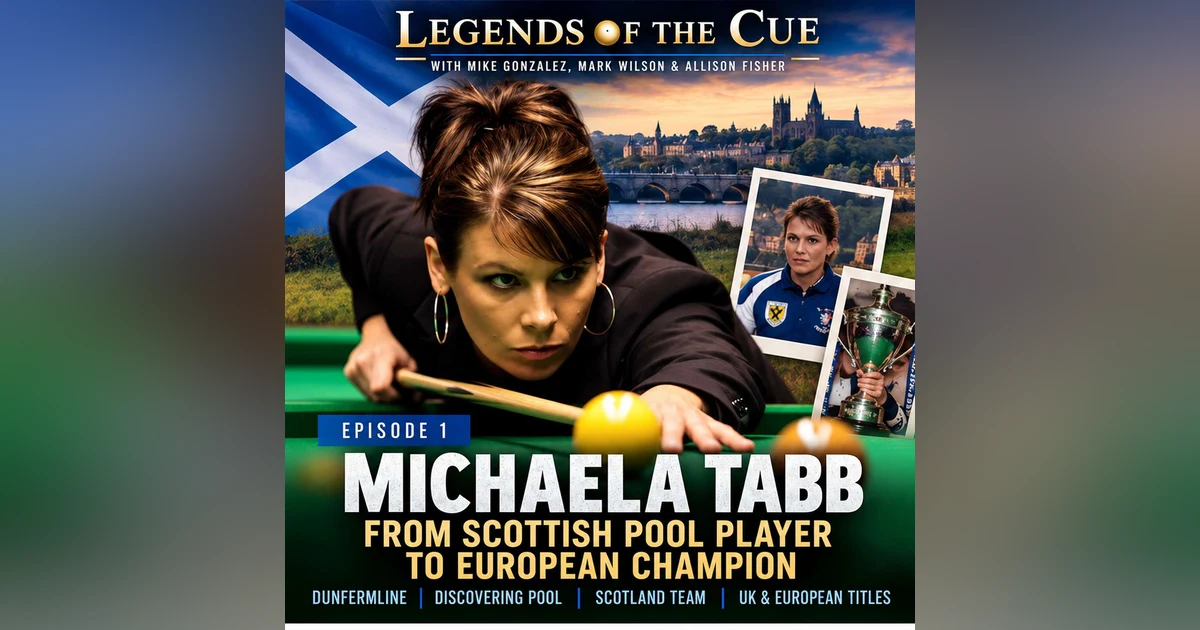
Michaela Tabb - Part 1 (From Scottish Pool Player to European Champion)

Key Takeaways
- Before becoming a legendary referee, Michaela Tabb represented Scotland internationally as a fiercely competitive pool player and won major UK and European titles.
- Early in her pool-playing career, Tabb developed a notoriously defensive tactical style to compensate for not being a natural potter, earning her the nickname "Michaela Hang-a-Bag."
- Growing up in Dunfermline, Scotland, Tabb balanced diverse interests including gymnastics, playing the bassoon and cornet in the local Salvation Army band, and studying at Glasgow University.
- Tabb's early working life included a stint at Halifax Building Society and a memorable experience working in direct sales for Ann Summers before fully committing to competitive pool and refereeing.
- Her meticulous tactical approach and resilience in single-frame team matches propelled her to win the 1998 European Championship in Gibraltar despite resistance from tournament promoters.
Before Michaela Tabb became one of the most recognizable referees in snooker and pool, she was a fiercely competitive player representing Scotland on the international stage.
In Part 1 of our Legends of the Cue conversation with Michaela, she takes us back to the beginning—from being born in England and growing up in Dunfermline, Scotland, to childhood gymnastics, playing bassoon and cornet, an unlikely ambition to become an air traffic controller, and her brief experience at Glasgow University.
Michaela recalls discovering pool in a local pub called The Thistle and quickly realizing that determination and tactical intelligence could compensate for not being a natural potter. Her defensive style became her trademark, earning her the nickname “Michaela Hang-a-Bag” and helping propel her into the Scottish women’s team.
She also shares stories from her early working life—including her unforgettable stint selling for Ann Summers—before discussing her rise through competitive pool, representing Scotland, and winning major individual titles.
The episode culminates with Michaela remembering her 1998 European Championship victory in Gibraltar, including the promoter who wanted to move her televised final because her deliberate playing style was taking too long—and Michaela’s emphatic refusal.
Before the white gloves, the Crucible Theatre and snooker history, there was Michaela Tabb the player.
Give Allison, Mark & Mike some feedback via Text.
Follow our show and/or leave a review/rating on:
Our website: https://www.legendsofthecue.com
YouTube: www.youtube.com/@LegendsoftheCue-MLG
Apple Podcasts: https://podcasts.apple.com/us/podcast/legends-of-the-cue/id1820520463
Spotify: https://open.spotify.com/show/4Za0IMh2SeNaWEGUHaVcy1
Music by Lyrium.
About
"Legends of the Cue" is a cue sports history podcast featuring interviews with influential figures from across the world of cue sports—including pocket billiards, snooker, and carom disciplines such as three-cushion billiards. We highlight the people, places, and moments that have shaped the game—celebrating iconic players, memorable events, historic venues, and the brands that helped define generations of play. With a focus on the positive spirit of the sport, our goal is to create a rich, engaging, and timeless archive of stories that fans can enjoy now and for years to come.
Co-hosted by WPA and BCA Hall of Fame member Allison Fisher and Mosconi Cup player and captain Mark Wilson, Legends of the Cue brings these stories to life—told in the voices of the game’s greatest figures.
Join A...
Frequently Asked Questions
Who is Michaela Tabb?
Michaela Tabb is a trailblazing cue sports figure who first made a name for herself as an international pool player representing Scotland, winning major UK and European titles before achieving global recognition as the first female referee of the World Snooker Championship final.
What was Michaela Tabb's nickname as a pool player?
During her competitive pool-playing days, Tabb was known as "Michaela Hang-a-Bag" due to her highly defensive, tactical playing style that focused on frustrating opponents and making the most of two-shot foul rules.
When did Michaela Tabb win the European Pool Championship?
Michaela Tabb won the European Championship in Gibraltar in 1998, defeating resistance from a promoter who wanted to move her televised final because her deliberate, strategic playing style was taking too long.
What instruments did Michaela Tabb play in her youth?
Before entering the world of cue sports, Tabb played the bassoon in her high school and county orchestras and played the cornet in the local Salvation Army band.
Welcome to another edition of Legends of the Cue and Mark Wilson. On the show today, we have our first, not only referee of Pool and Snooker, but woman referee.
Mark WilsonWell, I'm delighted to have my most respected referee in Billiards history. Joining us today, the very embodiment of referee excellence.
Allison FisherOur guest today has experienced Cue sports from almost every angle: international pool player, referee, business owner, and mother. Michaela Tabb represented Scotland and won UK and European pool titles before moving into professional refereeing. In 2009, she became the first woman to referee the World Snooker Championship final, returning for a second final in 2012. From the noise of the Mosconi Cup to the concentration of the Crucible Theatre, she's seen some of the game's biggest moments at close quarters. Today we're going back to the beginning, the people, decisions, setbacks, and opportunities behind that career, and the life she is building now. Michaela Tabb, welcome to Legends of the Cue. Hello. Hello.
Mike GonzalezNice to have you.
Allison FisherSo, Michaela, when you walked away from the crucible after those final frames in 2025, what part of your life came back to you most vividly?
Michaela TabbSo twofold, I suppose we could we could take that question. You're absolutely right. I was very honored to referee two world finals, which were both very different, but both very, very incredible experiences. So the um the walking away at the end of those matches is uh um when you leave on that high that you can't buy anywhere, um, which is an incredible feeling. Probably not dissimilar to winning um titles yourself when you're playing. Um there's something very, very uh fulfilling about knowing that you've done the job that was required and you've done it well, which is always um all that a referee wants. So, from that point of view, that's one sort of a feeling. Um when I hung my gloves up last year on what we will call traditional snooker, because we know there's a few different forms of it, it it was actually relief, but for a completely different reason. Um, because I had retired or resigned from World Snooker in 2015, I kept refereeing the seniors and different events with traditional snooker, but I was doing so few events per year that I was getting, I felt like I was getting rusty on the rule set. Um, and anybody that knows anything about snooker rules knows there are so, so many. It is, it is really quite detailed. And I was putting myself under pressure to make sure that I was sharp every time I went out without having the experience from year to year to give me that. Um, and that was making me then anxious and stressed. And and I was like, what are you doing this for? You've spent all these years building up a very good reputation as being an excellent referee, and you're gonna blow it on, not blow it, but I didn't want the end of my career to be tarnished by making some mistake that was a rule-based one that everybody picks apart because I should have known it. And it just felt that it was the right time. And I have to say, there were there were a few kind of not maybe tears, but you know, a few damp eyes I had, but it was more relief, to be fair, than anything else. It it was it was obviously the right decision to make. Uh, but it was uh yeah, it's and I'll still go back, I'll still work there, but I'll never be the same as referee in there because there's nowhere like the crucible.
Mike GonzalezYeah. Well, we're gonna come back to that obviously a lot to talk about with your career, but we always start at the beginning, Michaela, and so we know you were born in England, moved to Scotland at a fairly young age. Tell us about what young Michaela Tabb was like.
Michaela TabbOh, I don't know. I think my mom and dad would probably give you a different uh uh description than I might, but of course I was a perfect angel. Have to be said, have to yeah, no, uh young, carefree. I had a fabulous uh family, always have actually. My my family is is still with us, which is uh great. Uh very, very good, very close family. Um so I've got my my sister Juliet, there's the two of us. We we moved up uh to Scotland when I was only three and a half, Juliet was six months and um settled into to life up in Scotland. So young primary school age at that. In fact, I started primary school up here. Uh and I haven't known any other, I haven't lived in any other town other than Dunfarmon, which is is w where I still am. So um yeah, no, all what it is, I suppose, how how my my youth to now, because I'm not very young anymore, but we won't discuss that.
Mike GonzalezWhat what took you up?
Michaela TabbWhat took your folks up to Scotland at that young age you were So m my dad worked with the the dockyards uh down in um Devonport and it was a promotion up to the Resythe Naval Base. He he used to work on the refits of the nuclear submarines. So we had a dockyard, it's in Resithe, which isn't very far from uh Dum, it's the next uh village to Dumbarmlin, if you like. Um so yeah, it was uh a promotion for him that way. And I think they would have moved back down, but they'd left it too late, and then my sister and I put our roots down and had our families, which means if they moved back down now, they'd actually be leaving behind their uh their children and their grandchildren, and now um a great grandchild uh from my sister's side to my mum and dad. So they're still here in Scotland and they're from Cornwall. So although we moved from Bath, mum and dad are both Cornish, which is a beautiful, beautiful part of the country. And I wish they'd move down there because I would have been very happy to have been brought up down there surfing and all the gorgeous weather, because we don't have the same weather up here. It's like a completely different country.
Mike GonzalezYeah, yeah. Well, what was um what what are your fondest memories about growing up there as a young girl in a small town and uh that part of I guess that's that's the southern edge of fife that you're in.
Michaela TabbYes, absolutely. Yeah, just uh everything was so s much safer then. I th I think that's kind of what I I would reflect on. You used to be able to walk to school and it wasn't like just down the road, you know, that nobody does any of that stuff anymore. It's not deemed safe now, which is just such a shame because it's it's like the youth's been taken out of youngsters, but for for good reason, because there's a lot of places aren't safe now, even just walking to school, such an innocent thing. But you know, I'd I remember back and uh our idea of fun because there was no mobile phones and there was no iPads and all these kind of things. Um in those days you went and climbed trees, or I used to climb trees, I don't know about anybody else, but you know, you played rounders and and you you ran after a bull and and yeah, all the simple things that kids just don't seem to do so much anymore.
Mike GonzalezYeah, did you play a lot of sports as well in school?
Michaela TabbI was not sporty at all. Actually, that's not completely true. I did gymnastics, so I was a gymnast for quite a while. I never reached any heights, but that was my sort of younger sport that I did. Uh, then when I went to high school, I fell in love with music. Um, so I actually gave PE up to study for an extra O level in music, so that kind of stopped all sport because then I wasn't even doing the regular PE activities at high school. I w I was studying for an extra O level, uh, which I I enjoyed and got and did well in, but uh could have you could always do with having more sport in your life. Yeah. I think it's more of a chore now, it's not a love anymore.
Mike GonzalezUh what type of music?
Michaela TabbI used to play the bassoon in unusual one.
Allison FisherVery unusual. You haven't got it in the room there, have you? Say again. You haven't got it in the room there with you, have you?
Michaela TabbNo, I I stopped it when I was still in high school, but it's not exactly the smallest instrument. I really could have picked something easier to cart about, if I'm being honest. It's like a suitcase. You're taking the suitcase when you were going to get on the bus to go to orchestra practice.
Mike GonzalezYeah, read instruments are are difficult. I played uh saxophone uh when I was younger, but uh it wasn't a heckel bassoon, was it?
Michaela TabbI don't know what that means.
Mike GonzalezWell, it's it's uh probably the most famous uh bassoon maker that that ever was around. Uh German. Uh the factory was right close to where we lived in Frankfurt, Germany. As a matter of fact, uh we've got a family friend that plays bassoon for the Barcelona Symphony. So uh Wow. I don't know if you ever aspired to get to that level or not with your with your bassoon playing.
Michaela TabbNo, I never got as far as the even like the Scottish Orchestra. I was Fife. I was just the local county orchestra, but I've never got as any further than that. Then the other thing I did actually, um which you may allude to or not, it depends how much research you've done. I was in the Salvation Army for a number of years, and I played the cornet in their um band as well. So I had two instruments.
Allison FisherOh. Well, good. Very unusual instruments, too, a cornet and a bassoon. Well, yeah, yeah. Mark.
Mark WilsonPrior to uh Cue sports entering your life, Michaelo, what did you uh think that you might be doing later on?
Michaela TabbWhen I was at high school, because they they always do this um, what do you want to be when you grow up, and and try and sort of encourage you down a path that you've got no idea where you're going. Um, but I wanted to be an air traffic controller with the RAF. Now I don't know where that came from, um, but it was very quickly um stopped and I couldn't go any further with that because I used to wear glasses and they didn't allow glasses or contact lenses. So in those days, they do now. So that was the the beginning and the end of my career with them. It never went anywhere.
Mark WilsonWhat an intense thing to take up, though.
Mike GonzalezYeah, I've got to say, I can't remember in my whole life ever talking to somebody that said, Yeah, you know, when I was a little kid, I wanted to be an air traffic controller. That's interesting. And you have no idea where that where that came from.
Michaela TabbI think we had we had like um the uh days at the school where people would come along and like do presentations for the different things, and um the services were obviously one of them, and somewhere along the line I've ended up looking at what opportunities there were, and and that's the one that I I like the idea of.
Allison FisherIt's a good one too. So so where did your competitive street first show itself?
Michaela TabbUm it definitely wouldn't have been gymnastics because I really wasn't that good at it. Uh yeah. No, I don't know, maybe sales, because I I went into sales after sort of high school. Um and I always like being the the good or the best, and and I think that's it's sort of a natural thing anyway, isn't it? You never want to be at the the bottom. Uh so I think it probably came out of there. But if I'm being honest, I'm a Sagittarius and and that as kind of a strong-willed character. I'm not a wilting flower anyway.
Allison FisherSo that's good. So, what are your earliest memories of watching Snooker and which players made you care about the game?
Michaela TabbNo, good question, actually, because I've got I've got quite a few. So I grew up in the age when there was only the I want to say let's say four. I can't remember when channel four came in, um, but definitely only three channels, which was BBC One, BBC Two, and and ITV. And that that's what you did as a family. You watched Snooker on the telly. It is what everybody did in that day. Um now I remember, I remember watching um Alex Higgins. Yeah, what was it the Worlds when he cried and asked for Lauren to be brought out? That's right. Yeah, I remember that.
Mike Gonzalez1982 World Championship.
Michaela TabbI watched Cliff's 147 live. Yeah. Um obviously remember Tony Knowles and Kirk Stevens. Yeah. You know, though they were the the handsome ones in the day.
Mike GonzalezYeah.
Michaela TabbUm obviously watched Jimmy White failing miserably on multiple occasions. Yeah. Um and I saw the 1985, of course, as did however many million of people in the UK with Dennis and Steve. Yeah. Um there was there was another one, and I remember I remember seeing um Alex Higgins and I want to say it's not John Street, it was John Williams when he had his swept over. Yeah. And he was having words with Alex, but I don't know what match it was because it happened a lot. So I I don't really know. So but those were all the kind of I I suppose 80s or early 80s sort of memories. Definitely. Um but it was a family thing. So I was and I was always a fan.
Mike GonzalezYeah.
Michaela TabbAnd that was obviously before I started playing and then I started refereeing. I but I was always a fan way, way back because we were in those days. Yeah.
Mike GonzalezLet's talk a little bit about going to school. Uh you mentioned as we talked yesterday, you attended university, had some interesting choices of um of study, fairly diverse.
Michaela TabbYeah. I don't know what I was on when I came up with that lot, for goodness sake. Uh I mean, uh I chose to go to Glasgow University and study psychology, biology, and chemistry. Biology, I get, because that was sort of my main subject in school right up uh through to sixth year. But uh chemistry, I I wasn't bad at it. I wasn't great at it, but I wasn't bad at it, but psychology, uh anyway, it didn't last very long. I didn't complete my first year, so it was a short-lived aspiration, that one.
Mike GonzalezSo, what was it that sort of precipitated that, that sort of led you away from university to think about maybe doing some other things?
Michaela TabbI didn't like living away from home. It was the first time I'd had to move out of uh the town, Dunbarlin. I was staying in halls of residence. But the but the other side of that was um I went to uni in the days that there weren't student loans like there are now. And your salary, the salary of my parents was taken into consideration on whether uh or what they got as a grant from the government, and they were on the borderline of we got no grant, we got the halls of residence paid for, but there was no other money. So I was coming home every weekend from Glasgow to Dunbarmund to maintain a Saturday job. So I wasn't really getting the opportunity to immerse myself fully in uh university life. Um, and it was like, you know, I was I was away for five days and then back for two nights. So it it was it was a little sort of disjointed, really. It would have been different nowadays, I think, because you could have got a job over there, over that side, or um maybe had more of a grant to enable you not to have to do that. But I never really settled in because of that. But I needed that job because I needed to earn money to help my even help my parents because they couldn't afford to give me that money. Do you know what I mean?
Mike GonzalezYeah, yeah. Yeah. So uh let's try to get you transition from being a fan of particularly snooker to a player of pool and snooker. Allie?
Allison FisherSo take us to the first pool table that really hooked you and what kept bringing you back.
Michaela TabbSo I'd played pool a few times. You know what the likes of a holiday camp when you're on holiday and your mum and dad go and sit in the bar and have a couple of beers or wines or whatever, and the children get given the pound or the 50, well, it wouldn't be a pound in those days, it would probably be 20 feet, um, and there was a pool table. So, you know, I I've done that a few times, and um I quite enjoyed that, but not in any kind of serious level. And then I started seeing a former boyfriend um called Jimmy and in Dunfermland, and we used to go to his local, and his local had two pool tables, and it quickly became apparent that if I didn't get involved and pick up a queue and play pool, I was going to be sat on my own because it seemed to be that everybody in the pub played pool. So I did. I basically picked up a queue and and started playing. Um but because I wasn't a potter, because I wasn't n I wasn't natural, but also I I wasn't that good in the early days, I had to learn to play tactically, because the only way I could attempt to win was to play tactically when two shots carried. Get the foul wall, get the two shots, and then it gave myself the opportunity to probably to get another snooker, get another foul, because I it was never two shots was never enough. I probably needed about ten. But I learned I was very, very determined, and I almost learned to play. I played that way by being defensive to be able to win. Um, and that quickly got me into the team playing for Scotland. But part of that was there weren't many females that played English pool in those days. Uh there's a lot more now, but there there wasn't a lot, so you didn't have to be particularly good to get into the team. But I got so that that was where my playing days really started.
Mike GonzalezYeah, do us a favor. Uh take us, take our listeners back into that first room where you played. What did it look like? What it smell like, what did feel like? Tell us about the characters. What are your memories of that?
Michaela TabbThere that so it was and I've got a nice feeling about that pup, which is always nice. It was all kind of dark wood, and the um the seating was all round the sides. There was very few tables in the middle, because the pool tables were there. Um, couple of puggies, we call them that. What would you slot machines? Do you call them slot machines? Couple of slot machines. Um, the bar at the end. It did good food as well, actually. Lots of different characters, your typical people that go in the pub every day, and then your pool community that that come in at night for the league matches or whatever competitions were going on. It was it was a nice mix. It it was a nice, nice pub to be in, not a lot of trouble, um, and a really nice group of people, which was good because I was about 20, I want to say 22, 23, so relatively young still, I suppose, at that point. Um and it it was it it had that nice local pub feeling. It it was good.
Mike GonzalezIs it still around?
Michaela TabbIt is. It could call something completely different and feels different, but I don't think it will to the people go in it. It just feels different to me because it's not it's not the pub that it was when I went in it before.
Mike GonzalezYeah, and it was called back then what?
Michaela TabbUh oh.
Mike GonzalezWe can edit this.
Allison FisherYeah, we give you five minutes.
Mike GonzalezDo you know?
Michaela TabbIf you asked me that like 30 seconds ago, it would have come straight out. Isn't that funny? Don't you love this? It was called the thistle.
Mike GonzalezThe thistle. Now, when when we edit this, it'll sound like you just came right up with the thistle.
Allison FisherLove it.
Mike GonzalezYeah.
Allison FisherDo you remember your first cue?
Michaela TabbUh no, but I'll I'll tell you a funny story, which actually now, because I I do I talk about this now, I've got no idea what I played with. Um, but I changed cues quite a bit in those days because I didn't know what was suited to me. I didn't know what tip size, I didn't know any of that stuff. Someone just gave you a cue and you played with it. Yeah. I was playing internationally, I was playing for Scotland, and I came off and I knew I did it. And one of the girls from England said, How do you manage to pot a ball when you're constantly turning your cue in your hand? And I did. I used to have that my cue in the back. And I used to, I used to uh keep uh turning it. And then I would stop and I'd come through and and I'd I'd shoot and either hit the ball or I missed it or whatever, but I was obviously doing it quite well. And I couldn't explain why, I don't know why, but I ended up progressing on to a maple cue, which kind of makes sense because I think I was being distracted by the ash. Yeah, because it was obviously my cheap cue, which had terrible ash, or I was looking for the bit I I don't know, but I did end up progressing on and finished out my career, I've still got it actually, um, with a maple cue, which was a much cleaner shaft. So that seemed to suit me better.
Mike GonzalezHmm. Well, before we jump into Michaela Tabb the player, uh let's talk a little bit about some of the things you were doing back then. You leave university, you've picked up the game, you must have had a real job.
Michaela TabbYes. I came I came straight back and went for the first job in the newspaper that was advertised, which was working in a building society, as you do, either banks or building societies. Um And started and I got the job, which was quite getting very competitive, you know. Got the job. And started working for the Halifax Building Society. And that was my first job. It's not that I dis it's not that I wanted it. It was the one in the paper that I applied for and got. But hey ho Yeah.
Mike GonzalezAnd you you stayed with that how long?
Michaela TabbUm I probably I think it was a four or five years. Went through a few different roles with them, um, which is good because it's nice to change department. It means that you're you don't get stale. Uh so you know, d uh working, doing mortgages, loans, uh the the the different categories that are were in sort of building societies in those days, still are, I suppose, but I think there's much more regulations now surrounding the financial um institution than there were then.
Mike GonzalezAnd Allie, I think Michaela might have done some sales type things, huh?
Allison FisherYeah, there's something in here we haven't talked about yet. Is there a story from your Ann Summers days that still makes you laugh? Wouldn't you care to explain a little bit about that?
Michaela TabbYeah, I do know what I can't even remember how I got into it. For for any of you um listeners that don't know Anne Summers, you could Google it. But um it's it's Mark and I don't know. Do you know? Do you not? Right, okay. Well, that makes sense then. So Anne Summers is a very successful uh company over here, which you will have your own versions of um that um retail some lovely lingerie and um other items that you might like to enjoy related items, yes, with your lingerie. So yeah. Have I gone red?
Mike GonzalezOh yeah, this is gonna be a clip. I can see this now. This is gonna be a clip.
Allison FisherOh yeah, we could I I know it's yeah, I know what this could be. But come on, carry on.
Michaela TabbSo we used to um I got I got into it of obviously as it for additional uh money. I'm not even sure why I I needed it or whether it was uh just uh to pass time. I I don't know, this was before I played pool, obviously. Um but yeah, you used to go along to a party. You somebody would have a party and have their friends round, you'd go away for a party, you'd have your kit bag, and in your kit bag you would you would start with your the lovely lingerie, the night dresses, etc., and sort of show them that. But they weren't really interested in that. They they were more interested in the sex toys and the vibrators that came out further down the line. And of course you got free samples. Hey!
Allison FisherThere you go. Perfect.
Mike GonzalezOh, I love it. I love it. Yeah. I wanted to have you clear it up for our listeners whether you were just displaying it or actually demonstrating or modeling some of these garments. So I assume it's just you would.
Michaela TabbDid you behave yourself?
Mike GonzalezYou were just showing the stuff. I mean, no, I'm not talking about the implements. I'm just talking about the garments.
Michaela TabbYes, we did. We actually had the icons, which was always good. They were always very fun nights, I've got to say. Uh you can imagine. You that you couldn't have a very staid night like that when you're handing somebody a vibrator and turning it on, yeah.
Mike GonzalezAnother legends of the queue first, right here, ladies and gentlemen. Love it. Yeah. Yeah. Yeah.
Allison FisherExcellent.
Mike GonzalezYeah.
Allison FisherSo how long did you do that for, Michaela?
Michaela TabbI d I don't think it was very long, to be honest. Uh uh maybe a year or something. It's um I've I've come to realise I'm I'm a bit I'm not a homebody, but I turn into a bit of a hermit through the winter. I don't like going out when it's cold and miserable, wet outside. And of course, all these parties were pretty much all evening parties, so that's what folk wanted to do in the winter. Whereas when it gets dark, I want to shut the blinds and and sit underneath my blanket and watch, I don't know, mind-numbing TV or something, or a good movie or or something like that. You don't want to be outside in the rain and the wet or the snow or cold.
Allison FisherOf course, you wouldn't have that in Cornwall, would you?
Michaela TabbNo, we wouldn't have, but they never moved that day, did they?
Mike GonzalezAll right. You see, you mentioned you joined the the Scotland's women's team in uh in 1992. I think it was shortly before that you really took up the game seriously, so you progressed quite quickly. So we want to talk a little bit about uh some of that playing career, winning individual UK and European titles in 97 and 98. Uh Mark, why don't you get us started?
Mark WilsonHow did you go from learning the game to representing Scotland in such a short time?
Michaela TabbThere wasn't a lot of players um in Scotland. So it was as in ladies, because it obviously I played for Scotland ladies. Um but I think because I had been progressing my game defensively, then it meant when I went on trial, I wasn't looking, as someone told me once, I didn't look to win. I played to stop my opponent from winning. I was playing a completely defensive. I mean, they always used to call me Michaela hang a bag because the rules in those days meant you didn't have to hit a cushion. And I would play tactically, but you would win that way because I would never go for game unless I had something covered, whether I had the black ball covered, not covered, but in my side protected. So I I would always, or maybe my opponent had a dead ball on a cushion. There always had to be something. I was never one of these ones that people that would just, you know, like I'm not a Jimmy White where you start slamming everything around the table. I I wanted to win. Um, and I would get myself into a position that I could then go and take the opportunity to win, but also knowing that for instance, if the black was covered, I don't I can't think of how you play them. I think American pool's all different, but if the black's over by a pocket that I've got the say a red, which has got the pockets in control of the pocket, that'll be my last red. Or one near the middle pocket. So you pop the one in the bottom corner and then go up for middle, leaving yourself on the black into the bottom corner again. I would never go and leave everything wide open. It just wasn't in my uh in my mindset to do that. I was very defensive. Uh but then you got results because this when you played for Scotland, it was single frames. So it was a team game playing single frames. It wasn't like you were playing a race to five or more or or whatever. So it was like a do-or-die. So if they if they needed to put me out there to get a result, they would put me out there at that time in the match because I'll be out there for an hour for one frame if I needed to be. It's changed now. It's not like that nowadays, but that that's the way I played. And I, you know, I wouldn't you I I'm I was never kamikaze. You wouldn't see me just going for game. It would always be it's like a chess game on the pool table.
Mike GonzalezYeah. So is it true then that the the subsequent changes they made to the safety rules were referred to as the tab rules?
Michaela TabbThe anti-tab rule, probably more like. Uh we went from these, um Allison will probably remember. I in fact, I don't know if you played English pool, but it was called the EPA rules.
Allison FisherOnce or twice.
Michaela TabbUm which was two shots carry and you didn't have to hit a cushion. And and then these new rules came in that you had to hit a cushion either before or after. No, after making contact with the cue ball, you had to hit a cushion. And two shots didn't carry, so it changed the game completely. And I I had to adapt. And I didn't do too bad, but I I wasn't as quite so successful with that as I was with the two shots carry, because that was just broke.
Allison FisherIt's an interesting rule, that wasn't it? Two shots carry. So there's a foul, you can have two shots, can't you?
Michaela TabbYeah. So you would as long so if you kept potting a ball, you still had two shots. So what you what you used to do then was with your two shots, whether you picked the cue ball up or not, in those days, and though you I can't even remember if you could, the idea would be to keep potting because if you missed, then you still had a second shot. Whereas when they changed the rules that they didn't carry, you would use your first shot following a foul to develop something or kill something of your opponents because there was no advantage to potting a ball because they didn't carry. So you used that shot as a like a tactical shot before you went potting or on on the next part of that game too.
Allison FisherInteresting, interesting. So which victory means the most to you?
Michaela TabbWhich victory? Which title?
Allison FisherYeah.
Michaela TabbMy individually it would be the Europeans that um that I won. I hadn't long had Morgan. I think Morgan was about a year, 18 months. He was my first son. Um and that was that was my first big title. Uh and it was it meant so much because I'd kind of always been classed as the the team player, but never done well in a singles event, probably because of my style of play. Um somebody coming on attacking could completely uh ruin my defensive play. So it it did. It meant so much as far as that was concerned, to proven that I could do it. But every world championships that we won as part of a team was incredible. There's there's nothing better than uh a team um and winning as a team.
Allison FisherI I just love it. So that that victory, the European title, was in Gibraltar in 1998. That's correct, yeah. Right. Can you take us through any of the deciding moments? Do you remember much about the match? I can tell you about that match quite well.
Michaela TabbOh, okay. Which I won't tell you all of, but I'll tell you what they tried to do to me. Oh. And I am not somebody to be trifled with, as you remember. So my game is defensive, right? As we've we've covered. And the all the finals were being televised. So the promoter had come up, who was good friends with my husband, had gone up to my husband and said, Right, Ross, could you have a word with Michaela? Because what we're gonna do is we're gonna put their final on for an hour, and then we're gonna get them to switch tables because he knew how I played. And Ross went, There ain't no way on earth, Alan, I am having that conversation with my wife. If you want to go and decide or try and have that conversation with her, you go ahead. I'll not be anywhere near you. Well, he did, and you could imagine what he was told. He was told to flip and if I start on that table, I finish on that table, and we were three hours. Tough.
Allison FisherYeah, yeah. I could imagine. So we see who wears the pants in the family.
Michaela TabbHow can you think you could change someone's table? Oh, we'll put you on TV table for an hour, and then if you're not finished, we'll just push you over somewhere else.
Allison FisherAnd all. So yeah. Thank you for listening to another episode of Legends of the Cube. If you like what you hear, wherever you listen to your podcast, including Apple and Spotify, please follow, subscribe, and spread the word. Give our podcast a five-star rating and share your thoughts. Visit our website and support our poor history project. Until our next golden break with more Legends of the Cube, salon everybody.