Fisher, Allison
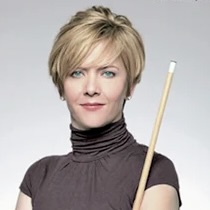
Pool Player
In cue sports, greatness usually comes in one language: the discipline of repetition, the quiet courage to keep showing up, and the ability to perform when everything is on the line. Allison Fisher, MBE speaks that language fluently, and has for decades, on two continents, across two different games. Known worldwide as “The Duchess of Doom,” Fisher is more than one of the most decorated champions in history; she is a standard of professionalism and composure, the rare athlete whose excellence has been sustained long enough to become part of the sport’s cultural DNA.
As co-host of "Legends of the Cue", Fisher brings what most interviewers can’t: lived experience at the highest level, paired with the emotional intelligence to draw out the stories behind the trophies. The podcast’s mission is to preserve pool’s heritage and elevate its best voices, and Fisher is uniquely suited to that work, because she has been a central figure in modern cue-sport history both as a competitor and as a respected ambassador for the game.
Roots: England, family, and the first spark
Born in Cheshunt, Hertfordshire, just north of London, Allison’s early life was shaped by movement and adaptation—by age four her family relocated to Thames Ditton, Surrey, and at eleven they moved again to Peacehaven, East Sussex, where much of her youth unfolded. Her earliest love of cue sports began not in a formal academy but in the everyday magic of discovery: watching "Pot Black" on television with her father and feeling something click. That fascination evolved into hands-on obsession, from a small tabletop snooker set to playing on a full-size table in a local pub, determined to find a place in a scene that wasn’t built with girls in mind.
That determination, quiet, persistent, and fiercely self-directed, became a defining trait. The snooker culture of the era was intensely traditional, often intimidating, and unmistakably male-dominated, yet Fisher kept pushing forward. She credits crucial early guidance to the legendary coach Frank Callan, who helped refine not only her mechanics but her competitive mindset as she approached her first world-level breakthrough as a teenager
Snooker dominance: earning respect in the deep end
By the time Fisher was building her reputation, she wasn’t simply “good for a woman.” She was good, period. Her early years were marked by intensity: the complexity of family dynamics, the grit required to keep developing, and the way top-level experience hardens an athlete. She competed in environments where she had to prove she belonged before she could even begin proving she could win. And she didn’t just belong, she became the defining champion of her generation.
Those years placed her in and around the sport’s biggest stages and most recognizable names, figures such as Steve Davis, Stephen Hendry, Jimmy White, and John Parrott, and she has spoken about how their professionalism mattered. Davis in particular stands out in her story as a respectful, invested partner who helped her feel like she was “one of them,” a dynamic that fueled performance rather than anxiety.
That context set the stage for one of her signature achievements: the first televised century break by a woman, made while partnered with Steve Davis, an iconic milestone that remains meaningful not only for the number on the scoreboard, but for what visibility does to belief. Fisher is characteristically precise in how she frames it, acknowledging the broader history while taking rightful pride in being first to accomplish it on television, because being seen can change what young players imagine for themselves.
The pivot: a breaking point, and a new horizon
Every career has a hinge point. For Fisher, one arrived during the Women’s World Championship experience in India. She has contrasted an earlier trip, marked by strong organization, memorable sightseeing, and a championship win, with a later return defined by disorganization, oppressive heat, and a sinking sense that the future in snooker wasn’t expanding. In a moment of clarity she recalls with startling directness, she turned to her mother and said: “You’re never going to see me play snooker again.”
That was not a casual comment. It was the moment the next act began.
Fisher had already tasted pool—through a made-for-TV challenge that paired her with Stephen Hendry against American pool icons, including Steve Mizerak and Ewa Mataya Laurance, and she had also competed in Europe, including a major event in Munich where she and Stacey Hillyard borrowed cues and finished first and third. Those experiences, plus encouragement from prominent American players she met along the way, helped turn “maybe” into a plan. In her telling, the decision wasn’t romantic, it was practical: she had achieved extraordinary things in snooker yet felt she had little to show for it financially, and she needed a road that offered both challenge and sustainability.
America and the WPBA: learning fast, winning faster
Fisher has described the emotional shock of committing fully, sitting on a plane with a cue case, heading to a new country with no guarantees, feeling the reality of the leap in her chest. She also recalls cultural whiplash: the “class and dignity” of snooker did not always translate to American tour life. The gamesmanship, what she and her co-hosts sometimes frame with a wink as learning about “sharking”, was real, and she credits those experiences with sharpening her competitive edge even further.
Then came the results.
Fisher’s transition to professional pool is one of the sport’s most remarkable success stories: she not only adapted to new concepts, banking, kicking, throw, she began winning quickly. She has spoken about early support from Cuetec, and her learning curve alongside legendary road player and instructor Grady Mathews, culminating in a stunning early milestone: a WPBA tournament victory just weeks into her tour experience. From there, she built a career defined by multi-year excellence, major titles, and an approach to pressure that opponents came to dread and fans came to admire.
Honors, perspective, and the work of legacy
Fisher’s public honors reflect both her competitive record and her influence. She was inducted into the Billiard Congress of America (BCA) Hall of Fame, and later received national recognition in the UK when she was appointed Member of the Order of the British Empire (MBE) for services to sport. Yet the most revealing parts of her story often come not from the award announcements, but from what surrounded them.
She has spoken candidly about the way life keeps moving even when accolades arrive, about juggling major life events, travel, family responsibilities, and personal challenges while still competing and building a career. That honesty, clear-eyed and unsentimental, is part of what makes her such a compelling voice on "Legends of the Cue". She doesn’t mythologize the grind; she explains it, respects it, and shows what it costs.
That ambassador role is exactly what she brings to the podcast. Fisher pairs a champion’s eye for detail with a storyteller’s respect for context: the mentors who matter, the rivalries that shape careers, the venues that become sacred, and the humanity behind the highlight reels. Her warmth shows in small moments, bonding over music, laughing about the realities of tour life, without ever losing the throughline of excellence that earned her the title “Duchess of Doom.”
In the end, Allison Fisher’s biography isn’t only about records. It’s about evolution: a young girl inspired by snooker on television, a teenage champion trained by Frank Callan, a trailblazer who earned respect in rooms that didn’t expect her, and a world-class competitor who reinvented herself in a second sport and still became the best. That is why she isn’t just a co-host of "Legends of the Cue", she is, undeniably, one of its central legends.

Allison Fisher - Part 5 (Legacy, Balance and the Final Frame)
In the final episode of our five-part deep dive with the incomparable Allison Fisher —aka the “Duchess of Doom”—we reflect on the later chapters of a legendary career that has shaped the world of cue sports. From navigating p...

Allison Fisher - Part 4 (Shifting Gears, Finding Greatness)
In the fourth installment of our exclusive five-part conversation with Hall of Fame legend Allison Fisher , the “ Duchess of Doom ” takes us deeper into the pivotal chapter of her remarkable journey—from reigning queen of wom...

Allison Fisher - Part 3 (From Snooker Glory to Pool Dominance)
In Part 3 of our compelling five-part series with Hall of Famer Allison Fisher, we explore the pivotal years that marked her transition from snooker stardom in the UK to international dominance in pool. We dive into the stori...

Allison Fisher - Part 2 (Early World Snooker Titles)
In this compelling second installment of our five-part conversation with World Snooker and Billiard Hall of Famer Allison Fisher , we dive into the powerful personal journey that shaped her into one of the most decorated cue ...

Allison Fisher - Part 1 (The Early Years)
In this premier episode of Legends of the Cue, we dive into the first installment of our five part interview beginning with the early life of the most decorated female cue sport athlete in history, World Snooker and Billiard ...

Welcome to Legends of the Cue
Welcome to "Legends of the Cue" , a pool history podcast featuring interviews with Pool Hall of Fame members, winners of major championships and others people of influence in and around pocket billiards. We also plan to highlight memorable pool brands, events and venues. Focusing on the positive as…